Your new post is loading...

|
Scooped by
jean lievens
October 3, 2015 5:01 AM
|
However the political and juridical content remains to be defined, especially for its interaction with the concepts of public and private. In certain domains the political and theoretical thinking about the commons is stronger than in others, therefore the contribution they can offer to the debate is particularly interesting. In this perspective the study focuses on urban spaces and the role played by social movements in their definition. In fact no legislation in Europe recognizes the commons as a legal category and most of the social and political thinking about is part of grassroots engagement. The lack in legislation however doesn’t imply a lack of interest among law scholar nor among institutions: the proceedings of the Rodotà Commission in Italy in 2007 (aiming to include the commonsin the classification of goods in the civil code) and the researches and publications sponsored by the Social Cohesion Division of the Council of Europe (highlighting the importance of a legal recognition of the commons to protect them) are two consistent examples of this attention and provide focused views and approaches to the topic. According to the study of the Council of Europe, for example, the recognition and protection the commons would contribute to the eradication of poverty and the protection of human rights. In fact for grassroots movements focusing on social and economic alternatives the use of the definition of the commons is particularly relevant as a form of resilience against the crisis. Furthermore among the same grassroots movements an interest for legal aspects and legal implications is raising and it could contribute to the definition of the framework, where different components and different levels of awareness are blended.
|
|
Scooped by
jean lievens
August 24, 2015 1:43 PM
|
The case for grassroots archives
|
|
Scooped by
jean lievens
August 5, 2015 4:24 PM
|
The collapse of Lehman Brothers in 2008 was a shock for many people. For a moment it seemed like capitalism, or at least ‘neoliberal’ capitalism, was on its last legs. But the moment passed and capitalism survived. The combination of huge cash subsidies for Wall Street and austerity for working people revived corporate profitability, trade, and production growth. Yet a sense of crisis and uncertainty remains pervasive in American society and many other countries around the world.
|
|
Scooped by
jean lievens
August 5, 2015 4:18 PM
|
OuiShare Fest is an international gathering in Paris of sharing economy pioneers, enthusiasts and organizers. This year’s fest, which ran May 20-22, featured panels, presentations and discussions that explored numerous aspects of the sharing economy, collaboration, technological developments, and human connectedness. Here are 10 of the top presentations, as chosen by our friends at OuiShare. 1. Nick Grossman: Bringing Collaborative Platforms to Market
|
|
Scooped by
jean lievens
June 30, 2015 12:45 PM
|
Feenberg (2002) analyses technology in terms of managerial autonomy to assert control over and through technological choices, implying the necessity of increased democratisation of technological relations in the workplace in achieving a more participatory and democratic society. I argue that the recent history of the relationship between organised labour and digital technologies has seen a retreat from earlier attempts to assert control over technology, most notably through the Scandinavian traditions of participatory design, to an increasingly tactical and defensive view of these technologies as tools in labour organising and campaigning. This reflects the decreasing power of organised labour in the industrialised West and global North, at least. Simultaneously, the workplace is no longer the only, or even primary, place in which the majority encounter sophisticated digital technologies. The most prominent debates about the use of ICT in social emancipation are largely outside the workplace, concerning for example, debates about surveillance, the technical and economic relations around technological infrastructure (as, for example in the US net neutrality debate), and the role of ICT in social uprisings (see for example, Castells 2012 ).
|
|
Scooped by
jean lievens
June 9, 2015 2:07 PM
|
The third annual OuiShare Fest, hosted with the theme “Lost in Transition” in Paris’ charming Cabaret Sauvage, concluded last Friday. This unique gathering of sharing economy leaders from around the world found itself in at least two ways with their latest edition.
|
|
Scooped by
jean lievens
February 26, 2015 3:51 PM
|
The proliferation of activist initiatives calling for systemic change around the world has never been more impressive. Yet collaborations among like-minded organizations, projects and movements have been disappointingly modest. As neoliberal economics and policies tighten their grip on American society—notwithstanding the dismal misbehavior of financial institutions, corporations and the two political parties—can leading alt-economic and social movements find ways to work more closely together?
|
|
Scooped by
jean lievens
January 21, 2015 1:44 PM
|
Article cross-posted from Bollier.org. It is always refreshing to read Peter Linebaugh’s writings on the commons because he brings such rich historical perspectives to bear, revealing the commons as both strangely alien and utterly familiar. With the added kick that the commoning he describes actually happened, Linebaugh’s journeys into the commons leave readers outraged at enclosures of long ago and inspired to protect today's endangered commons.
|
|
Scooped by
jean lievens
December 23, 2014 1:51 PM
|
The demands of sustainable social-historical change are so complex - we need input from all disciplines, we need radical democratic and alternative philosophical foundations. We can’t possibly think that we can just overthrow the system – to suddenly remove presents structures and systems – and then some Utopia will suddenly emerge. It will take a lot of healing and support to move beyond capitalism’s coercive legacy (psychologically, emotionally, relationally, socially, epistemologically and so on). To suddenly destroy the capitalist system will not make its coercive legacy disappear. That is why, again, I think that seeing emancipatory change as a transitory process is crucial. Indeed, it will take a lot of participation and grassroots organisation, and it will require different systems to support this in both the short and long term. I am reminded, for instance, of a great paper by Michel Bauwens and Vasilis Kostakis titled From the <em>Communism of Capital to Capital for the Commons: Towards an Open Co-operativism</em>, which highlights a similar transitional approach to a post-capitalist economy that I’ve alluded above, combining both commons-oriented open peer production models with common ownership and governance models, such as those of co-operatives (i.e., worker self-directed enterprises, economic democracy, etc.) and the solidarity economic models. The idea here is basically to create a “proto-counter-economy”, which, again, could support the development and expansion of alternative (political, social and economic) space and assist in the greater multidimensional sociohistorical transition. There is something fundamentally significant about this concept."
|
|
Scooped by
jean lievens
December 17, 2014 12:58 PM
|
With the rise of the sharing economy, people are sharing cars, houses, sports equipment, clothing, toys, meals, surfboards and much more. There's an intuition among sharers that sharing is not only good for the pocketbook, it’s good for the planet. The thinking goes that sharing helps us reduce consumption and keep usable goods out of landfills.
|
|
Scooped by
jean lievens
December 2, 2014 3:51 PM
|
Creating a fair and environmentally sustainable economy is no easy task, nor does it have a certain outcome. It takes vision, commitment, an understanding of how we got into our current state as well as insight into how to get out of it.
|
|
Scooped by
jean lievens
December 3, 2013 12:27 AM
|
Cosmopolitan Civil Societies: An Interdisciplinary Journal is concerned with developing a better understanding of social change and cultural cohesion in cosmopolitan societies. Its focus lies at the intersection of conflict and cohesion, and in how division can be transformed into dialogue, recognition and inclusion.
|
|
Scooped by
jean lievens
November 2, 2013 5:38 PM
|
Many a video campaign has relied on a celebrity narrating a heartfelt story over footage of a heartbreaking scene. (Think Sally Struthers asking you to sponsor a child in Africa.) But precious few change agents can get that kind of star power behind their cause. And if today's top social change videos are any indication, that may have gone out of style anyway.
|
|
|
Scooped by
jean lievens
September 17, 2015 12:07 PM
|
Are you deeply plugged into the sharing movement or simply curious about how the sharing economy works? Whether you're a veteran of the movement or a newcomer, the sharing events happening around the world this fall are bound to spark ideas for new ways to engage in the collaborative economy.
|
|
Scooped by
jean lievens
August 9, 2015 6:35 PM
|
Transition Streets is a toolkit for neighborhood transformation—a catalyst for action, dialogue, and community building. A project of Transition US, Transition Streets is as simple as neighbors coming together for seven meetings to explore carbon-saving and resilience-building actions in the areas of food, water, waste, energy, transportation, all the while building relationships with each other and a stronger sense of community.
|
|
Scooped by
jean lievens
August 5, 2015 4:20 PM
|
On November 6-7 in Bologna, Italy, leading scholars, researchers, policymakers, practitioners and social innovators will gather to further the discussion and movement around the urban commons.
|
|
Scooped by
jean lievens
July 7, 2015 1:27 PM
|
Everybody just has a very clear idea that if you have a central square and everybody grazes their crops on the central square, there's no grass left. Unless you control that, either through some cooperative arrangement, or ownership arrangement, you have a tragedy. If data is a non-rival good, where's the tragedy? We can all feed on that central square without impinging in any way on the other's use of that.
|
|
Scooped by
jean lievens
June 9, 2015 2:56 PM
|
Have you started a summer reading list? For those of us interested in the sharing economy, there is no shortage of great reads. Whether your interests lie in collaboration, sustainable cities, community-building, simplicity, or work in the new economy, there is something for everyone. We’ve rounded up the top 21 books for summer to inspire, empower, and inform.
|
|
Scooped by
jean lievens
March 21, 2015 2:13 AM
|
Photo credit: LendingMemo / Foter / CC BY. As the U.S. continues to recover from the financial crisis started over seven years ago, the prospect of "too big to fail" banks still lingers because no real reforms have been made in the financial sector.
|
|
Scooped by
jean lievens
February 18, 2015 4:24 PM
|
Photo credit: DonkeyHotey / Foter / CC BY. Article cross-posted from On the Commons. Written by Peter Barnes.
|
|
Scooped by
jean lievens
January 13, 2015 3:56 AM
|
Last week, commons advocates the P2P Foundation, Guerilla Translation, and their partners launched Commons Transition, a public forum to further commons-oriented policy-making. Commons Transition is based on the groundbreaking work of the Free/Libre Open Knowledge (FLOK) Society in Ecuador.
|
|
Scooped by
jean lievens
December 18, 2014 3:30 PM
|
John Boik’s talk at Houston Oasis, December 7, 2014 is available on YouTube. The title is “Creating a More Egalitarian Society: An Introduction to Economic Direct Democracy.” A general overview of the LEDDA framework and the LEDDA Partnership is provided.
|
|
Scooped by
jean lievens
December 3, 2014 4:58 PM
|
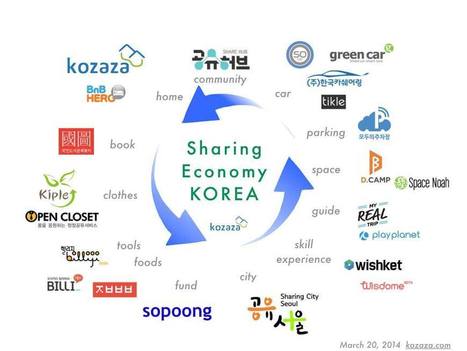
Saturday night in the Hongdae district of Seoul. Restaurants, bars, and nightclubs line the streets four stories high for blocks. The crowds in the street cover acres of blacktop. It's nightlife on mega-city scale.
|
|
Scooped by
jean lievens
May 13, 2014 12:34 AM
|
UMMON THE BREATHTAKING IMAGE of the multitude pouring into streets and plazas around the world in millions to demonstrate against tyranny. Now imagine instead they’re demanding a free and open internet. The likelihood of that is almost zero, we would agree. But why is that? What would have to happen to make that utopian spectacle reality? What insurgent algorithm would get us from here to there? That is the subject of this lecture.
|
|
Scooped by
jean lievens
November 7, 2013 12:39 AM
|
Technologies are not innocent. They embody human values. And the way we design them determines winners and losers among us.
|


 Scoop.it!