Your new post is loading...

|
Scooped by
jean lievens
June 28, 2014 3:02 AM
|
"Knowledge commons" describes the institutionalized community governance of the sharing and, in some cases, creation, of information, science, knowledge, data, and other types of intellectual and cultural resources. It is the subject of enormous recent interest and enthusiasm with respect to policymaking about innovation, creative production, and intellectual property.
|
|
Scooped by
jean lievens
June 23, 2014 2:21 PM
|
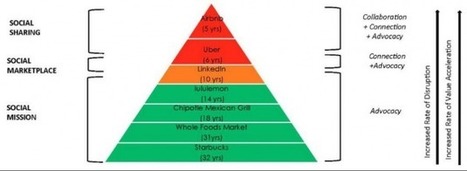
And social sharing companies Uber and Airbnb, the quickest to reach the $10 billion valuation mark, sit atop the pyramid. Why?
|
|
Scooped by
jean lievens
June 6, 2014 4:28 PM
|
The United States government is broken beyond repair, corrupt beyond reform. There’s no debating that. The question is, what can we do about it?
|
|
Scooped by
jean lievens
April 9, 2014 2:53 PM
|
"We address the problem of engineering self-organising electronic institutions for resource allocation in open, embedded and resource-constrained systems. In such systems, there is decentralised control, competition for resources and an expectation of both intentional and unintentional errors. The ‘optimal’ distribution of resources is then less important than the sustainability of the distribution mechanism, in terms of endurance and fairness, based on collective decision-making and tolerance of unintentional errors. In these circumstances, we propose to model resource allocation as a common-pool resource management problem, and develop a formal characterization of Elinor Ostrom’s socio-economic principles for enduring institutions. "
|
|
Scooped by
jean lievens
March 16, 2014 6:18 PM
|
A bioregion is a geographic area that has roughly the same geology and plant life, that is different from the man-made borders imposed upon it. For example, the North Downs, South Downs and the Weald are all distinctive geographic features. Hampshire, Surrey, West Sussex and Kent are all man made counties. The Weald and Downland is possibly a bioregion. It shares distinctive landscape and farming practices, and also building styles, as revealed at the Weald and Downland museum.
|
|
Scooped by
jean lievens
March 6, 2014 12:48 PM
|
The open source software Linux and the popular free online encyclopedia Wikipedia are considered as prominent peer production projects, where individuals voluntarily participate and, using mechanisms of self–governance, produce digital commons. Peer production, a term coined by Benkler (2006), is a third open mode of production that has become typical of the Internet recently, where decisions arise from the free engagement and cooperation of producers. Peer governance is a new mode of governance and bottom–up mode of participative decision–making (Bauwens, 2005a; 2005b). It is the way that peer production, the process by which common value is produced, is managed.
|
|
Scooped by
jean lievens
December 9, 2013 12:44 AM
|
= interfirm coordination that is characterized by organic or informal social systems, in contrast to bureaucratic structures within firms and formal contractual relationships between them.
|
|
Scooped by
jean lievens
November 24, 2013 1:16 AM
|
More century lather, in the 1860, Giuseppe Mazzini wrote a book entitled “The duties of the human being”. The central thesis of the book was that we speak always of rights, but making so we forget that exist “the other side of the coin”, such as the duties. And this forgetful approach will bring the human kind in a age of decay ... The other consideration that we can make is that the society was not an abstract subject, but the algebraic sum of all citizen and the basic cell of the society was the family. In fact, in the Parliament was present each head of household, older than 20 years.
|
|
Scooped by
jean lievens
October 30, 2013 3:52 PM
|
The paper provides a nice introduction to this concept for those that are unfamiliar with it, and whilst unlikely to do any more than that, is nevertheless useful for those without a background in the topic.
|
|
|
Scooped by
jean lievens
June 26, 2014 2:10 PM
|
Back in 2008, Michel Bauwens was asking Is something fundamentally wrong with Wikipedia governance process? In reply, P2P Lab pointed to a First Monday article from 2010 about Wikipedia's peer governance.
|
|
Scooped by
jean lievens
June 23, 2014 1:41 PM
|
“You cannot change your name to MadeUpNick. This name is already taken,” I bluntly explained to the user, who had filled out an application requesting a name change on Polish Wikipedia. Should I tell him or her that there is a separate procedure, allowing usurpation (taking over) of a name? Or maybe even correct his or her incorrectly filed request and resubmit it through this separate channel? Perhaps. But this was not my job. After all, I’m a bureaucrat—one of the highly trusted community elected functionaries on Wikipedia, allowed to change names of other users, as well as grant administrator rights (upon community’s approval). I just enforce the rules, not explain them.
|
|
Scooped by
jean lievens
April 18, 2014 12:21 AM
|
In BriefFisheries management has generated a litany of failures, but better incentives to link individuals with a collective interest, and approaches that support resilience can turn this around—and already have in some parts of the world. Collectively, these approaches offer the prospect of sustainably managed and economically viable fisheries forever.
|
|
Scooped by
jean lievens
April 8, 2014 4:45 PM
|
The two-day conference will feature a number of notable speakers from the industry, including Blockchain’s Nicolas Cary, GoCoin’s Steve Beauregard and Kraken’s Jesse Powell, and is expected to draw roughly 1,000 attendees.
|
|
Scooped by
jean lievens
March 10, 2014 2:17 AM
|
"This article deals with the phenomenon of hackerspaces and sheds light on the relationship of their underlying values, organizational structures and productive processes to those of the online communities of Commons-based peer production projects. While hackerspaces adopt hybrid modes of governance, this article attempts to identify patterns, trends and theory that can frame their production and governance mechanisms. Using a diverse amount of literature and case studies, it is argued that, in many cases, hackerspaces exemplify several aspects of peer production projects’ principles and governance mechanisms."
|
|
Scooped by
jean lievens
February 17, 2014 3:35 PM
|
This article deals with the phenomenon of hackerspaces and sheds light on the relationship of their underlying values, organizational structures and productive processes to those of the online communities of Commons-based peer production projects. While hackerspaces adopt hybrid modes of governance, this article attempts to identify patterns, trends and theory that can frame their production and governance mechanisms. Using a diverse amount of literature and case studies, it is argued that, in many cases, hackerspaces exemplify several aspects of peer production projects’ principles and governance mechanisms.
|
|
Scooped by
jean lievens
November 25, 2013 2:15 AM
|
I’ve taken part in a class of Open Collaboration and Peer production, exploring what open source means in theoretical sense and engaging in practical exploration and engagement of open source projects. As part of the course, we did try to develop a common report of our experiences, including a survey and analysis of our experiences. In the spirit of open collaboration, we developed the survey together and are now engaged the writing of the report.
|
|
Scooped by
jean lievens
November 2, 2013 5:15 PM
|
"The Lands of Sheraga are a free and open source conglomerate nation comprised of a variety of interlocal governing bodies. Together, these governments form an aerocratic meta-structure in which they work together. Aerocracy is an eclectic societal structure in which multiple forms of government and arbitrary groups can peacefully co-exist and develop shared cultural values.
|