Whether they're driving around with your late night snack or with you in the back seat, we caught up with the folks working in Boston's service startups.
The San Francisco-based startup, which is operating out of Logan Airport, plans to use the funds to expand. (Is airport car sharing the sharing economy's next big thing?
In about 40 minutes, Cindy Manit will let a complete stranger into her car. An app on her windshield-mounted iPhone will summon her to a corner in San Francisco’s South of Market neighborhood, where a russet-haired woman in an orange raincoat and coffee-colored boots will slip into the front seat of her immaculate 2006 Mazda3 hatchback and ask for a ride to the airport. Manit has picked up hundreds of random people like this. Once she took a fare all the way across the Golden Gate Bridge to Sausalito. Another time she drove a clown to a Cirque du Soleil after-party.
San Francisco is experiencing a parking crisis and the cost of living here is rising every day. But a new proposal to create dedicated parking spaces for app-enabled shared cars (like mine) could be the solution. It could also potentially set a world-changing precedent for other cities exploring how sharing can make city life richer and more sustainable. \n\nThe San Francisco Municipal Transit Authority has identified 900 parking spaces in the city that it wants to reserve for shared cars beginning this summer. Experts say that these dedicated parking spaces can take 10,000 cars off the road by increasing access for people who want to be able to use a car occasionally without having to own one themselves. They\'d reduce congestion and pollution, too.\n\n* * * But the new parking spots aren\'t a sure thing! They need to be approved in a hearing on May 2. I started this petition so city officials will know the plan has widespread support and will approve it without delay. Please sign it now and I\'ll deliver your signature to city officials before the vote. * * *\n\nI\'ve hosted couchsurfers and stay at Airbnbs when I travel, so it made sense to me to try sharing my car when it would otherwise sit idle and cost me money. Now, I make $600 a month by listing my car on a carsharing app called Getaround. So not only would this new proposal improve the parking situation in San Francisco, it would help more people earn money from their cars like I do -- in every neighborhood in the city. \n\nCarsharing has been a great thing for me, and this new parking proposal is about making a good thing even better. Please sign my petition now to make sure that city officials know the public stands behind the carsharing parking proposal. With your support, the reserved spaces can be approved quickly and other cities can follow San Francisco\'s lead!
The phenomenon that is Uber can be explained by even a luddite—it’s a brilliant yet simple idea that solves a real pain point for people around the world — how to get from point A to point B in a safe, efficient and cost effective way. You push a button, and in as little as 5 minutes a black car, taxi or a peer-to-peer driven car is there to pick you up. The experience is nonpareil.
A combination of ongoing financial strain and a genuine desire for enlivened social interaction among the 99% has moved the “sharing economy” into the mainstream in recent months. This quasi-social movement relaxes long-held preoccupation with ownership and material accumulation and celebrates product reuse, informal exchange, communal provisioning, and Internet-enabled peer-to-peer transactions. All seemingly constructive and sustainability enhancing ideas, right?
Zipcar & Other Car-Sharing Services Have Killed 500,000 Auto Sales: Study Car-sharing services like Zipcar and RelayRides are poised to shake up the auto industry. On a macro-level, they represent a huge change in the way that we view and use automobiles. In more practical terms, they reduce the public's need to buy cars.How much of a reduction have they caused? According to one firm, car-sharing services have cost automakers 500,000 in lost car sales since their debut. And it's about to get a whole lot worse.
Tamyca, Autonetzer, Nachbarschaftsauto – three years ago, private car sharing arrived in Germany. Since then, it’s attracted an actively-growing user base. Stuttgart-based startup Autonetzer, for example, claims to offer over 4,000 vehicles in Germany, which owners choose to share with friends or strangers. The company has been expanding rapidly – it grew by 65 per cent this year and more than doubled its user figures to 30,000.
Milan has embraced the idea of car-sharing so much that Car2Go, the first private operator of the service in the city, said it has reached its financial target ahead of time in its first year.
July 14, 2014 - Lyft driver Geoffrey Frisch, 36, enters his vehicle before heading to the Memphis International Airport Monday afternoon, July 14, 2014. Memphis has issued a cease-and-desist order against the ride-share service, which has been in service in the city since April, until they meet the same regulatory requirements as taxis and other vehicles for hire. (AP Photo/The Commercial Appeal, Yolanda M. James) Photo: Yalonda M. James, Associated Press
This new mobile solution from Verizon allows enterprises to enhance rental and vehicle sharing for drivers. With Verizon Auto Share, drivers can use an app on their smartphone to scan a QR-code on a car, validate their identity, pay for their rental and unlock the car – virtually anywhere, anytime, within minutes and without stepping foot into a rental agency.
The transportation market has seen a number of different companies pop up in recent years to turn it on its head, including Uber, Lyft, Sidecar and Hailo. One that stands out from that pack is RelayRides.
California Department of Insurance wants ride-sharing firms to have $1 million commercial liability insurance that starts when drivers look for customers on the app.
After nearly one year of deliberation, the Seattle City Council voted Monday afternoon to regulate app-based transportation companies like UberX, Lyft and Sidecar.
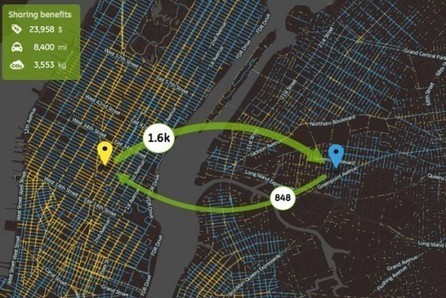
Thanks to services such as Lyft, ride-sharing is now a much more accepted idea, except when it comes to the taxi business. Michael Szell at MIT’s Senseable City Lab, recently found out that 80% of all cab journeys in the city could have been shared. With more than150 million taxi trips taken in 2011, it’s clear that if people embrace the sharing economy, they could have an enormous environmental, and social impact on New York City.
In an event at The Brookings Institution Wednesday hosted by the Japan International Transport Institute, Mobility Lab Director Tom Fairchild sat on an engaging panel about ridesharing, the sharing economy, and how the future of transportation needs to be shaped by both private and public enterprises.
Carsharing service Communauto has launched a pilot fleet of 100% electric vehicles in Le Plateau-Mont-Royal, a borough of Montreal. The program aims to analyze the viability of electric carsharing, and if successful, will lead to greater numbers of electric vehicles in Communauto’s fleet.
To get content containing either thought or leadership enter:
To get content containing both thought and leadership enter:
To get content containing the expression thought leadership enter:
You can enter several keywords and you can refine them whenever you want. Our suggestion engine uses more signals but entering a few keywords here will rapidly give you great content to curate.



 Your new post is loading...
 Scoop.it!