PLOS Collections joined forces with Andre Maia Chagas and Tom Baden of University of Tübingen, TReND in Africa and Openeuroscience to create a collection o
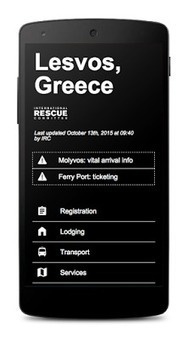
Millions of people around the world want to do what they can to help refugees and migrants caught up in the crisis in Europe, the Middle East and Northern Africa. We wanted to give you an update on where things stand as we continue to think about what Google—and all of us—can do to help.
Open Democracy Why revolution is no longer possible Open Democracy But it is mistaken to claim — as Jeremy Rifkin does in his newest book, The Zero Marginal Cost Society — that the sharing economy has sounded the end of capitalism and inaugurated a...
Revolution is no longer possible because the power and domination over the people strikes more fear to the people then it has ever before. It requires power to take power, but anyone who tried to get power to over throw it is quickly shot down and the threat is eliminated. Any violent behavior or signs of rebellion is dealt with immediately. People are now viewing themselves as the problem instead of the society they live in.
Wall Street and Silicon Valley may be excited about the emergence of the so-called sharing economy, but freelance workers driving for Uber are getting ...
When you want something, all the universe conspires in helping you to achieve it. – Paulo Coelho, The Alchemist Professor of Economics and former Greek Finance Minister Yanis Varoufakis in conversa...
Some twenty years have elapsed since we identified and named end-to-end arguments[1], a class of system design principles that organize and guide the placement of function within a system. These arguments and the underlying principles have now been invoked in many contexts, becoming part of the vocabulary of network protocol and operating system designers. Like other general design principles, end-to-end arguments impose a structure on the design space, rather than solving the design problem. This structure provides a basis for discussion and analysis of trade-offs, and suggests a strong rationale to justify design choices.
* Essay: Oligarchies of the World Unite. By Kees van der Pijl. From the Abstract: “The argument of this paper is that after the crisis of 2008 which has turned into an enduring stagnation amidst proliferating violence, capitalist property relations are increasingly being upheld by authoritarian means. The mode of production and social organisation, including …
The block-size limit debate has dominated Bitcoin blogs, forums, chat rooms and meet-ups for months on end, while many of Bitcoin’s brightest minds are gathering in Montreal to discuss the issue face-to-face at the Scaling Bitcoin Workshop this weekend.
http://p2pfoundation.net/Ten_Commandments_of_Peer_Production_and_Commons_Economics Source The ten commandments of peer production and commons economics For a mode of production and value creation that is free, fair and sustainable! Michel Bauwens, Berlin, October 23, 2015, for the Uncommons conference Text “As we have tried to show elsewhere, the emergence of Commons-Oriented Peer Production has generated the emergence of a…
The Pirate Party in Iceland continues to gain support, causing a revolution in the local political arena. According to the latest poll the party now has over a third of all votes in the country, beating the current Government coalition.
A spectre is haunting Europe — the spectre of democracy. All the powers of old Europe have entered into a holy alliance to exorcise this spectre: The state-sponsored bankers and the Eurogroup, the Troika and Dr Schäuble, Spain’s heirs of Franco’s political legacy and the SPD’s Berlin leadership, Baltic governments that subjected their populations to terrible, unnecessary recession and Greece’s resurgent oligarchy.
This is an important synthesis of ten years of research at the P2P Foundation, on the emerging practices of the new productive communities and the ethical entrepreneurial coalitions that create livelihoods for shared resources. I’m working with Neal Gorenflo of Shareable on a more accessible version for a broader public, but this one is for …
Human Ecosystems (HE) is an international city based project running from 2013. Its main goal is to explore the mutation of public spaces in cities, designing performative strategies to promote citizen participation and ubiquitous, peer-to-peer innovation processes, in which citizens and other types of urban dwellers are able to use the city’s infoscape: its informational landscape. The project …
Connecting with family is a top priority for newly arrived refugees who want their loved ones to know they are safe. IRC staff direct people to cafés and restaurants that provide WiFi free of charge. Because refugees use their mobile phones to navigate routes through Europe, we advise them on locations where they can purchase SIM cards and recharge their phones.
Europe’s energy future requires us to master a substantial transformation towards sustainability. We are caught in national ways of thinking, yet need a common European vision to design our future energy system. Europeans across all sectors - public policy, corporate, civil society and individual citizens - need to work together towards a sustainable energy system in order to secure prosperous living conditions for themselves and future generations. The System Innovation Lab offers an extraordinary opportunity for participants to exchange, co-create and reflect in an international setting. It combines scientific expertise, practical insights and innovative methods.
To get content containing either thought or leadership enter:
To get content containing both thought and leadership enter:
To get content containing the expression thought leadership enter:
You can enter several keywords and you can refine them whenever you want. Our suggestion engine uses more signals but entering a few keywords here will rapidly give you great content to curate.




 Your new post is loading...
 Scoop.it!