


“When Gutenberg invented the printing press the deployment of knowledge outside of the clergy and nobility quickly caused problems in the institutions of the feudal system; the decline of feudalism significantly expanded science and the university, and radically changed the world and its operations to lead us to the industrial era.

Peer2Politics
145.4K views |
+0 today
on peer-to-peer dynamics in politics, the economy and organizations
Curated by
jean lievens
 Your new post is loading... Your new post is loading...
 Scoop.it!
Let’s imagine that we are living at the dawn of human history. Back then there were very small bands and tribes of 30, 40 or 50 people. The women usually went out foraging and the men went hunting. They did it in groups and when they came back from foraging or hunting they had some kind of rule that established that the elderly got this, the female got that. However, anthropologically speaking, the important thing is that the totality of the tribe was a primary entity and the individuals were part of the tribe. In anthropological terms, this is called “communal shareholding”. So at the dawn of human history, the human anthropological system was communal. 
Scoop.it!
This is a French-language interview on the possible convergence between commons-based peer production and the social and solidarity economy.
jean lievens's insight:
Ethical Economy, P2P Theory , Peer Production, Videos.
Scoop.it!
Remember when YouTube was only a year old, Facebook was two, and Twitter was just rolling out? Yeah, that was the prehistoric year 2006. That year Time magazine chose a surprising figure as its Person of the Year: You: “Yes, you, You control the information age. Welcome to your world.” The feeling at the time was one of widespread hope that the Web in general, and social networking sites in particular, would lead to more intercultural understanding and a more flourishing and vibrant democracy. The Internet seemed to promise a more equitable world, with a narrowing of the gap between the powerful and the marginalized. Social justice 2.0 seemed a click away.
Scoop.it!

Few days ago, I stumbled upon Angel, an amazing project for a healthcare/fitness related wristband sensor.
Scoop.it!

"“Whether or not readers are familiar with the concept of presentism—the theory that society is more focused on the immediacy of the moment in front of them (actually more specifically on the moment that just passed) than the moment before or, perhaps more importantly, the future—they’ve certainly felt the increasing pressure of keeping up with various methods of communication, be it texting, Web surfing, live interactions, or a litany of other media for staying “connected.” Using Alvin Toffler’s concept of “future shock” as a jumping-off point, media theorist Douglas Rushkoff (Cyberia; Get Back in the Box; Media Virus; etc.) deftly weaves in a number of disparate concepts (the Home Shopping Network, zombies, Kurzweil’s Law of Accelerating Returns, Internet mashups, hipsters’ approximation of historical ephemera as irony, etc.) to examine the challenge of keeping up with technological advances as well as their ensuing impact on culture and human relations in a world that’s always “on.” By highlighting five areas (the rise of moronic reality TV; our need to be omnipresent; the need to compress time in order to achieve our goals; the compulsion to connect unrelated concepts in an effort to make better sense of them; and a gnawing sense of one’s obsolescence), Rushkoff gives readers a healthy dose of perspective, insight, and critical analysis that’s sure to get minds spinning and tongues wagging.”
Scoop.it!
"On my trip to Thailand in August I had the pleasure to meet Michel Bauwens, founder of the P2P Foundation and interviewed him about Peer-to-Peer Economy. In many ways, I tried to “extract” all his knowledge in 15 min which was definitely not easy at all :-) . But I’m sure that you will learn something by watching this interview, especially if you have an interest in Economics :-)
Scoop.it!
This is a draft version of an essay which appeared in Framework,the Finnish Art Review on contemporary art and culture, which dedicated Issue 10 on the 'Rescue Plan" for the current financial meltdown.
Scoop.it!
“I was recently asked to talk about the idea of “open”, and I realized the term is used in at least eight different ways. The distinct interpretations are all important in different but interlocking ways. Getting them confused leads to a lot of misunderstanding, so it’s good to review them all.
Scoop.it!
‘Co-operative accumulation to what end’ is a strategic issue, John. So too, is the invisibility of the ecological in this discourse and the question of how we invent language and practices that explicitly help us to live within limits. Practically none of the comments you so far have received touch on the latter point. Here are some further reflections, grist for the commonweal so to speak. (Please note that I have not had the benefit of reading Robin’s paper. I am only picking up on the thread.)
Scoop.it!
"In the days of the Arab Spring, Syntagma Square, the Occupy Movement, the public sector strike and the education struggles we were witness to a renewed ‘popular front’ of sorts. A ‘populous front’ that brought together different levels, forms and registers of protest. It was interesting to note that in Athens many sectors of the left viewed the initial Syntagma Square assemblies with suspicion. The spectre of nationalism, inaugural in the historic popular front of Soviet Policy, was off-putting and, however briefly, seen by some as a definitional overcoding of the assemblies. Yet, re-reading some of the initial statements made in these assemblies and the reported suspicion of a political hijacking of them, it is interesting to note that many of these statements were directly ‘affecting’ expressions of suffering that seem to be uttered in defiance of the ‘languages of power’.
Scoop.it!
“Historically, the anti-statist tendency in Marxism has been largely carried in a very different ‘worker council’ tradition, that, against the powers of party and state has insisted on the role of workplace assemblies as the loci of decision-making, organization and power. In an essay antediluvian by digital standards, ‘Workers’ Councils and the Economics of a Self-Managed Society,’ written in 1957 but republished in 1972, immediately after the Soviet crushing of Hungary’s Workers Councils, Cornelius Castoriadis noted the frequent failure of this tradition to address the economic problems of a ‘totally self-managed society.’ The question, he wrote, had to be situated ‘firmly in the era of the computer, of the knowledge explosion, of wireless and television, of input-output matrices’, abandoning ‘socialist or anarchist utopias of earlier years’ because ‘the technological infrastructures … are so immeasurably different as to make comparisons rather meaningless’ (Castoriadis, 1972: np).
Scoop.it!

The favelas are emerging as “symbolic capital”, as “wealth”, and as “commodities” in cities like Rio de Janeiro, Brazil. They are no longer the place of “excluded” non-subjects, as in some imaginaries and discourses, but rather a cyber-periphery, a place of “wealth in poverty” fought over by Nike, Globo Network Television, and the State, as well as laboratories for subjective production. The black bodies of the favelas, the possibilities for co-operation without hierarchy, the invention of other times and spaces (on the streets, in dancehalls, LAN centers, and rooftops) are all subjected to forms of appropriation, just like anything else in capitalism. However, the favelas are no longer seen simply as “poverty factories”, but rather a form of capital in the market of symbolic national and local values, having been able to convert the most hostile forces (poverty, violence, states of emergency) into a process of creation and cultural invention.
|
Scoop.it!
This article set out to show, through the Helix_T wind turbine project, two things: first, on a theoretical level, that CBPP is not limited to ICT, but that in conjunction with the emerging technological capabilities of 3D printing, it can also produce really promising hardware, globally designed (with the direct or indirect support of Commons-based communities) and locally pro- duced. Second, beyond its illustrative role as a case study, the Helix_T also contributes to the quest for novel solutions to the urgent need for (autonomous) renewable sources of energy, more as a development process and less as a ready-to-apply solution. And while the Helix_T does not offer huge amounts of energy and suffers from several shortcomings, we showed that it is possible to create a low-cost, DIY wind turbine with 3D printed modules in a cost-effective way to provide individuals with small amounts of clean energy. The illustration has also worked in theory by showing that it is possible to produce innovative hardware based on CBPP. The case shows that for someone with only very partial initial knowledge, it is feasible to start a similar project based on an interesting idea and to succeed in implementing it through the collaboration with Commons-oriented communities while using CBPP products and tools.
Scoop.it!
Let’s imagine that we are living at the dawn of human history. Back then there were very small bands and tribes of 30, 40 or 50 people. The women usually went out foraging and the men went hunting. They did it in groups and when they came back from foraging or hunting they had some kind of rule that established that the elderly got this, the female got that. However, anthropologically speaking, the important thing is that the totality of the tribe was a primary entity and the individuals were part of the tribe. In anthropological terms, this is called “communal shareholding”. So at the dawn of human history, the human anthropological system was communal.
Scoop.it!
“What is optimal scale? The optimum size for the use of resources, starting with capital itself, that are used as means of production. Logically, scale is optimal for a particular market size and for a given technology.
Scoop.it!
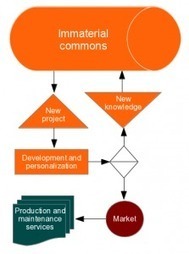
The purpose of this talk is to trace the relationship between collectivization and the concept of the commons, and discuss the P2P mode of production, analyzing the impact and the consequences for economic and social forms of relationships and organization.
Scoop.it!
“All isn’t lost for distributed power, though. For institutional power the Internet is a change in degree, but for distributed power it’s a change of kind. The Internet gives decentralized groups – for the first time – access to coordination. This can be incredibly empowering, as we saw in the SOPA/PIPA debate, Gezi, and Brazil. It can invert power dynamics, even in the presence of surveillance censorship and use control.
Scoop.it!
“Most co–operative practice is single stakeholder. Therefore the co-op sector divides between typically consumer co-ops, worker co-ops and farmer co-ops, each generally with their backs to each other and walking away from each other. This one dimensional aspect is impeding in my view an untapped revolutionary economic potential for a new generation of full dimensional co-ops to ignite.
Scoop.it!
“All commodities have to be understood as having a use value and exchange value. If I have a steak the use value is that I can eat it and the exchange value is how much I had to pay for it.
Scoop.it!

“The favelas are emerging as “symbolic capital”, as “wealth”, and as “commodities” in cities like Rio de Janeiro, Brazil. They are no longer the place of “excluded” non-subjects, as in some imaginaries and discourses, but rather a cyber-periphery, a place of “wealth in poverty” fought over by Nike, Globo Network Television, and the State, as well as laboratories for subjective production. The black bodies of the favelas, the possibilities for co-operation without hierarchy, the invention of other times and spaces (on the streets, in dancehalls, LAN centers, and rooftops) are all subjected to forms of appropriation, just like anything else in capitalism. However, the favelas are no longer seen simply as “poverty factories”, but rather a form of capital in the market of symbolic national and local values, having been able to convert the most hostile forces (poverty, violence, states of emergency) into a process of creation and cultural invention.”
jean lievens's insight:
This entry was posted on Friday, November 1st, 2013 at 6:56 pm and is filed under Cognitive Capitalism, Ethical Economy, P2P Art and Culture, P2P Movements, P2P Public Policy, P2P Theory, Peer Production. You can follow any responses to this entry through the RSS 2.0 feed. You can leave a response, or trackback from your own site.
Scoop.it!
Submitted to the Program in Media Arts and Sciences, School of Architecture and Planning, in partial fulfillment of the requirements for the degree of Master of Science in Media Arts and Sciences at the Massachusetts Institute of Technology, June 2013
Scoop.it!
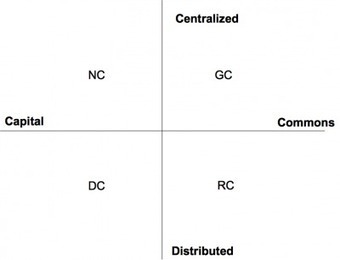
This entry is about the theory of the four future scenarios for a collaborative economy, firstly developed by Michel Bauwens. It is important to mention that Vasilis Kostakis and Michel Bauwens are working on a research monograph that explores the relation of capitalism and the Commons. The book Network Society and Future Scenarios for a Collaborative Economy is contracted by Palgrave Macmillan.
Scoop.it!
When we talk about the end of workplaces and lifetime employment, please don’t get the wrong idea. This has nothing to do with what Silicon Valley and venture capitalists are now calling the “sharing economy.” It was once the darling of open source advocates and socially-conscious entrepreneurs, but I now consider the term “sharing economy” to be co-opted by predatory business models. Here’s how it happened.
jean lievens's insight:
This entry was posted on Tuesday, September 24th, 2013 at 5:41 am and is filed under Economy and Business, Ethical Economy, P2P Movements, P2P Theory, Sharing. You can follow any responses to this entry through the RSS 2.0 feed. You can leave a response, or trackback from your own site.
Scoop.it!
These changes are highly visible in a city like Rio de Janeiro, a territory in dispute. The city, which has always been a meta-narrative for Brazil, is currently undergoing profound transformations that place it at the centre of cognitive, affective and communicationalCapitalism 2.0.
|





