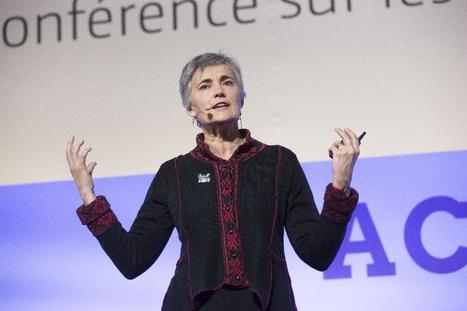
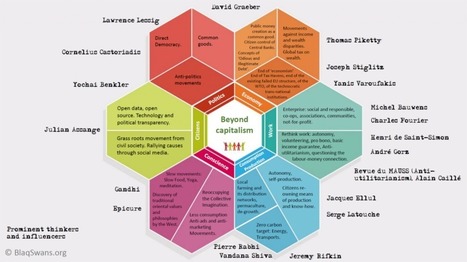
“The shared future of our world is no longer industrial capitalism,” she declared before hundreds of delegates and activists and reporters at the Paris Climate Conference. “Today, because the internet exists, we create the most value by sharing assets.”
Michel Bauwens is the founder and director of the P2P Foundation and works in collaboration with a global group of researchers in the exploration of peer production, governance, and property. Bauwens travels extensively giving workshops and lectures on P2P and the Commons as emergent paradigms and the opportunities they present.
The Association of Space Explorers reached out to their fellow astronauts to pass on a simple message of solidarity, hope and collaboration to combat climate change and reach our political leaders during such a crucial time.
Open supply chains are a recurring theme here on the P2P Foundation blog, whether it’s a ‘FairMouse‘, the (very popular) Fairphone, or Sourcemap, (website here) there have been various efforts to make supply chains transparent, whether from the vendors themselves or from third parties. I am working with the (P2PF-endorsed) FairCoop project on a new …
Peer production is based on ‘stigmergic’ coordination through signals, to massively bring together contributions and microtasking. This model is now moving mainstrain, with many technologies in the pipeline. What pricing is to the market and decision-making is to planning, coordination is to the commons economy. However, it is also being used by the extractive platforms …
* Book: The Geology of Media. Jussi Parikka. University of Minnesota Press, 2015 In this book, the author “argues that to adequately understand contemporary media culture we must set out from material realities that precede media themselves – Earth’s history, geological formations, minerals, and energy”. From the press release: “The geological history of media comes …
In his 1973 bestseller Small Is Beautiful, the British economist E.F. Schumacher outlined a concept that would come to be known as “appropriate technology.” This meant, in essence, adopting technologies that actually suit the needs they’re meant to address and the contexts in which they’re meant to operate. He was worried chiefly about technological overkill in international development, but it’s an idea that resonates elsewhere. In sum: Use the tool that fits the need.
There are without a doubt some very heavy implications that arrive with the popularization of the "sharing economy" in the last few years. Some of the ideas out there like Uber and Airbnb are simply revolutionizing the way we do things, and from an efficiency and user-friendliness standpoint, it's hard competing against them. But as more and more people in the workforce transition towards sharing economy roles in the next couple decades to capitalize on the wage-earning potential that's out there, will the net impact of putting other industries out of business do more damage than good? And is this type of business model really sustainable for the long haul? On today's Big Game Hunters, Landon and Jason share their thoughts on where this will ultimately lead to in the future.
“Don't ever take a fence down until you know the reason it was put up.” - G.K. Chesterton. Technologists and free-marketeers are obsessed with removing barriers: Barriers to entry. Frictions. Levee...
For the first time ever, neuroscientists have demonstrated the viability of direct — and completely non-invasive — brain-to-brain communication in humans. Remarkably, the experiment allowed subjects to exchange mentally-conjured words despite being 5,000 miles apart.
Human sensory and motor systems provide the natural means for the exchange of information between individuals, and, hence, the basis for human civilization. The recent development of brain-computer interfaces (BCI) has provided an important element for the creation of brain-to-brain communication systems, and precise brain stimulation techniques are now available for the realization of non-invasive computer-brain interfaces (CBI). These technologies, BCI and CBI, can be combined to realize the
Everybody knows the motto “Supply chains compete, not companies”. Some even use “networks” instead of “supply chains”. We agree with this because it is not sufficient to focus only on internal efficiency of your company. It’s clear one should also focus on their supply chain partners But why don’t we see more integrated supply chain partners nowadays? What is the reason that we don’t hear much about collaboration initiatives, such as CPFR, anymore? What will actually be the future of collaborative supply chains? Let’s investigate these questions further.
On the evening of December 5th, I participated at the OpenCon Satellite Event in Berlin. It was organised by Jon Tennant and Peter Grabitz, my travelling was kindly subsidised by Stephanie Dawson o...
Presentation given at Open Education Conference 2015 in Vancouver British Columbia, November 19, 2015. Description: In March of 2015, with support from the Hew…
Excerpted from a discussion by Giotitsas, Pazaitis and Vasilis Kostakis: “Energy flows define and determine life itself, so it makes sense that they also influence human societies greatly. For the largest part of the human species’ history, energy surpluses were minimal. According to Ref. [75] approximately 250,000 years ago began what could be described as …
We welcome you to what promises to be a most intensive, exciting intellectual experience. We have both written extensively on the topic of Open Innovation (which we will define carefully during the Course), but we believe that the best work in this area is yet to come! We have selected some readings and chapters to guide you in preparing for the first two days of the Course. You will get much more out of the Course if you make the time to put more into it. Please read the assigned material carefully, and come prepared to share your questions, reflections and criticisms with us and your colleagues. Furthermore, upon registration participants bring a poster (A2 format) of their current or indented PhD research on open innovation to be discussed with faculty and Ph.D. candidates.
To get content containing either thought or leadership enter:
To get content containing both thought and leadership enter:
To get content containing the expression thought leadership enter:
You can enter several keywords and you can refine them whenever you want. Our suggestion engine uses more signals but entering a few keywords here will rapidly give you great content to curate.


 Your new post is loading...