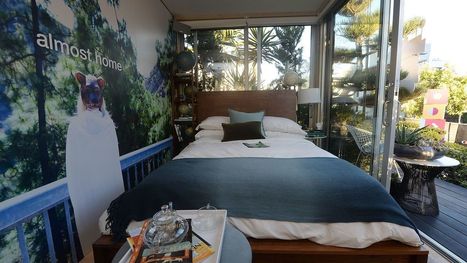
More than 3 million people in the UK used Airbnb accommodation for their travels this year in a boost to the sharing economy, the site has revealed. There were 2.2 million travellers who used Airbnb to visit the UK in the year to November.
* Book: They Can’t Represent Us!: Reinventing Democracy from Greece to Occupy. by Dario Azzellini and Marina Sitrin. Verso, 2014 Here’s the summary from the publisher: “Mass protest movements in disparate places such as Greece, Argentina, and the United States ultimately share an agenda—to raise the question of what democracy should mean. These horizontalist movements, …
* Paper: Measuring the complexity of adaptive peer-to-peer systems. Michele Amoretti, Carlos Gershenson. Peer-to-Peer Networking and Applications, 2015 From the Abstract: “To improve the efficiency of peer-to-peer (P2P) systems while adapting to changing environmental conditions, static peer-to-peer protocols can be replaced by adaptive plans. The resulting systems are inherently complex, which makes their development and …
In this four part series we look at the impact of new technologies on the future of the workplace and how organisation can embrace new practices to become truly digital.
Tapazz is taking the sharing economy on a new journey with our peer-to-peer car rental network. Our user-friendly online software allows car owners to rent t...
The rationale behind Seattle's new Uber law could help shake up the running debate over the future of work. The post Seattle’s Move To Give Uber Drivers Labor Rights Is As Much About Riders As Drivers appeared first on ThinkProgress.Original...
The video below was produced with the help of Sharon Ede in Adelaide, as I could not attend the Mapping the Next Economy of December 14th, in real time due to my engagements in Adelaide, South Australia. This is a short seven-minutes summary of the problems associated with the emergence of commons-based peer production as …
* Article: ENTREPRENEURSHIP, SOVEREIGNTY, AND VIOLENT SOCIAL CONFLICT. By Jurgen Brauer and Robert Haywood. WIDERAngle, Article Archive 2009-2010, May 2009 This article was presented as a keynote address to the UNU-WIDER workshop on Entrepreneurship and Conflict which was hosted in collaboration with the Households in Conflict Network (HiCN) and INCORE (University of Ulster) in Londonderry, …
A recent review made an attempt to group the Maker Movement into three categories – which in fact overlap significantly but are a good way to start teasing out some interesting aspects for our own project: making as entrepreneurship and/or community...
Need a great image for your blog post? How about some original music for your slideshow? Or a free textbook? Or access to historical photos or public data? Look no further than Creative Commons. A “simple, standardized way to give the public permission to share and use your creative work — on conditions of your choice,” Creative Commons licenses are now used on a whopping one billion works.
You don't have to spend much time on Shareable to realize that sharing, peer-to-peer services, and avenues for collaborative consumption are popping up in almost every corner of our society.
Seattle has been on the leading edge of many of the cultural shifts transforming our nation for nearly a quarter century – from the music we listen to, to
A phrase commonly used to describe the global, connected environment we live in, is the Sharing Economy. Tech startups like AirBnB, Parkhound, AirTasker and
The foundation of the collaborative economy is allowing others to use something you own or a service you can provide for a fee. We didn’t kill the sharing economy: We’ve just transformed it.
The sharing economy has created a new business model whereby all products, ideas, and skills can be rented for money, all leading to the benefit of the crowd economy.
Sharing is not a recent term or trend, but the “sharing economy” is. The sharing economy takes the idea of sharing our possessions with our friends and family members, and maybe even neighbors, to the entire community, turning sharing into a business model and our possessions into opportunities to make additional money.
What we do to any part of nature, so, inescapably, we do to ourselves. The current climate change narrative is but a first step toward that understanding.
Fashion is a $1.2 trillion global industry, with more than $250 billion spent annually in the United States. Behind these big numbers is a big negative social and environment impact.
To get content containing either thought or leadership enter:
To get content containing both thought and leadership enter:
To get content containing the expression thought leadership enter:
You can enter several keywords and you can refine them whenever you want. Our suggestion engine uses more signals but entering a few keywords here will rapidly give you great content to curate.


 Your new post is loading...
 Scoop.it!