




What happens when you apply the tools of the sharing economy to the mission of an enterprising arts organization?

 Your new post is loading... Your new post is loading...
 Scoop.it!
What happens when you apply the tools of the sharing economy to the mission of an enterprising arts organization? 
No comment yet.
Sign up to comment
Scoop.it!

Based on the results of a 2012 survey on people doing 3D printing, we present results on the demographics and self-identification of the community, as well as describing participants' printing activity. Combining results from the survey with insights from research literature, we analyse emerging patterns and practices of 3D printing as a subdivision of a more general trend of physical peer production, and, even, of a revolution in manufacturing, as predicted by several theorists.
Scoop.it!
This article advances the thesis that "commons sourcing" is the emerging third wave of commercial transformation. It begins with the iCommons concept and its origin in open source software (OSS) methodologies and emergence in other business models. It then defines commons sourcing and situates it with respect to the two earlier waves of commercial transformation. It concludes with some reflections by a commons sourcing lawyer.
Scoop.it!

Michel Bauwens is opening a discursive path which, in my judgement, prepares new consensuses and tools broad social and ideological sectors fit into. It would be a mistake to see it as something “passing” or as a mere ideological expression. It’s still in an early state, but it’s quite possible that, in the near future, it may bring together or constitute broad opinion trends.
Scoop.it!

snapshot data as CSV to Statistical Studies of Peer Production
Scoop.it!

This is a draft version of an essay which appeared in Framework,the Finnish Art Review on contemporary art and culture, which dedicated Issue 10 on the 'Rescue Plan" for the current financial meltdown.
Scoop.it!

The paper provides a nice introduction to this concept for those that are unfamiliar with it, and whilst unlikely to do any more than that, is nevertheless useful for those without a background in the topic.
Scoop.it!
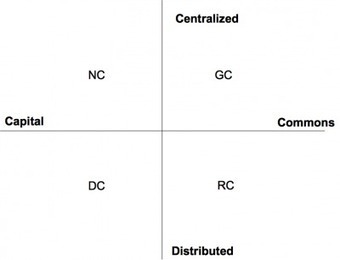
This entry is about the theory of the four future scenarios for a collaborative economy, firstly developed by Michel Bauwens. It is important to mention that Vasilis Kostakis and Michel Bauwens are working on a research monograph that explores the relation of capitalism and the Commons. The book Network Society and Future Scenarios for a Collaborative Economy is contracted by Palgrave Macmillan.
Scoop.it!
“Both brokering and boundary-spanning roles greatly increase the likelihood of leadership points to the importance of social positions that can unite open innovation communities. We argued that trust does not come easily to community members who fear cooptation by commercial interests or forking over technical disagreements. Because brokers by definition contrive less cohesive and less trusting contexts, the probability that they will assume leadership roles remains highly contingent on building trust with community members. We argue that aspiring leaders can build trust through physical attendance and, consistent with this argument, find a positive interaction with physical attendance. Also consistent with our emphasis on trust in open innovation communities, brokerage and boundary spanning demonstrated a negative interaction, indicating that brokers who span boundaries remain at a disadvantage. While brokerage alone demonstrates positive influence on becoming a leader, boundary spanning demonstrates a much stronger effect. Finally, we did not observe a contingent relationship between boundary spanning and attendance. Our results emphasize the importance of intermediary and integrating roles—for brokers within technological boundaries, and for boundary spanners across cohesive technological boundaries."
Scoop.it!

People have very different ideas about what’s exciting. I think companies don’t give enough credit to their own people, both in terms of their ability to decide what knowledge they have and what is interesting and not interesting to them and in terms of self-regulation. A big surprise for me is that in the open-source software world, this notion of self-selection takes center stage. You find that all the work, even the dullest work, gets done in the interest of finishing the project.
Scoop.it!
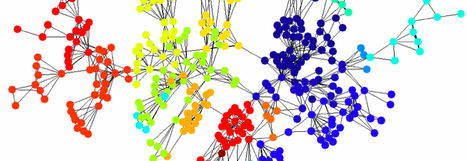
Commons-based peer production (CBPP) is a new and increasingly significant model of social innovation based on collaborative production by citizens through the Internet.
Scoop.it!
This essay set out to show, through the case of the RepRap-based, Lego-built 3D printing-milling machine, two points: First, on a theoretical level, that modularity, not only in terms of development process but also of hardware components, can catalyze CBPP’s replication for tangible products enabling social experimentation, learning and innovation. Second, that the synergy of a globally accessible knowledge Commons as well as of the CBPP practices with digital fabrication technologies, which are advancing and becoming more and more accessible, can arguably offer the ability to think globally and produce locally.
Scoop.it!
This entry is about the theory of the four future scenarios for a collaborative economy, firstly developed by Michel Bauwens. It is important to mention that Vasilis Kostakis and Michel Bauwens are working on a research monograph that explores the relation of capitalism and the Commons. The book Network Society and Future Scenarios for a Collaborative Economy is contracted by Palgrave Macmillan.
|
Scoop.it!
This is a French-language interview on the possible convergence between commons-based peer production and the social and solidarity economy.
jean lievens's insight:
Ethical Economy, P2P Theory , Peer Production, Videos.
Scoop.it!
"We are a Chilean group called “Red de Evolución Colaborativa” (Collaborative Evolution Network), RedEC. We work in the study, analysis, implementation and promotion of alternative production models.
Scoop.it!
The aim of this paper is to make the case that peer production offers a unique chance to transcend capitalism, and that peer-to-peer movements represent the succession of industrial-society based socialisms. The paper describes the salient characteristics of peer production before going on to explore whether it is ‘transcendent’ or ‘immanent’ to the market system, concluding that it is both in that it creates a new form of capitalism and also points out how that new form might be overcome. Following a review of the hybrid economic forms emerging today, I formulate the hypothesis that peer production is actually a hyperproductive mode, forcing for-profit entities to adapt to its characteristics, thereby further integrating it into the existing political economy, but not without the transformative effects of its market transcending aspects. After examining the possible expansion of peer-production modalities to physical manufacturing, I also examine the class aspects of commons and sharing-based platforms and hypothesise the emergence of a new section of capital, netarchical capitalists, who enable and empower participation, but also monetise it and attempt to control it.
Scoop.it!
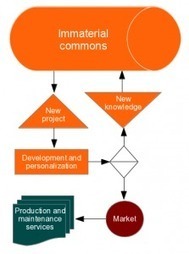
The purpose of this talk is to trace the relationship between collectivization and the concept of the commons, and discuss the P2P mode of production, analyzing the impact and the consequences for economic and social forms of relationships and organization.
Scoop.it!
Production and Governance in Hackerspaces: A Manifestation of Commons-Based Peer Production in the Physical Realm? http://t.co/Tl0uw7dkVQ
Scoop.it!

“The favelas are emerging as “symbolic capital”, as “wealth”, and as “commodities” in cities like Rio de Janeiro, Brazil. They are no longer the place of “excluded” non-subjects, as in some imaginaries and discourses, but rather a cyber-periphery, a place of “wealth in poverty” fought over by Nike, Globo Network Television, and the State, as well as laboratories for subjective production. The black bodies of the favelas, the possibilities for co-operation without hierarchy, the invention of other times and spaces (on the streets, in dancehalls, LAN centers, and rooftops) are all subjected to forms of appropriation, just like anything else in capitalism. However, the favelas are no longer seen simply as “poverty factories”, but rather a form of capital in the market of symbolic national and local values, having been able to convert the most hostile forces (poverty, violence, states of emergency) into a process of creation and cultural invention.”
jean lievens's insight:
This entry was posted on Friday, November 1st, 2013 at 6:56 pm and is filed under Cognitive Capitalism, Ethical Economy, P2P Art and Culture, P2P Movements, P2P Public Policy, P2P Theory, Peer Production. You can follow any responses to this entry through the RSS 2.0 feed. You can leave a response, or trackback from your own site.
Scoop.it!

New paper by Yochai Benkler, Aaron Shaw and Benjamin Mako Hill: “Peer production is the most significant organizational innovation that has emerged from
Scoop.it!
“In addition to developing highly advanced scientific instruments, Tiberus Brastaviceanu and his team have created an innovative process halfway between traditional research and open collaboration. Based on fairness, transparency and redistribution of profits, their methodology is likely to revolutionize scientific collaboration.”
Scoop.it!
jean lievens's insight:
This entry was posted on Friday, October 25th, 2013 at 6:58 pm and is filed under Commons, Ethical Economy, Open Innovation, P2P Action Items, P2P Collaboration, P2P Ecology, Peer Production. You can follow any responses to this entry through the RSS 2.0 feed. You can leave a response, or trackback from your own site.
Scoop.it!

Scoop.it!
These changes are highly visible in a city like Rio de Janeiro, a territory in dispute. The city, which has always been a meta-narrative for Brazil, is currently undergoing profound transformations that place it at the centre of cognitive, affective and communicationalCapitalism 2.0.
Scoop.it!

The favelas are emerging as “symbolic capital”, as “wealth”, and as “commodities” in cities like Rio de Janeiro, Brazil. They are no longer the place of “excluded” non-subjects, as in some imaginaries and discourses, but rather a cyber-periphery, a place of “wealth in poverty” fought over by Nike, Globo Network Television, and the State, as well as laboratories for subjective production. The black bodies of the favelas, the possibilities for co-operation without hierarchy, the invention of other times and spaces (on the streets, in dancehalls, LAN centers, and rooftops) are all subjected to forms of appropriation, just like anything else in capitalism. However, the favelas are no longer seen simply as “poverty factories”, but rather a form of capital in the market of symbolic national and local values, having been able to convert the most hostile forces (poverty, violence, states of emergency) into a process of creation and cultural invention.
|




