


= A principle underlying systems of organisation that asserts that everyone has the right to make and act on decisions about things that affect them and that no one else has the right to take that away from them.
Get Started for FREE
Sign up with Facebook Sign up with X
I don't have a Facebook or a X account


 Your new post is loading... Your new post is loading...
 Scoop.it!
= A principle underlying systems of organisation that asserts that everyone has the right to make and act on decisions about things that affect them and that no one else has the right to take that away from them. 
No comment yet.
Sign up to comment
Scoop.it!

*On the other hand, given the historical behavior of Italian city-states, man, I have to wonder. All I need is some Milanese Sforzas with catapults at the gates of Torino. It took the ultra-wealthy some real effort to completely subvert and own governments, but in Medici Florence that was what it was about from the get-go. Hello, Mayor Bloomberg! Thanks for the public-art!
Scoop.it!

The newDemocracy Foundation believes there is a better way to do democracy.
Scoop.it!

In a radical experiment, one politician is asking people what they think about a new transparency bill, and voting accordingly
Scoop.it!
In ancient Rome, especially during the late Republic, oligarchs resorted to mob violence to block, intimidate, assassinate or drive from power the dominant faction in the Senate. While neither the ruling or opposing factions represented the interests of the plebeians, wage workers, small farmers or slaves, the use of the ‘mob’ against the elected Senate, the principle of representative government and the republican form of government laid the groundwork for the rise of authoritarian “Caesars” (military rulers) and the transformation of the Roman republic into an imperial state.
Scoop.it!

Technical infrastructure and geopolitical power; rampant consumerism and ubiquitous surveillance; the lofty rhetoric of “internet freedom” and the sober reality of the ever-increasing internet control – all these are interconnected in ways most of us would rather not acknowledge or think about. Instead, we have focused on just one element in this long chain – state spying – but have mostly ignored all others.
Scoop.it!

D-CENT creates digital tools for direct democracy and economic empowerment across Europe. It is an open, decentralised social networking platform for large-scale collaboration.
Scoop.it!
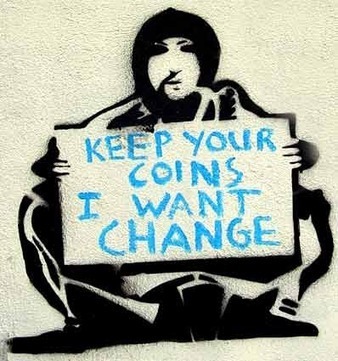
It appears to me that in majority of discussions about life after capitalism and possible social-economic alternatives, a very familiar anxiety tends to surface and resurface. This anxiety, I argue, is both existential and social in nature. It is the result of what I describe as one of the most fundamental philosophical problems of the 21st Century: namely that if capitalism, as a system of in-direct domination, emerged in history as an alternative to systems of direct domination; how might we then formulate, in the present, a truly progressive and emancipatory alternative without reproducing direct or in-direct systems of domination?
Scoop.it!

John Naughton: The social networking service has the power to control the expression of public opinion in political debate (RT @sufisal: While dinosaurs sleep through a Revolution, the world is transforming rapidly.
Scoop.it!

There is nothing idealized about the difference between a society whose arrangements serve all its citizens and one whose institutions have been converted into a stupendous fraud.
Scoop.it!

Harvard law professor Yochai Benkler says acts of conscience are integral to balancing security and freedom.
Scoop.it!
The digital revolution, we are told everywhere today, produces democracy. It gives “power to the people” and dethrones authoritarians; it levels the playing field for distribution of information critical to political engagement; it destabilizes hierarchies, decentralizes what had been centralized, democratizes what was the domain of elites.
Scoop.it!

In the current historical moment, the line between fate and destiny is difficult to draw. Dominant power works relentlessly through its major cultural apparatuses to hide, mischaracterize or lampoon resistance, dissent and critically engaged social movements. This is done, in part, by sanitizing public memory and erasing critical knowledge and oppositional struggles from newspapers, radio, television, film and all those cultural institutions that engage in systemic forms of education and memory work. Historical consciousness has been transformed into uplifting narratives, box-office spectacles and lifestyle stories fit for the whitewashed world of the Disney musketeers. As Theodor W. Adorno puts it, "The murdered are [now] cheated out of the single remaining thing that our powerlessness can offer them: remembrance."[i] The relentless activity of thoughtlessness - worship of celebrity culture, a cravenly mainstream media, instrumentalism, militarism or free-roaming individualism - undermines crucial social bonds and expands the alleged virtue of believing that thinking is a burden.
|
Scoop.it!
Social media sites provide users with outlets for entertainment, sharing, and games. But can social networking sites influence, or even encourage, digital democracy? Social Media and Democracy: Innovations in Participatory Politics, edited by Brian D. Loader and Dan Mercea, looks at the relationship between social media, democracy, and citizenship.1
Scoop.it!

Fifty-one years ago President Kennedy shocked the world when he revealed reconnaissance photos of Soviet missile launch sites in Cuba. Today, I can browse satellite images of the same locations from the comfort of my sofa on Google Earth. This once top secret capability has become democratized and available to all. At some point, today's top secret technology will also be accessible from your sofa.
Scoop.it!
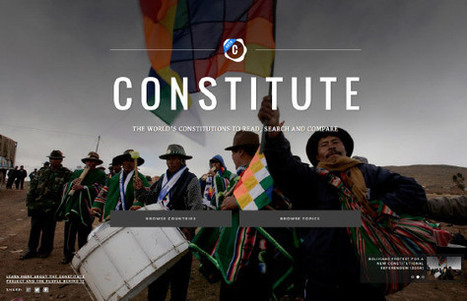
Google Ideas supported the Comparative Constitutions Project to build Constitute, a new site that digitizes and makes searchable the world’s constitutions.
Scoop.it!
The bad news is that the 1% and the mainstream media have caught us in their web of ideological control. The good news is that there’s still a way out.
Scoop.it!
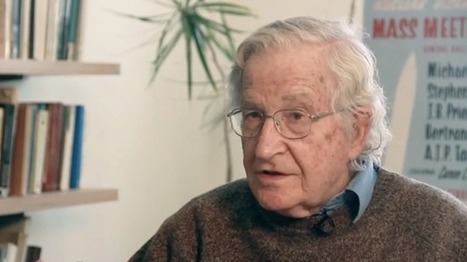
“There are two major dark shadows that hover over everything, and they’re getting more and more serious,” Chomsky said. “The one is the continuing threat of nuclear war that has not ended. It’s very serious, and another is the crisis of ecological, environmental catastrophe, which is getting more and more serious.”
Scoop.it!

Help us build a brand new platform for independent news and critical analysis, providing grassroots perspectives on the global struggle for real democracy.
Scoop.it!
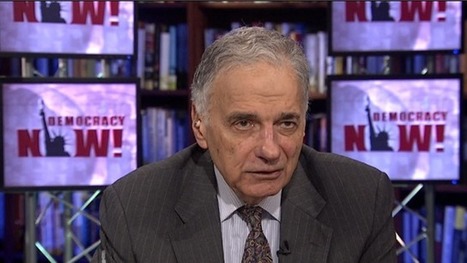
Describing the United States as an "advanced Third World country," longtime consumer advocate and former presidential candidate Ralph Nader calls for a new mass movement to challenge the power corporations have in Washington.
Scoop.it!

Democracy is lost unless we re-structure our economies, and re-structuring our economies requires a new system based on different values. This is the sixth article in our series on empathy and transformation.

Brenda Robinson's curator insight,
December 24, 2013 8:25 AM
Please sign/share if you're so inclined. Thank you. x
Scoop.it!

Guy Debord once argued that the spectacle suggests society's desire for sleep.[1] He was enormously prescient, and his words and work are more important today than when they were first written. The spectacle has been energized and reworked under the forces of neoliberalism and now promotes a mix of infantilism, brutality, disposability and lawlessness. As the visibility of extreme violence is endlessly reproduced in various cultural apparatuses and screen cultures, it functions increasingly, alongside a range of other economic and political forces, to legitimate a culture of cruelty and disposability in everyday life. Pleasure is now colonized in the service of violence, reinforcing Rustom Bharacuha's claim that "there is an echo of the pornographic in maximizing the pleasure of violence."[2]
Scoop.it!

Direct democracy is when every citizen can vote on each issue directly, this allows people an equal voice, independent of whom they are. Direct democracy has a number of drawbacks. Firstly many people don’t have the time or energy to continuously vote on single policy issues, also many people don’t feel informed enough to take the decisions, meaning they may not vote, this means that voting can become a privilege of those with free-time and confidence in their knowledge. The Second problem is that where direct democracy and popular assemblies, can work well in smaller and less complex communities, such as in ancient Athens, modern nation states are incredibly complex.
Scoop.it!

Have you ever tried to imagine democracy? How does it look like? Do you see it as close as your neighbourhood or as far as the national state? We posed similar questions to more than 20 citizens of Bosnia and Herzegovina. They were challenged to revoke, analyse and visualise very intimate relationships in the society and their bonds with the state. This process created new spaces for people – space for revoking personal stories, space for visualisation of experiences, space for learning, space for establishing relationships, and space for deepening knowledge about democracy.
Scoop.it!
In addition, the depoliticization of politics and the increasing transformation of the social state into the punishing state have rendered possible the emergence of a new mode of authoritarianism in which the fusion of power and violence increasingly permeates all aspects of government and everyday life.[ix] This mad violence creates an intensifying cycle rendering citizens' political activism dangerous, if not criminal. On the domestic and foreign fronts, violence is the most prominent feature of dominant ideology, policies and governance. Soldiers are idealized, violence becomes an omniscient form of entertainment pumped endlessly into the culture, wars become the primary organizing principle for shaping relations abroad, and a corrosive and deeply rooted pathology becomes not the mark of a few individuals but of a society that, as Erich Fromm once pointed out, becomes entirely insane.[x]Hannah Arendt's "dark times" have arrived as the concentrated power of the corporate, financial, political, economic and cultural elite have created a society that has become a breeding ground for psychic disturbances and a pathology that has become normalized. Greed, inequality and oppressive power relations have generated the death of the collective democratic imagination.
|





