Nevertheless, I believe that the distant future of the balance or unbalance between humankind and nature has a great importance. Certainly, if we look far enough ahead, it will be beyond our own lifetimes. But I feel that we we should think not only of our own children, and of their children and grandchildren, but also about the fate of all future human generations; and not only about humans, but also about what will happen to all the animals and plants and microbes with which we share our existence.
For millions of people, Wikipedia is a quick and easy way to settle a factual disagreement or research a school paper. For Thomas Malone, professor of management at the Massachusetts Institute of Technology(MIT), the online, crowd-sourced encyclopedia is an inspiration.
Anyone with a computer can now join an Oxford University research project to reveal what role global warming played the UK’s record-breaking wet winter
The US needs to invest trillions just to keep our nation’s basic infrastructure--energy, transportation, water, and waste systems--in working order. Will we lock in inefficient, carbon-polluting systems for decades to come?
Held on November 20, 2013 in Edmonton, this workshop gave participants the chance to interact with Paul Hawken in an intimate setting. Participants heard his perspective on how current sustainability behaviors and plans measure up to the challenge posed by climate change, and how citizen involvement and collaboration might help us to meet this challenge. In small discussions, participants explored answers to these questions, followed by open discussion with Paul Hawken.
It’s an odd thing, really. in certain precincts of the left, especially across a broad spectrum of what could be called the economic left, our (by which I mean humanity’s) accelerating trajectory toward the climate cliff is little more popular as a topic than it is on the right. In fact, possibly less so. (Plenty of right-wingers love to talk about climate change, if only to deny its grim and urgent scientific reality. On the left, to say nothing of the center, denial takes different forms.)
Corporations are created by state-issued charters. Where corporations are violating their duty to the public trust — for example by pouring climate-destroying greenhouse gasses into the atmosphere — governments have an obligation, to stop them from doing so or to revoke their charters.
Why? Any admission that humans are responsible for climate change would result in new carbon-emission restrictions and taxes. Until then, the impact of those 400,000 daily atomic bombs exploding on Planet Earth remains in force, and the Big Money–Big Oil–Big Government–Big TV Networks conspiracy will keep winning. And Planet Earth will keep losing, unfortunately.
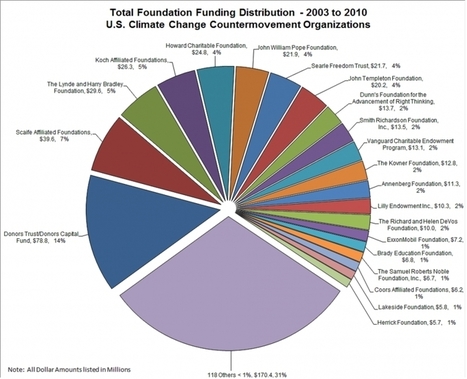
The major findings of this study reveal that Conservative foundations have bank-rolled the climate change denial countermovement. Although the Koch brothers and ExxonMobil have publicly reduced funding from 2007, this occurred at the same time as a dramatic rise in funding through untraceable sources such as Donors Trust. Most funding for climate denial efforts is now publicly untraceable.
Rifkin: "This is the moment of decision". Global temperatures might rise up to 6 degrees by the end of the century. He made his remarks during a speech for "The Solar Future" congress in Eindhoven, May 23 2013. Source: www.new-energy.tv.
Reclaim the Power is not the only barometer by which to measure climate activism in the UK, but it does epitomise the coalition-building that is happening in order to generalise activism on reclaiming power for a commons – our climate, our energy, our labour. Focusing on a symptom of capitalism – climate change – that affects everyone – Left and Right, top or bottom of the pile – can open up genuine concepts of a collective and of what rights people should have to meet our common needs and aspirations. Drilling license applications in the UK could sow the seeds of a fertile network of resistance and coalitions dispersed all over the country. It can also provoke the possibility of planned alternatives – local sustainable community controlled power in your backyard rather than a fracking rig.
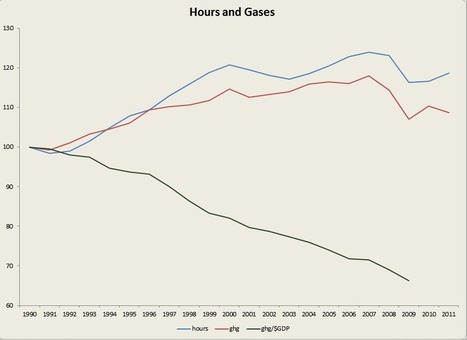
In terms of greenhouse gases, there has been a modest improvement in the U.S. over the last 20 years in emissions per hour of work. If I may put it crudely, in 2011, the average worker emitted about a ton of GHGs per week compared to about 1.12 tons in 1990. Of course the workers didn't emit the GHGs but when you look at the historical relationship between hours and emissions it's easy to get that impression. There is a very strong correlation between hours of work and GHG emission -- stronger than the correlation between population, labor force or GDP and emissions. Here's a little chart I cobbled together to illustrate:
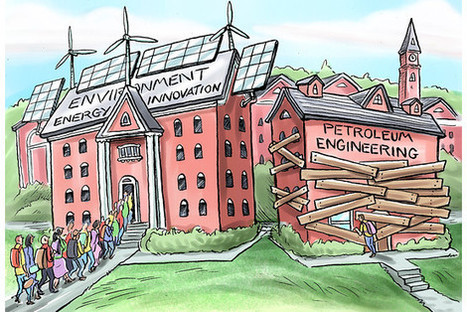
In The Wall Street Journal, Paul H. Tice writes that the top-paying job for grads last year: petroleum engineer, at $97,000. Yet most colleges seem oddly uninterested.
Google plans to create high-resolution drought mapping for the mainland United States as part of a White House effort -- to be unveiled Wednesday -- to give communities more data to help them prepare for climate change.
Some of the rapid changes we face in our global climate are irreversible. They are 250 years in the making, beginning with the industrial revolution in Europe; and according to NASA they are unprecedented, given the last 10,000 years of the earth's history. The consequences of these changes, as explained by NASA, are enumerated in further detail at the bottom of this column. Climate change is the new normal.
Climate change is one of the defining issues of our time. It is now more certain than ever, based on many lines of evidence, that humans are changing Earth’s climate.
For those who don’t have the time to spend 2 hours watching a talk by this yesterday’s man, here is a shorter video with far more interesting and revealing opinions:
When I heard in late December that Bill McKibben had written another article for Rolling Stone, I was thrilled. His July 2012 piece for that publication -- "Global Warming's Terrifying Math" -- started a firestorm. McKibben had determined that the public was losing interest in battling climate change because there was no clear enemy. With no titanic force to battle, consumers had no one to blame but themselves, and that notion was driving away supporters. Then McKibben's article identified the fossil fuel companies as the once and future evil, and because of horrors such as the Exxon Valdez and BP's Gulf Oil Spill, they were bad guys we already loved to hate.
Bren Smith's vertical ocean farm in Long Island Sound grows seaweed and shellfish and is designed to restore ecosystems, mitigate climate change, and create blue-green jobs for fishermen.
Rifkin: "This is the moment of decision". Global temperatures might rise up to 6 degrees by the end of the century. He made his remarks during a speech for "The Solar Future" congress in Eindhoven, May 23 2013. Source: www.new-energy.tv.
Policies to counter global warming effectively “will only advance if accompanied by radical social movements”, socialist writer and activist Naomi Klein has told theRadical [greenhouse gas] Emissions Reduction conference in London. “Transformative policies… must be backed by transformative politics.”
To get content containing either thought or leadership enter:
To get content containing both thought and leadership enter:
To get content containing the expression thought leadership enter:
You can enter several keywords and you can refine them whenever you want. Our suggestion engine uses more signals but entering a few keywords here will rapidly give you great content to curate.


 Your new post is loading...