


RT @iMinds: Want to learn more about Open Knowledge? Join the next @openbelgium, on February 29th: https://t.co/pbiGfhwvy8

 Your new post is loading...
 Scoop.it! RT @iMinds: Want to learn more about Open Knowledge? Join the next @openbelgium, on February 29th: https://t.co/pbiGfhwvy8 
No comment yet.
Sign up to comment
Scoop.it!

Are the sharing economy and the “Uber effect” just a fad or a revolution in consumption and...
Scoop.it!

One in five adults have worked in the sharing economy, while two in five have used it, according to new report.
Scoop.it!

Eventbrite - Gen Why Media presents Platform Cooperativism: Alternatives to the Sharing Economy and Collaborative Consumption - Tuesday, 12 January 2016 at Groundswell Cafe & Learning Space, Vancouver, BC.
Scoop.it!
Find out how individual designers benefit from the use of the FabLab facilities located within the Cardiff School of Art & Design at Cardiff Metropolitan Uni...
Scoop.it!
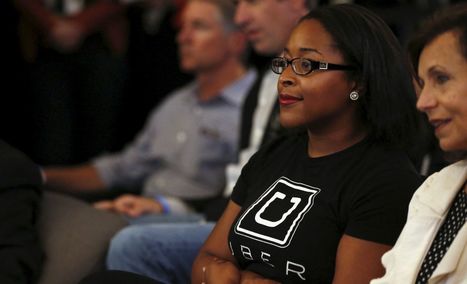
From qz.com: Author : Alison Griswold In 2015, the number of people driving for Uber in the US ballooned from 160,000 to more than 400,000. Lyft also added drivers. Airbnb signed up new hosts.
Scoop.it!
Yuval Harari, Kenneth Cukier, and Jeremy Howard talk about BIg data, ML, and the future of work. This is a compilation of clips. I do not own the source mate...
Scoop.it!

EconoTimes is a fast growing non-partisan source of news and intelligence on global economy and financial markets, providing timely, relevant, and critical insights for market professionals and those who want to make informed investment decisions.
Scoop.it!

Fed up with privately-owned mobility platforms? La Zooz’ could be a decentralised alternative to services like Uber.
Scoop.it!

Blockchain, the technology underlying bitcoin, is coming to a back office, and clearing house, and bank, and front office near you. Instead of one authority keeping records, everyone will. That’s th...
Scoop.it!

For the team behind design technology company ReDeTec, the mandate from Day 1 has always been to “make awesome things.” Now, thanks to the help...
Scoop.it!

“Worker, build your machine!” So Ernesto "Che" Guevara’s proclaimed to Cuba’s industrial sector, shortly after the triumph of the evolutionary movement he
Scoop.it!

David Bollier is a policy strategist, activist, and a leading voice in the commons movement. In a new book, Bollier and commons activist Silke Helfrich, both members of the Commons Strategies Group, collaborated to underscore the fact that commons are not things, resources or goods; they are social structures, processes and patterns.
|
Scoop.it!
There’s a palpable feeling in the air that these are not ordinary times. The changes currently brewing will be sweeping rather than incremental as technology alters the structure of companies and the future of work.
Scoop.it!

https://www.youtube.com/watch?v=QOmyiqHHcBQ
Scoop.it!

Futurist and Keynote Speaker Gerd Leonhard is blogging about the future. Humanity will change more in the next 20 years than in all of recent human history
Scoop.it!
Read More: http://www.engadget.com Get More Engadget: •Subscribe to Engadget on YouTube: http://engt.co/subscribe •Like us on...
Scoop.it!

Forty-five million Americans, or 22 percent of the adult population, say they have worked or offered services in the On-Demand Economy, while 86.5 million, or 42 percent of the adult population, have used at least one On-Demand Economy service,...
Scoop.it!

Circulate - the go-to location for circular economy related news and insight.
Scoop.it!

U.S. Democratic Senator Mark Warner, who helped start wireless company Nextel, is focused on bringing stability to workers in the on-demand economy.
Scoop.it!

EconoTimes is a fast growing non-partisan source of news and intelligence on global economy and financial markets, providing timely, relevant, and critical insights for market professionals and those who want to make informed investment decisions.
Scoop.it!

Jason Swanson considers how the education system could use new technologies, such as blockchain, to improve learning for students.
Scoop.it!

Since its inception in 2009, Bitcoin—a digital currency secured by encryption—has attracted attention, interest, and controversy. Less attention (at least until
Scoop.it!

German group builds an 'Airbnb for refugees' allowing landlords to offer space in their homes to those fleeing wars.
Scoop.it!
From
c4ss

In a preview article at The Guardian last July for his new book Post-Capitalism (“The end of capitalism has begun,” July 17), Paul Mason — following a path previously trodden by John Holloway and by Toni Negri and Michael Hardt — argued that the emergence of a successor system to capitalism would resemble not so much the 19th and 20th century models of storming the bastions of power and seizing control of state and corporate institutions, as the earlier evolution of capitalism itself from within the interstices of feudalism. Post-capitalism will grow from many building blocks in the present system, now present only in nascent form, as the old system succumbs to chronic crisis tendencies and the seeds of the new system grow together into a whole and finally supplant the old one.
|




