At a recent Mayfield Fund dinner for hardware entrepreneurs and investors hosted by the firm’s partner Tim Chang, former Wired editor-in-chief-turned-drone entrepreneur Chris Anderson opened up about how he turned a hobby of building robots and drones into an actual business.
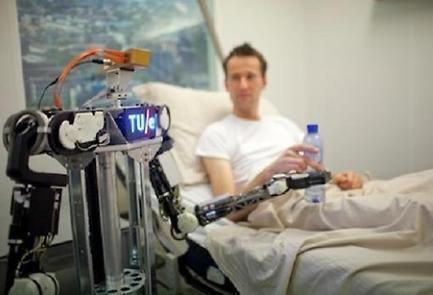
That is why Oxford University researchers are exploring the privacy concerns around surrogate robots in their EPSRC-funded project 'Being There: Humans and Robots in Public Spaces', which will be described at this year's Oxford London Lecture on 18 March.
Are we on the brink of a robotics revolution? That’s what numerous media outlets asked last December when Google acquired eight robotics companies that specialize in such innovations as manipulation, vision, and humanoid robots.
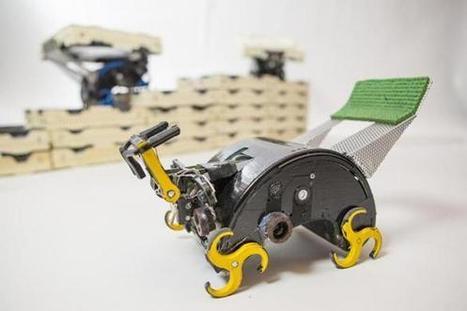
Compared with human-like robots that are being built to comprehend emotion, perform complex tasks, and outsmart people on quiz shows, a trio of bug-like machines designed by Harvard University engineers with a handful of crude sensory abilities hardly seems to merit the word “intelligence.”
US scientists develop small robots that behave much like termites, able to build large structures even though each individual acts on its own and can follow only simple rules. (Stigmergic builder robots.
On the plains of Namibia, millions of tiny termites are building a mound of soil—an 8-foot-tall "lung" for their underground nest. During a year of construction, many termites will live and die, wind and rain will erode the structure, and yet the colony's life-sustaining project will continue.
(Visit: http://www.uctv.tv/) Chris Anderson, the former Editor-in-Chief of Wired and now CEO of 3-D Robotics, talks with The Atlantic's James Fallows about the role of drones for civilian uses. This program is part of The Atlantic Meets the Pacific 2013 conference presented by The Atlantic and UC San Diego. Series: "The Atlantic Meets The Pacific" [11/2013] [Public Affairs] [Science] [Show ID: 25784]
With autonomous multicopters and aircraft all over the news, 2014 promises to be a big year for drone makers 3D Robotics. The five-year old company has grown from its launch (spinning off from the successful DIYDrones.com community) to over 180 employees, $35M in financing, and three locations — Berkeley, San Diego, and Tijuana.
In 2004, Chris Anderson’s now famous Wired article introduced the World to the Long Tail of niche marketing. This is a frequency distribution — a graph, that can be used to understand a retailing strategy for selling a large number of unique items in individually small volumes.
3D Robotics develops innovative, flexible and reliable personal drones and UAV technology for everyday exploration and business applications. 3DR's UAV platforms capture breathtaking aerial imagery for consumer enjoyment and data analysis, enabling mapping, surveying, 3D modeling and more. Our technology is currently used across multiple industries around the world, including agriculture, photography, construction, search and rescue and ecological study. 3DR is committed to bringing the power of UAV technology to the mainstream market.
Kevin Kelly shares his views on technology driven innovations and the impact that these rapidly advancing technologies are having on job growth and employment numbers. Kelly acknowledges that computers will continue to automate many jobs, though he states that technology is also facilitating new jobs at an even faster rate. He predicts that jobs will continue to evolve rapidly in five to ten years, and that the most lucrative positions have not even been invented yet. You will also learn what he means by the “hacker mentality” and how this negative connotation can be seen as a type of exploration of design solving.
Tom Malone gave a very interesting talk on collective intelligence at the IBM Cognitive Systems Colloquium which I recently attended and wrote about. Malone is Professor of Management at MIT’s Sloan School and the founding director of the MIT Center for Collective Intelligence (CCI). His research is primarily driven by this fundamental question: “How can people and computers be connected so that - collectively - they act more intelligently than any individuals, groups, or computers have ever done before?” This is a very important question to explore to help us understand the impact of our increasingly smart machines on the very nature of work and organizations.
This article is an interesting synopsis of extensive studies that have been conducted into the field of Collective Intelligence. it surmises specifically a study conducted by Tom Malone, Professor of Management at MIT's Sloan School. The study conducted by Malone tested the effectiveness of 'Human Agents', 'Artificial Neural-Network Agents' and 'Hybrid Agents' (combination of human and artificial intelligence) to test which were the most effective at making predictions, specifically when looking at an NFL match. NFL was selected as the test material as video content is hard to code for artificial intelligence to analyse, and as such was more viable as a test when compared to human intelligence. the study found that the Hybrid agents made the most accurate predictions. This is interesting as it helps to solidify the point of view that collective intelligence, be it just in humans, or humans and artificial intelligence working in unison, is more powerful then any one individual element on its own.
This article is extremely credible as it was a study undertaken by a well known and respected academic body, and the findings have been published and peer reviewed. the relevancy of this article is very high, as it clearly details the power of collective intelligence, and the benefits it can provide.
Friday is Fly Day at 3D Robotics, a maker of small robotic aircraft. So here we are, on a windswept, grassy landfill with a spectacular view of San Francisco’s Golden Gate Bridge, looking up at a six-prop copter with a gleaming metal frame. It’s like a spiffy toy from the future. Buzzing like a swarm of bees, it lifts off smartly, hovers, then pinwheels.
“These are hardware platforms for research labs to develop algorithms for mobile manipulation, social robotics, and human-robot interaction,” says Edsinger, who was Meka's chief executive officer.
Compared with human-like robots that are being built to comprehend emotion, perform complex tasks, and outsmart people on quiz shows, a trio of bug-like machines designed by Harvard University engineers with a handful of crude sensory abilities hardly seems to merit the word “intelligence.”
Termites have a reputation for breaking buildings down, not constructing them. But that’s about to change. Harvard engineers have used the insects as inspiration for a new robot called the TERMES. One day, they say, it could complete simple construction tasks without any supervision.
One weekend, Wired editor-in-chief Chris Anderson and his 9-year-old son hacked together a Lego Mindstorms with a model airplane—the first Lego drone. The results inspired Chris to start DIY Drones, the world's largest community of unmanned aerial vehicle enthusiasts, and leave Wired to launch 3D Robotics, a company manufacturing the open-source hardware the community designed. This experience with indie hardware led to his most recent book, Makers: The New Industrial Revolution.
This week's roundup of Good Reads topics includes the future of humanoid robots, the endless loop of poverty, crowdsourcing science problems, how to better manage burned forests, and the impact of too much praise for children.
The concept of 'work' has been at the heart of both the industrial as well as the information society, along with 'jobs' and 'growth' and that most rapidly outmoding term, GDP (expect a new metric to emerge here, soon, along the lines of 'gross national well being'). But what will work mean in a knowledge society, or indeed in some form of an 'experience society'? What will happen when merely maximizing efficiency and productivity becomes the chief domain of machines, rather than humans?
Writes Markoff in the NYT: "Google confirmed on Friday that it had completed the acquisition of Boston Dynamics, an engineering company that has designed mobile research robots for the Pentagon. The company, based in Waltham, Mass., has gained an international reputation for machines that walk with an uncanny sense of balance and even — cheetahlike — run faster than the fastest humans."
This is so cool! I also read an article of Drudge and it aid that the miliary could use these! The stuff now coming into the future just fascinates me!
To get content containing either thought or leadership enter:
To get content containing both thought and leadership enter:
To get content containing the expression thought leadership enter:
You can enter several keywords and you can refine them whenever you want. Our suggestion engine uses more signals but entering a few keywords here will rapidly give you great content to curate.


 Your new post is loading...