The totality of destructive damage that transnational corporations have perpetrated against all forms of planetary life has destroyed the eco-systems of thousands upon thousands of animal and plant species. Of the five times that life on earth has become massively extinct in the past, we humans are rapidly causing the sixth great cycle of mass extinction and the first and fastest due to manmade effects in the form of rising global air and water temperatures and over-polluted water, air and soil. The dead zones across the planet are spreading faster rates of extinction amongst plant and animal life than at any prior time in the earth’s known history. Destruction of our living habitat and eco-system carries perhaps the most damning, ultimate dumbing down effect that the oligarchs have caused. But then they no doubt have laid out their own contingency plan utilizing a hidden technology that can save them when the lights go out on mother earth for the rest of us lowly expendables.
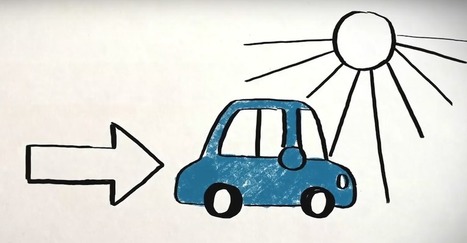
Can autonomous cars give us a do-over with our cities, fossil fuel dependence, affordable housing, and also workers? Robin Chase, author of Peers, Inc and co-founder of Zipcar says yes. Or at least they have the potential to.
by Maira Sutton, Cat Johnson and Neal Gorenflo The sharing economy held great promise when it first emerged. It was seen as a way to help people build community, reduce unnecessary consumption, and generate extra income. It was based on the brilliantly simple notion that when we share, everybody has more.
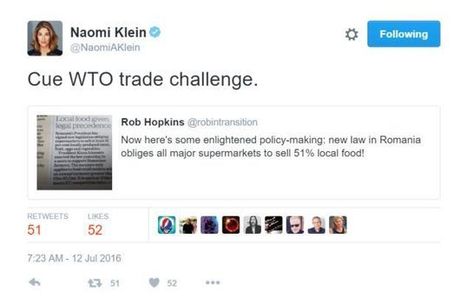
Amid all the mayhem and turmoil of recent weeks, here's a news story you may have missed. The Romanian parliament unanimously passed an amendment to the country's "Law on the Sale of Food Products" bill which states that every large supermarket in the country must ensure that 51% of the fruit, vegetables, meat, eggs, honey, dairy products and baked goods they stock are "locally sourced". As a demonstration of how enlightened policymaking can unlock Transition, it's an eye-catching and paradigm-shifting piece of legislation. But is it legal, and, actually, does that matter anyway?
I came across a fantastic article, that, at least for me, could be a game changer. It deals with clinical practice in the Amish communities of America. The Amish faith dictates they vet very carefully any innovation for stuff that could introduce perverse incentives in their lives. They prize something they call "autonomy": electricity, for example, can be bad if it powers activities that will make people drift away from the community, but it's OK for, say, lighting your workplace.
The three main ideas are summarised here. They were more progressive taxation to create greater equality both as a matter of fact and to deliver justice in the way that the deficit was tackled. Second, the tax gap was to be tackled to provide funding and to create a level playing field for business. And third, People’s Quantitative Easing was, in combination with a National Investment Bank, to be used to fund a new industrial strategy. What the document did not say was what the overall vision was: it focussed on policies not philosophies but it rattled the mainstream media and much of Labour nonetheless.
Michel Bauwens answered to the critique of Stefan Meretz on Peer Production License. Jakob Rigi from Hungary enters the debate commenting on both positions. They are documented in the following. My…
"Our economy is neither overwhelmingly capitalist, as Marxist political economists argue, nor overwhelmingly a market economy, as mainstream economists assume. Both approaches ignore vast swathes of the economy, including the gift, collaborative and hybrid forms that coexist with more conventional capitalism in the new digital economy. Drawing on economic sociology, anthropology of the gift and heterodox economics, this book proposes a groundbreaking framework for analysing diverse economic systems: a political economy of practices. The framework is used to analyse Apple, Wikipedia, Google, YouTube and Facebook, showing how different complexes of appropriative practices bring about radically different economic outcomes. Innovative and topical, Profit and Gift in the Digital Economy focusses on an area of rapid social change while developing a theoretically and politically radical framework that will be of continuing long-term relevance. It will appeal to students, activists and academics in the social sciences."
Recommended reading if you want to know what is Changing Fast. I. "Exponential Organizations" Exponential Organizations: Why new organizations are ten times better, faster, and cheaper than yours (and what to do about it) Paperback – October 14, 2014 by Salim Ismail (Author), Michael S. Malone (Author), Yuri van Geest (Author), Peter H. Diamandis (Foreword)…
((updates: Bratislava, Köszeg and Kumport added; Leicester added)) Since 2008 we all are in an economic crisis. Fortunately, in certain cities and city area's recently business and industry is suddenly picking up speed. Examples are Rotterdam, Eindhoven and Bavaria in Germany ("Laptops und Lederhosen"). On closer inspection city area's are booming in a trail from…
The Book of Peer Production has been released as a special edition of Journal of Peer Production. It consists of papers written by presenters at the Peer Production-track at the Free Society Conference and Nordic Summit (FSCONS) in Göteborg 2014. It is cool, that all content in the book is in the public domain.
When healthcare is expensive, the Amish culture of autonomy and thrift may be a way to balance communal support and individual responsibility. Sara Talpos finds out more.
Complementary currencies like the Bristol Pound act as vouchers for national currency. You swap one Bristol Pound for a Bank of England pound at a 1:1 or 1:0,9 rate. The benefit of a currency like that is that it encourages money to stay in the local economy (jobs with it). The Bristol Pound is valid…
This video will be updated soon to reflect more recent developments in Noomap´s progress, and we still love sharing this because it expresses some core values,…
To get content containing either thought or leadership enter:
To get content containing both thought and leadership enter:
To get content containing the expression thought leadership enter:
You can enter several keywords and you can refine them whenever you want. Our suggestion engine uses more signals but entering a few keywords here will rapidly give you great content to curate.





 Your new post is loading...