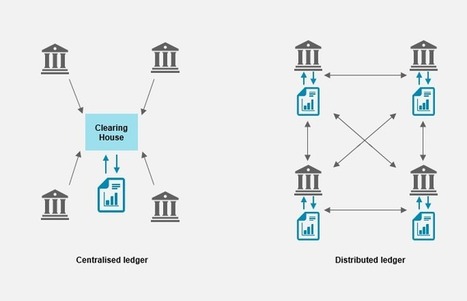
Blockchain technology will have a dramatic impact on business and society, says digital visionary Don Tapscott, by providing a secure, direct way of exchanging money, intellectual property and other rights and assets without the involvement of...
Eventbrite - Commons Transition Coalition presents Sharing Value & Ownership for the Common Good: Building the Commons Economy - Friday, June 10, 2016 at Church of All Nations, Carlton, VIC. Find event and ticket information.
"Fuchs (2010, 2012) argues that users of social media produce value and surplus value in the Marxian sense. Arvidsson and Colleoni (2012) critique this hypothesis, claiming that Marx's theory of value is irrelevant to the regime of value production on social media platforms in particular and in informational capitalism in general. They claim that the affective relations and financial speculations that generate value on social media are not dependent on labor time. This article critically engages Fuchs, and Arvidsson and Colleoni, by revisiting Marx's theory of value. Contra Fuchs, we argue that audiences do not produce value and surplus value—neither for social nor for mass media. Contra Arvidsson and Colleoni, we argue that so-called affective relations (philia) do not produce value either. Instead we demonstrate that social media generate revenue from four primary sources—by leasing advertisement space to generate advertisement rent, by selling information, by selling services to advertisers, and by generating profits from fictitious capital and speculative windfalls. All four, we argue, can be adequately explained by Marx's theory of value."
Global Tolerance CEO Rosie Warin recently had the opportunity to speak at +SocialGood UK on technology and its role as the driving force behind the Values Revolution. Listen to Rosie’s talk and find out some of the ways we can use digital media for social good.
However, both the Keen-Minsky debt school and the behaviourist ‘animal spirits’ school have one thing in common. They see the flaws of capitalism in the financial sector only. In contrast, Marx posits the ultimate cause of capitalist crises in the capitalist production process, specifically in production for profit. That does not mean the financial sector and, in particular, the size and movement of credit does not play any role in capitalist crises. On the contrary, the growth of credit and fictitious capital (as Marx called speculative investment in stocks, bonds and other forms of money assets) picks up precisely in order to compensate for the downward pressure on profitability in the accumulation of real capital.
I recently encountered a brilliant new essay by German writer Ina Praetorius that revisits the feminist theme of “care work,” re-casting it onto a much larger philosophical canvas.
An Energy Theory of Value Background Lately I've been spending some thought energy on the whole notion of value and what it must mean in biophysical economics terms. As with other economic notions, especially ones that have failed t
The road to future ecosystems is paved by stakeholder action in the coming decades. These ecosystems support life experiences and have no regard for industry boundaries.
We have now entered a period…when new waves of commodification set in motion in earlier periods are reaching maturity. The new commodities have been generated by drawing into the market even more aspects of life that were previously outside the money economy, or at least that part of it that generates a profit for capitalists. Several such fields of accumulation have now emerged, each with a different method of commodity genesis, forming the basis of new economic sectors and exerting distinctive impacts on daily life, including labor and consumption. They include biology, art and culture, public services, and sociality.… | more…
ValueWeb: How FinTech firms are using bitcoin blockchain and mobile technologies to create the Internet of Value After months of writing and editing, I’m delighted to say that my new book ValueWeb …...
I recently encountered a brilliant new essay by German writer Ina Praetorius that revisits the feminist theme of “care work,” re-casting it onto a much larger philosophical canvas. “The Care-Centered Economy: Rediscovering what has been taken for granted” suggests how the idea of “care” could be used to imagine new structural terms for the entire economy.
To get content containing either thought or leadership enter:
To get content containing both thought and leadership enter:
To get content containing the expression thought leadership enter:
You can enter several keywords and you can refine them whenever you want. Our suggestion engine uses more signals but entering a few keywords here will rapidly give you great content to curate.





 Your new post is loading...
 Scoop.it!