More than 42 million Americans owe a total of $1.1 trillion in student debt, yet we don’t know much about it. We’re changing that. Using zip code-level Experian data on student debt, we’re mapping how borrowing for college affects the nation, your city, and even your neighborhood.
Young people facing career choices are constantly under pressure at exam time. We love this piece as a way of getting conversations going around what role ...
It really bothers me when I hear anyone questioning the benefits of bringing 3D printing into our educational systems. There is so much potential out there when the students who make up tomorrow’s workforce...
Across the globe, journalists and activists are in jail for doing the kind of work we do everyday here at EFF—advocating for free speech and privacy. Last April, for instance, the Ethiopian government arrested six members of theZone 9 bloggers network and three other journalists. All now face terrorism charges for blogging about free speech and online surveillance and for using free digital security software.
Lauriston is the first in Australia to introduce FabLab@School, a digital workshop - pioneered by Stanford University in the US - that encourages students to embrace technology in its many aspects.
What would happen if communities took higher education into their own hands? What if education meant pursuing our passions and growing at our edges, immersed in a culture of creativity, accountability, integrity and action? What if instead of using degrees to measure our success, we were credited by the direct impact our work has on the world? We could transform our communities and build resilient new systems that will carry us through the next century.
his form of student-lead exploration into cutting-edge technologies is a continuation of a long-standing tradition at the prominent academic institution. Over $500,000 has already been raised to cover all 4,528 prospective undergrads from 25 MIT alumni and those in the Bitcoin community. Rubin, a sophomore in computer science, said “Giving students access to cryptocurrencies is analogous to providing them with internet access at the dawn of the internet era”. This statement echoes many other Bitcoin advocates who regularly draw parallels between the information revolution caused by the internet and the financial liberty that the Bitcoin protocol could offer users. Ruben explains the entrepreneurial relevance of the scheme: “Everybody has access to the Internet, right — so you want to launch a webapp? Everybody can do that. You want to launch a bitcoin or cryptocurrency app? That’s a little bit harder … you can’t test it in your immediate friend group. But hopefully [that’s] what we’ll enable.”
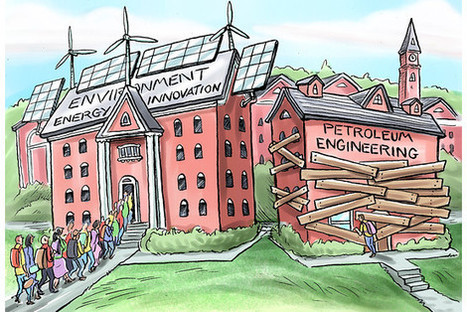
In The Wall Street Journal, Paul H. Tice writes that the top-paying job for grads last year: petroleum engineer, at $97,000. Yet most colleges seem oddly uninterested.
“The world has changed, the syllabus hasn't.” That’s the motto of the Post-Crash Economics Society, a group of students at the University of Manchester who demand reforms to the way undergraduate economics is taught in light of the worldwide economic crisis. Similar activism is occurring in other elite undergraduate institutions: There was the well-publicizedOpen Letter to Greg Mankiw from students in the introductory economics class at Harvard, during the height of the Occupy movement. Meanwhile, institutions like the Institute for New Economic Thinking (INET) are getting involved by launching a pilot program to revamp the undergraduate economics curriculum.
Since the crash of 2008, university students around the world have been rebelling against how they are taught economics. No other academic discipline has ever endured such criticism.
Final extract from the article by Rebecca Ratcliffe at the Guardian looking at how students around the world are fighting back against the commercialisation of University education. University of Amsterdam, Netherlands What’s happening? Students are occupying Maagdenhuis, the university’s main administrative building, calling for a democrastisation of the institution. What prompted the protest? Protesters want to …
LSE is the epitome of the neoliberal university. It is managed and organised around corporate interests, which promote elitism and perpetuate inequality.
The stories that I personally love to cover the most within the 3D printing space are those which focus on bringing the technology to students around the globe. These are our future leaders, creators,...
Nathan Hornes didn’t think he’d still be working in fast food on his 25th birthday. He had a plan: he wanted to be a pop singer-songwriter and had moved from Missouri to Los Angeles after his 2008 high school graduation in order to become a star.
Jeremy Rubin, a sophomore studying electrical engineering and computer science at MIT, and Dan Elitzer, founder and President of the MIT Bitcoin Club and a first-year in the MBA program at MIT Sloan, have undertaken an ambitious project aimed at creating an ecosystem for digital currencies at MIT. Plans for the MIT Bitcoin Project involve a range of activities, including working with professors and researchers across the Institute to study how students use the bitcoin they receive, as well as spurring academic and entrepreneurial activity within the university in this burgeoning field.
Each of the 4,500-plus undergraduates at MIT will soon get $100 in bitcoin as part of a project launched by a pair of students who announced today that they’ve raised a half million dollars to fund the effort.
I had always envisioned myself going to college. I led a very typical and mediocre life when I was nearing adulthood. I had no thoughts of what life could present for me besides a casual interest in earning a degree. Learning had always been my objective, but even at a young age, I knew that I would be forced me into taking student loans, with tuition at local state and city colleges consistently increasing. And then I would be forced into working my way out of debt. I wanted freedom, and buying a ticket into the standard education system did not seem like a right path.
To get content containing either thought or leadership enter:
To get content containing both thought and leadership enter:
To get content containing the expression thought leadership enter:
You can enter several keywords and you can refine them whenever you want. Our suggestion engine uses more signals but entering a few keywords here will rapidly give you great content to curate.




 Your new post is loading...
 Scoop.it!