Using 2,5 k boids to travel throug vector field. Every movement, beginning from the random, leaves a trail on a field and nearby boids follow. After few iter...
This paper examines the stigmergic dimensions of online interactive creativity through the lens ofPicbreeder. Picbreeder is a web-based system for collaborative interactive evolution of images. The Picbreeder applet starts by randomly generating several images, which are then mated and mutated based on the user’s selections. The user can then publish the image to the Picbreeder website where other users can download and continue the image’s evolution. Within this process, users collaboratively create images with significant complexity, all without explicit communication. In short, Picbreeder encourages a new form ofstigmergic collaborative creation. The most surprising result of the Picbreeder experiment during more than 3 years of operation has been the quality of the resulting images, despite the limited ways of interacting with other users. This fact challenges some commonly held notions of creativity, both online and offline.
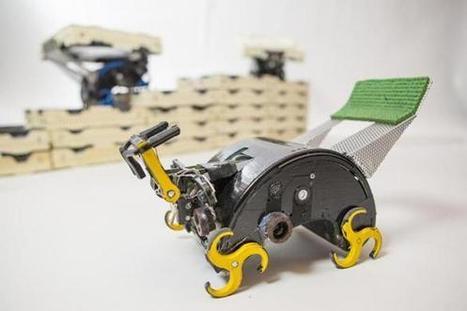
Compared with human-like robots that are being built to comprehend emotion, perform complex tasks, and outsmart people on quiz shows, a trio of bug-like machines designed by Harvard University engineers with a handful of crude sensory abilities hardly seems to merit the word “intelligence.”
"This morning my best friend's house burnt down. Kyle Burris, his sister Cecilia Borealis and the rest of their punk house are homeless. They've lost virtually everything. (I lost 95% of my textbooks, notes & paperwork, which were being stored in their attic.) I've known Kyle for well over a decade and he's unquestionably one of the sweetest people in the world. He's an anarchist, a mutualist, a union organizer, and one of the very few born and raised working class portlanders in the radical scene. Unfortunately, being poor, sweet, quiet & shy, he has relatively nothing in the way of a safety net, financially or socially. Both his partner and myself are hundreds of miles away. I can think of few more deserving of support from the radical community."
Heather Marsh’s new book puts forward a challenge: how to achieve mass collaboration on a global scale and awaken what is inherently human in the heart.
The increasing number of available collaborative tools and their extensive use in many organizational activities has constantly raised the complexity of collaboration engineering. It presumes the design of group decision processes, supported by a wide-range of groupware tools, in an ill-structured, dynamic, and open environment. As many of these processes are recurring by nature, the development of a shared repository to store the collective knowledge and experiences of group decision process designs became a core research topic of collaboration engineering in last few years. The paper presents a human–computer interaction engineering approach to design a software prototype that provides personalized, contextual and actionable recommendations for this problem.
The explosive development of “free” or “open source” information goods contravenes the conventional wisdom that markets and commercial organizations are necessary to efficiently supply products. This paper proposes a theoretical explanation for this phenomenon, using concepts from economics and theories of self-organization. Once available on the Internet, information is intrinsically not a scarce good, as it can be replicated virtually without cost. Moreover, freely distributing information is profitable to its creator, since it improves the quality of the information, and enhances the creator’s reputation. This provides a sufficient incentive for people to contribute to open access projects. Unlike traditional organizations, open access communities are open, distributed and self-organizing. Coordination is achieved through stigmergy : listings of “work-in-progress” direct potential contributors to the tasks where their contribution is most likely to be fruitful. This obviates the need both for centralized planning and for the “invisible hand” of the market.
self-organization,self-organizing,stigmergic systems,self-organizing web sites,strategy,agents,evolutionary strategy,kempelen box,using agents,knowledge management,critical mass (RT @nireiny: What is stigmergy?
Liquefying an organization means disrupting the industrial-age driven assumptions on which rigid structures are designed and move on to make it adaptive, dynamic and anti-fragile. Based on lean management and open collaboration principles, the liquid organization model is flat, meritocratic and value-driven, enabling stigmergic behaviour and "organic" effectiveness.
This thesis presents an application-oriented theoretical framework for generalised and specific collaborative contexts with a special focus on Internet-based mass collaboration. The proposed framework is informed by the author’s many years of collaborative arts practice and the design, building and moderation of a number of online collaborative environments across a wide range of contexts and applications. The thesis provides transdisciplinary architecture for describing the underlying mechanisms that have enabled the emergence of mass collaboration and other activities associated with ‘Web 2.0′ by incorporating a collaboratively developed definition and general framework for collaboration and collective activity, as well as theories of swarm intelligence, stigmergy, and distributed cognition.
People have very different ideas about what’s exciting. I think companies don’t give enough credit to their own people, both in terms of their ability to decide what knowledge they have and what is interesting and not interesting to them and in terms of self-regulation. A big surprise for me is that in the open-source software world, this notion of self-selection takes center stage. You find that all the work, even the dullest work, gets done in the interest of finishing the project.
Definitions: “Collaboration is the process of two or more people collectively creating emergent, shared representations of a process and or outcome that reflects the input of the total body of contributors” (Elliott, 2007, p. 31).
To get content containing either thought or leadership enter:
To get content containing both thought and leadership enter:
To get content containing the expression thought leadership enter:
You can enter several keywords and you can refine them whenever you want. Our suggestion engine uses more signals but entering a few keywords here will rapidly give you great content to curate.


 Your new post is loading...


 Scoop.it!