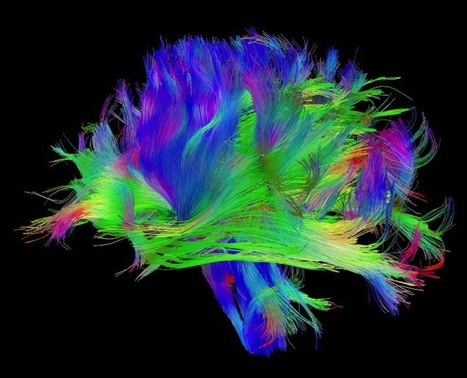
While you may not remember life as a toddler, you most likely believe that your selfhood then—your essential being—was intrinsically the same as it is today. Buddhists, though, suggest that this is just an illusion—a philosophy that's increasingly supported by scientific research. “Buddhists argue that nothing is constant, everything changes through time, you hav
A year has already gone by the launch of openQCM and there are many things to tell. When we have tried as private company, the way of the open source by
The Documentary is LIVE! Help spread the word. After nearly 2 years of shooting and post production we're finally ready to release the full Driftless Zon
It's a question that's perplexed philosophers for centuries and scientists for decades: Where does consciousness come from? Neuroscientist Christof Koch, chief scientific officer at the Allen Institute for Brain Science, thinks he has an answer.
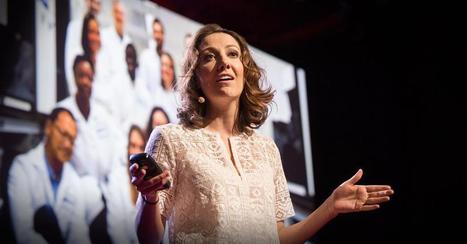
When Ebola broke out in March 2014, Pardis Sabeti and her team got to work sequencing the virus's genome, learning how it mutated and spread. Sabeti immediately released her research online, so virus trackers and scientists from around the world could join in the urgent fight. In this talk, she shows how open cooperation was key to halting the virus ... and to attacking the next one to come along. "We had to work openly, we had to share and we had to work together," Sabeti says. "Let us not let the world be defined by the destruction wrought by one virus, but illuminated by billions of hearts and minds working in unity."
Popular hypotheses credit a primordial soup, lightning, and a colossal stroke of luck. But if a new theory is correct, luck may have little to do with it.
"The cadre that call themselves skeptics, atheists, or rationalists act to enforce orthodoxy of all kinds; they are a kind of intellectual paramilitary goon squad that roots out subversion and enforces dominant paradigms. It is therefore unsurprising that, as Horgan describes, they celebrate the deep-roots theory of war. That theory basically says that group violence is a fundamental part of human nature; therefore it justifies the security state and a geopolitical stance in which we must ceaselessly protect ourselves from each other."
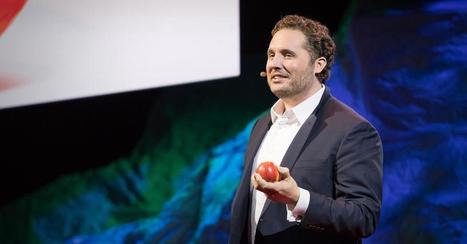
What if we could grow delicious, nutrient-dense food, indoors anywhere in the world? Caleb Harper, director of the Open Agriculture Initiative at the MIT Media Lab, wants to change the food system by connecting growers with technology. Get to know Harper's "food computers" and catch a glimpse of what the future of farming might look like.
ShararaTech Art & Science Mediterranean Festival is an emergent desert camp-out annual event that fosters creativity-for-change around the Mediterranean at the intersection of art, humanities, science and technology.
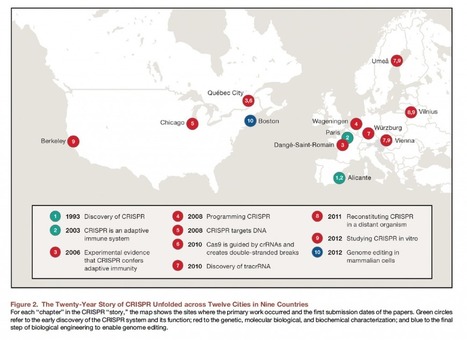
Lander’s recent essay in Cell entitled “The Heroes of CRISPR” is his masterwork, at once so evil and yet so brilliant that I find it hard not to stand in awe even as I picture him cackling loudly in his Kendall Square lair, giant laser weapon behind him poised to destroy Berkeley if we don’t hand over our patents.
- See more at: http://www.michaeleisen.org/blog/?p=1825#sthash.6uWiMDwc.dvJPQmLb.dpuf
By Fabian Tompsett in Cybernetics and Second-Order Cybernetics. Otto Neurath (1882-1945) developed the approach of encyclopedism as an important tool to achieve the Unity of Science. This is examined in terms of his long term commitment to socialism
New approaches to research investigation are looking to go beyond blanket objectivity to include experiential knowledge and local contexts. Dan McQuillan looks at the counter-cultural roots of the …
To get content containing either thought or leadership enter:
To get content containing both thought and leadership enter:
To get content containing the expression thought leadership enter:
You can enter several keywords and you can refine them whenever you want. Our suggestion engine uses more signals but entering a few keywords here will rapidly give you great content to curate.


 Your new post is loading...