Your new post is loading...

|
Scooped by
jean lievens
April 7, 2016 4:19 PM
|
Solid, from social linked data, is a proposed set of conventions and tools for building decentralized social applications based on Linked Data principles.
|
|
Scooped by
jean lievens
February 8, 2016 12:38 PM
|
An example of this would be my perplexity towards encountering CodeSolid and their proposal for Employee-Owned Source Code, originating as it does from a cooperative, which Nathan Schneider considers to be a platform cooperative. As he writes about them in a Facebook exchange:
|
|
Scooped by
jean lievens
August 21, 2015 3:17 PM
|
Continuing our series on P2P women, we present Lynn Foster’s interview with Michel Bauwens Q: Dear Lynn: Can you tell us a bit about the history of your engagement, and also about the interesting aspects of the place and region where you are living now? A: I came of age in the late 60’s and early …
|
|
Scooped by
jean lievens
June 23, 2015 1:52 PM
|
This post from the P2Pvalue blog by Florian Glatz is based on an article by Primavera de Filippi posted on Internet Policy Review – read the full article here Today we want to point you to one of the many studies we are conducting at P2PValue, regarding the different applications of peer-to-peer technology in today’s networked information …
|
|
Scooped by
jean lievens
May 19, 2015 5:41 PM
|
Source: shareable.net. Nice overview by Nina Misuraca Ignaczak of the rapidly maturing technologies which are set to move power out of the hands of centralised organisations and help usher in a new world of resilient distributed networks. Featuring OpenGarden, whose FireChat iPhone app is proving immensely popular, even outstripping Facebook and Twitter in daily download …
|
|
Scooped by
jean lievens
April 6, 2015 9:37 AM
|
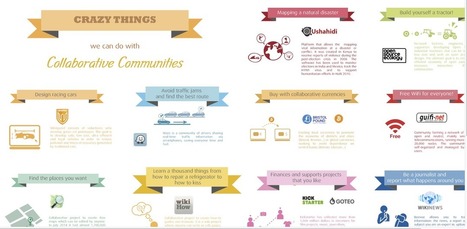
The last in the series of free posters about Commons-Based Peer Production produced by P2Pvalue & designed by Laura Recio shows some of the crazy things we can do with collaborative communities. The poster can be downloaded below (click on image to go to the downloads page on Wikimedia Commons) & used under a CC BY-SA 4.0 license. …
|
|
Scooped by
jean lievens
March 14, 2015 2:33 PM
|
Behind the superficial public discussions about Bitcoin you’ll discover a software breakthrough that could change the future of commoning on open networks
|
|
Scooped by
jean lievens
December 26, 2014 11:03 AM
|
Over the course of The Nature of Order, Alexander manages to show that environments or structures that are built according to that method all end up having the Quality Without A Name. He calls this living structure. It can be measured and compared. It no longer has no name; we can now speak of environments with more or less living structure than others, or of programs with more or less living structure than others – and we strive to make have more of that property.
|
|
Scooped by
jean lievens
May 16, 2014 5:37 PM
|
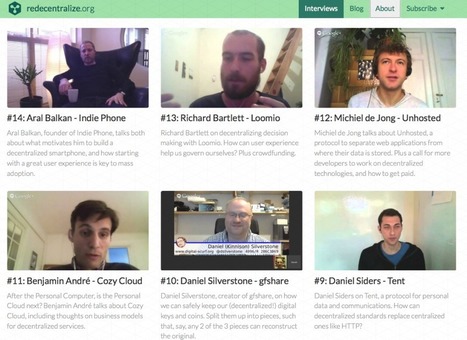
Redecentralize.org is an effort to find and promote projects that will help bring the internet back into its ‘native’ state, which is that of a decentralized, distributed network dominated by its users, not by central servers or grotesquely overgrown data silos.
|
|
Scooped by
jean lievens
March 7, 2014 11:39 AM
|
|
|
Scooped by
jean lievens
February 24, 2014 2:26 PM
|
Excerpted from ars technica, by Lee Hutchinson. A meme-based cryptocurrency that came and went almost unnoticed, seems pretty frivolous. But how much more insubstantial is it than making “regular” money out of thin air? Plus, this particular (and popular) meme lends itself well, graphically, to the “coin” icon.
|
|
Scooped by
jean lievens
October 2, 2013 3:15 PM
|
Packed into a small conference room, this rag-tag band of software developers has an outsized digital pedigree, and they have a mission to match. They hope to jailbreak the internet. They call it the Indie Web movement, an effort to create a web that’s not so dependent on tech giants like Facebook, Twitter, and, yes, Google — a web that belongs not to one individual or one company, but to everyone. “I don’t trust myself,” says Fitzpatrick. “And I don’t trust companies.” The movement grew out of an egalitarian online project launched by Fitzpatrick, before he made the move to Google. And over the past few years, it has roped in about 100 other coders from around the world. On any given day, you’ll find about 30 or 40 of them on an IRC chat channel, and each summer, they come together in the flesh for this two-day mini-conference, known as IndieWebCamp.
|
|
|
Scooped by
jean lievens
February 18, 2016 11:32 AM
|
Once in a while, we are confronted by initiatives which elicit contrary feelings, especially if they come from what you consider as ‘your own side’.
|
|
Scooped by
jean lievens
December 18, 2015 9:53 AM
|
The SocialCapital plugin is a key piece for the promotion of GNU social as an operating system for cities.
|
|
Scooped by
jean lievens
July 29, 2015 2:04 PM
|
This is a paper proposing improvements to onion routing, which anonymises data traffic and communications on the internet. The proposal is to put the routing protocol at network level, providing higher speed transmission and adding encryption features. HORNET: High-speed Onion Routing at the Network Layer In this paper, we address the question of “what minimal …
|
|
Scooped by
jean lievens
June 16, 2015 2:47 PM
|
|
|
Scooped by
jean lievens
April 7, 2015 9:12 AM
|
The last in the series of free posters about Commons-Based Peer Production produced by P2Pvalue & designed by Laura Recio shows some of the crazy things we can do with collaborative communities.
|
|
Scooped by
jean lievens
March 15, 2015 4:42 AM
|
Bitcoin has taken quite a beating for its libertarian design biases, price volatility due to speculation, and the questionable practices of some currency-exchange firms. But whatever the real or perceived flaws of Bitcoin, relatively little attention has been paid to its “engine,” known as “distributed ledger” or “blockchain” technology. Move beyond the superficial public discussions about Bitcoin, and you’ll discover a software breakthrough that could be of enormous importance to the future of commoning on open network platforms.
|
|
Scooped by
jean lievens
January 2, 2015 10:15 AM
|
“Free software does not exist. This is sad for me, since I wrote a whole book about it. But it was also a point I tried to make in my book. Free software—and its doppelganger open source—is constantly becoming. Its existence is not one of stability, permanence, or persistence through time, and this is part of its power. Free software is valued for its peculiar form of potentiality. It is not any particular thing or technology or license: it is a possibility, a concrete utopia perhaps (Broca 2012). Free software promises a sequence of other values: experimentalism and creativity, provisionality and modifiability, rectification and refraction, dissent and critique, participation and obligation. Free software is not just process over product though—it is principle made material.
|
|
Scooped by
jean lievens
October 27, 2014 4:19 PM
|
PirateBox creates offline wireless networks designed for anonymous file sharing, chatting, message boarding, and media streaming. You can think of it as your very own portable offline Internet in a box!
|
|
Scooped by
jean lievens
March 20, 2014 5:22 PM
|
Ownshelf is a virtual bookshelf for discovering and recommending eBooks with friends across devices. It is a file-locker for legitimately storing eBooks, like Goodreads meets DropBox.
|
|
Scooped by
jean lievens
February 25, 2014 1:43 AM
|
Love of money can cause people to do unwise things—like stealing time on your university's resident supercomputer to mine crypto-coins. The Harvard Crimson is carrying the story of someonewho did exactly that: an unnamed individual who was discovered using Harvard's Odyssey supercomputing cluster to generate dogecoins.
|
|
Scooped by
jean lievens
November 15, 2013 2:39 PM
|
Surveillance of the net and of all our communications has become commonplace with the NSA rapidly gaining the dubious distinction of worst offender. But including the communications of everyone and sundry in their dragnet, not even stopping before diplomats and foreign heads of State, the surveillance culture has overdone it. A serious backlash is now in the making.
|
|
Scooped by
jean lievens
August 24, 2013 1:48 AM
|
Since real support for privacy, control and data ownership should be present in everything we do online, last January I also pointed out that alternatives to corporate social networks already exist and only need proper packaging.
|


 Scoop.it!