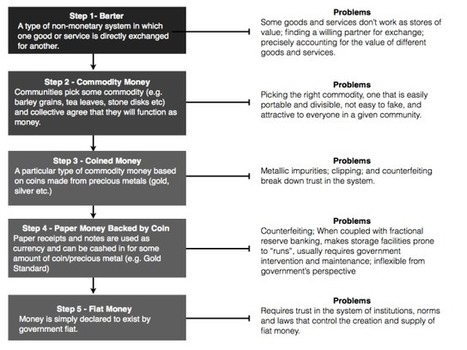
You probably won’t be surprised to know that exchange, trade, reciprocity, tit for tat, and associated notions of “fairness” and “just deserts” have deep roots in humans’ evolutionary origins. We see expressions of these traits in capuchin monkeys and chimps (researchers created a “cash economy” where chimps were trained to exchange inedible tokens for food, then their trading behaviors were studied), in human children as young as two, in domestic dogs, and even in corvids — ravens and crows.
The current monopoly of conventional money is a main source for unsustainable behaviors. New currency designs – among which crypto-currencies, but not only c...
Outlandish proposals granting huge powers to control the money supply to a committee of men would above all ensure things stay just as they are. Positive Money are wrong to call for the abolition of credit creation.
In a challenge to conventional views on modern monetary and fiscal policy, Professor Bill Mitchell of Newcastle University in Australia has emerged as one of...
Tweet Just in case you thought Positive Money’s ideas are a bit cranky, they nowhere near as cranky as some of the ideas that make up the conventional wisdom in economics. Here is a selection of truly crackpot ideas which … Continue reading →
The ostensible reason for the Spanish conquests in the New World was the bringing of Christ to the natives. But the extraordinary rapacity and cruelty shown by many of the Spanish soldiers often ma...
Money has long fascinated me, and not for the obvious reasons. Although I’d like to have more of it, my interest is largely philosophical. It is the ontology of money that has always disturbed me.
When I asked a panel of experts in a The Great Currency Debate Hangout last July whether a peer to peer, values-focused, reputation-based exchange system was possible, they came back with a resounding 'Yes!'
Join us as we dive in a little deeper, asking a panel of leading experts a series if questions that help us explore.
When: 5th March 2015, 9:00PST; 18:00CET Panel: Michel Bauwens of P2PFoundation.net, Leander Bindewald of NewEconomics.org, Art Brock of MetaCurrency.org, Edgar Kampers of Qo
I decided to build a rather large database of academic research on Bitcoin. If you'd like to see it, click on the link. It's a Google Doc, and it allows you to comment if you think there is something I've missed. You can also download it as an Excel spreadsheet. It includes academic, and quasi-academic, research papers, journal articles and theses related to Bitcoin.
"The financial crisis occurred because we failed to constrain the private financial system's creation of private credit and money." Adair Turner, Chairman of the Financial Services Authority
I've given up on fixing the economy. The economy is not broken. It's simply unjust. There's a difference. We have to stop looking at our economy as a broken system, but one that is working absolutely true to its original design. It's time to be pro
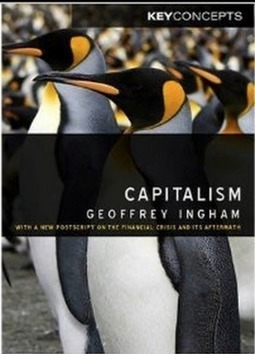
The Power to Create Money out of Thin Air is a review of Geoffrey Ingham’s book, Capitalism (Polity Press, first published 2008). However, like all the best reviews, it has become a hook on which to hang discussion of the author’s contemporary pet themes. Here, these include primarily, capitalism’s ‘elastic production of money’. However, Pettifor also takes the opportunity to explain why misunderstanding about the creation of money is so widespread, and why orthodox economists are mainly responsible for the confusion.
This series of videos captures a lecture Bernard Lietaer provided to Occupy Boulder. This video was recorded during the last currency crisis in Greece and
This article comes to us from returning contributor Nozomi Hayase. It is her second for The Cryptosphere. Six years since the inception of Bitcoin, awareness of this stateless currency has grown ex...
A proposal commissioned by the Prime Minister of Iceland, authored by Frosti Sigurjonsson argues for a new system of money, created at source by the state rather than the banking system. The proposal credits in particular the landmark 2001 report by the New Economics Foundation, A Monetary Reform for the Information Age, by James Robertson and Joseph Huber, for which I happened to write the foreword.
Bernard Lietaer, author, financial expert, and co-designer of the ECU (the monetary mechanism that later became the euro) presented compelling arguments to show that there is a structural flaw in the current monetary system that generates all the current problems and repeated financial and monetary crises, including the eurozone crisis. It is also ecologically unsustainable as it encourages climate change and over-consumption.
If someone told you that a mountain of personal debt could be cleared via 3 simple changes to the way that money and banking works, would you like to know how?
To get content containing either thought or leadership enter:
To get content containing both thought and leadership enter:
To get content containing the expression thought leadership enter:
You can enter several keywords and you can refine them whenever you want. Our suggestion engine uses more signals but entering a few keywords here will rapidly give you great content to curate.



 Your new post is loading...
 Scoop.it!