The digitalisation of work is creating new ways of intermediating work, with for example platforms intermediating work between individuals online. These so-called online collaborative platforms have the potential to fundamentally change the labour market, but for the moment, with an estimated 100,000 active workers or 0.05% of total employees in the EU, they do not seem to have a large impact on the offline/traditional labour market or the create/destroy impetus.
In the context of our foresight project on the “sharing economy” we carried out a second workshop on 25-26 February. Building on the relevant drivers of change identified in the 1st workshop in December 2015, a set of four future scenarios was developed to be further enriched and used as a basis for discussion. About 40 participants from “sharing economy” platforms, academia, international organisations, trade unions, agency work industry, think tanks, and Commission Services shared their views and ideas about future platform-mediated labour markets, a sector of the ‘sharing economy’ with potentially strong implications for the future of work, and the focus of this workshop.
"There are now more self-employed workers than at any time since modern records began. Some 4.6 million people, around 15 per cent of the workforce, are now self-employed and data from the Office for National Statistics show that two thirds of new jobs in the UK created in recent years are down to self-employment.
Paul Mason is the latest big name to join Labour's 'New Economics' public tour while Jeremy Corbyn has revealed that former Greek Finance minister Yanis
Workers of the World: International Journal on Strikes and Social Conflict aims to stimulate global studies on labor and social conflicts in an interdisciplinary, global, long term historical and non-Eurocentric perspective. It intends to move away from traditional forms of methodological nationalism and conjectural studies, adopting an explicitly critical and interdisciplinary perspective. Therefore, it will publish empirical research and theoretical discussions that address strikes and social conflicts in an innovative and rigorous manner. It will also promote dialogue between scholars from different fields and different countries and disseminate analyzes on different sociocultural realities, to give visibility and centrality to this theme.
This presentation begins by summarising changes in employment patterns since the middle of the twentieth century, arguing that the mid 2000s marked the begin...
The Journal of Labor & Society, in it’s 21st year, is issuing a call for the special issue “Workers Beyond Unions, Parties, NGOs, and the State? to rethink how workers organize and struggle. Co-edited by Robert Ovetz, Ph.D., a political science lecturer San Jose State University, and Gifford Hartman, an independent San Francisco, USA based scholar, the issue seeks submissions from scholars, organizers, and activists critically reexamining the multiplicity of forms of class struggle outside of and inside unions, parties, NGOs, and the state happening around the world.
The Bureau of Labor Statistics issued a report yesterday saying that labor productivity showed the worst quarter-to-quarter decline since 1993. Productivity as a whole had been in a downtrend every year since it peaked in 2003, after an extended period of growth. Productivity per worker is one of the most important measures of economic health and a significant long-term forecaster. Its rise signals aggregate growth, and its decline signals trouble.
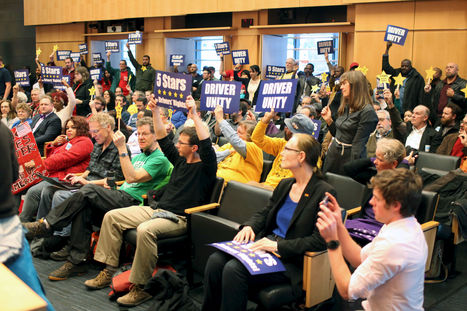
Uber has famously fought off regulators on its way to becoming one of the world's fastest-growing companies. But has it finally met its match in Washington State?
by Kevin Lin Ed. note: The New York Times Business Day section (10 March 2016) included a feature article entitled "Not the Chinese Dream" by Owen Guo, that highlighted the inability or unwillingness of China's 257 million [internal] migrant workers to occupy the thousands of vacant urban apartments that are weighing down the Chinese economy.…
Establishment of a European Platform to enhance cooperation in the prevention and deterrence of undeclared work (debate) - Vilija Blinkevičiūtė - Plenary session of 02 02 2016
There is a contradiction at the heart of digital media. We use commercial platforms to express our identity, to build community and to engage politically. At the same time, our status updates, tweets, videos, photographs and music files are free content…
Through technological advances, businesses today are able to connect customers to services more seamlessly than ever before. However, the workers providing t...
To get content containing either thought or leadership enter:
To get content containing both thought and leadership enter:
To get content containing the expression thought leadership enter:
You can enter several keywords and you can refine them whenever you want. Our suggestion engine uses more signals but entering a few keywords here will rapidly give you great content to curate.


 Your new post is loading...


 Scoop.it!