This is a guest post by David Manheim. If you’re in Silicon Valley, you might have missed the trend, but the percentage of American workers working for big companies has been increasing, even as co…
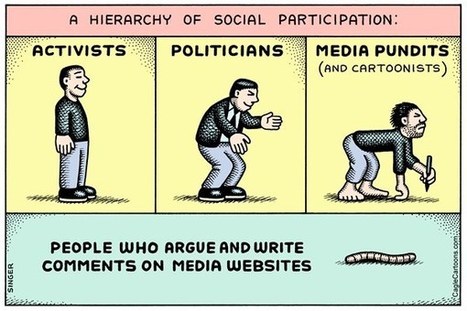
Hierarchy of Social Participation horizontal, Political Cartoons, Comics, Editorial Commentary on the latest news, politics, cartoon memes and events around the world
The cancer of “rankism” persists as a residue of our predatory past. But the urge to dominate others isn’t working any more. Using weapons of mass disruption, the disenfranchised can bring modern life to a stop. Humiliation is more dangerous than plutonium.
This is an extended summary and discussion of David Graeber's book 'The Utopia of Rules'. It also contains some comments on what the book might offer our analysis of the current failures of radical left politics in contemporary Britain.
“Authority” is an interesting word to contemplate. On the one hand it invokes images of dictators and repression. But it also breaks down as author-ity. A..
The problem with undemocratic institutions – be they the government of a country or a business – is that they do the bidding of those in charge at the top, without being accountable to others who have to live with the consequences of their actions.
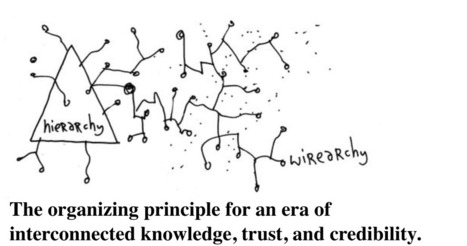
What Is Wirearchy ? Pulse In that context of ubiquitous impact, reams have been written about the erosion of the effectiveness of command-and control as the dominant model for leading and managing purposeful organized activities in business,...
It used to be the man made the company. Great businesses were personified in the figures of their visionary bosses like Jack Welch, Michael Ovitz, Bill Gates, and Steve Jobs, around whom a carefully constructed hierarchy of managers assembled to ensure maximal success. There has always been something aspirational in this, a collective desire to invent a symbolic vessel for greatness none of us suspect we could have on our own. After decades of pursuing charismatic leaders to magically create growth in any industry—from app design to car manufacturing—a number of big corporations have turned toward non-hierarchical, leaderless structures and are actually outperforming many of their more structured competitors.
I was recently asked to review this World Bank publication entitled: “The Role of Crowdsourcing for Better Governance in Fragile States Contexts.” I had been looking for just this type of research on crowdsourcing for a long time and was therefore well pleased to read this publication. This blog posts focuses more on the theoretical foundations of the report, i.e., Part 1. I highly recommend reading the full study given the real-world case studies that are included.
Ben Peters, Assistant Orofessor of Communication at the University of Tulsa, presents preliminary findings of a dissertation chapter examining why the Soviets did not succeed in building an ARPANET equivalent. In particular, he examines Soviet bureaucratic and social structures as decentralized networks, compares them to conventional critiques of centralized power, and speculates on the chapter’s relevance for modern-day practices of power distribution.
Over the past 10+ years, thousands of people have asked me “what is wirearchy?” There’s one common misconception that I’d like to clear up first, which is that wirearchy is mainly about technology. If anything, wirearchy is about the power and effectiveness of people working together through connection and collaboration … taking responsibility individually and collectively rather than Read More →
I realized that most social change movements have a serious skills deficit in the social technologies which businesses use to succeed. So I dedicated myself to learning these and sharing them.
Why do we work? Leading thinkers and Impact Hub founders from around the world shared their thoughts on the future of work at #UnlikelyAllies (Impact Hub ...
“To transform bureaucratic hierarchies into technology driven networks” (Fred Wilson). That is what the actors from the GETDecentralized community want to achieve. Their next meetings are in San Francisco and Paris.
The Podemos ‘convention process’ (consolidating the new party’s structures) which began on September the 15th, ended on Saturday, November the 15th with the election of Pablo Iglesias as General Secretary. He won 88.7% of the votes cast (96.9% valid). His list won the 62 posts for the ‘Citizens’ Council’ and 10 for the Safeguards Commission.
We live in an era in which it is increasingly normal for individuals not only to reject the power of corporations over their lives, but for some to even occupy public space and defy police and established authorities.
Cooperatives are traditionally understood as entities that are owned by their members, whether these are consumers or producers/workers. I don't think incentives are really the problem, since coops already hire more workers than private multinational companies (Page on davegraceassociates.com) and for example, 80% of tech coops still exist after 3 years vs 60% for private startups.
“The impression of healthy competition among a wide variety of counselling and therapy approaches that this picture may give is, in my view, in itself misleading, for in fact they all share one very important assumption. What’s more, despite the appearance of radical contrast, they share it also with psychiatry. This is the assumption that psychological disturbance has its origin within the individual, whether the latter is conceived of as mind or body.
We seem to have reached an impasse. Capitalism as we know it appears to be coming apart. But as financial institutions stagger and crumble, there is no obvious alternative. Organized resistance appears scattered and incoherent; the global justice movement a shadow of its former self. There is good reason to believe that, in a generation or so, capitalism will no longer exist: for the simple reason that it’s impossible to maintain an engine of perpetual growth forever on a finite planet. Faced with the prospect, the knee-jerk reaction — even of “progressives” — is, often, fear, to cling to capitalism because they simply can’t imagine an alternative that wouldn’t be even worse.
To get content containing either thought or leadership enter:
To get content containing both thought and leadership enter:
To get content containing the expression thought leadership enter:
You can enter several keywords and you can refine them whenever you want. Our suggestion engine uses more signals but entering a few keywords here will rapidly give you great content to curate.


 Your new post is loading...