



The book Banking on Words: The Failure of Language in the Age of Derivative Finance, Arjun Appadurai is published by University of Chicago Press.

 Your new post is loading... Your new post is loading...
 Scoop.it!
The book Banking on Words: The Failure of Language in the Age of Derivative Finance, Arjun Appadurai is published by University of Chicago Press. 
No comment yet.
Sign up to comment
Scoop.it!

Bank bail-ins have begun in Europe, and the infrastructure is in place in the US. Poverty also kills.
Scoop.it!
Adair Turner, Chairman of the Board of the Institute for New Economic Thinking, became Chairman of Britain’s Financial Services Authority just as the world financial crisis erupted in 2008, and he played a leading role in designing a new global regulatory structure. In his new book, Between Debt and the Devil: Money, Credit, and Fixing Global Finance, Turner reveals that out-of-control private debt actually caused the crisis, and he explains what to do about it.
Scoop.it!
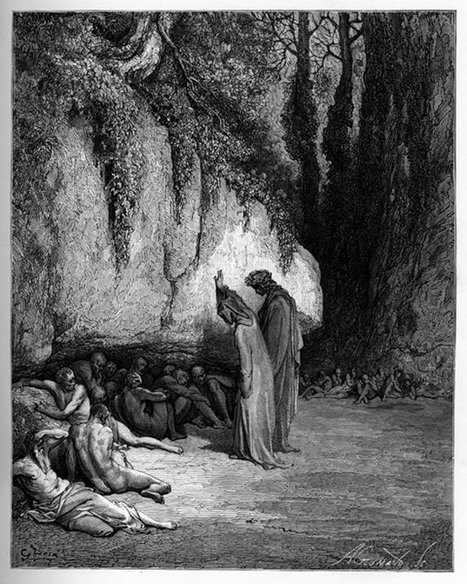
If proposed solutions depend on a cooperative social context at large scale, they will not be part of solution space.
Scoop.it!

The intergenerational theft that is the legacy for our youth is not public debt, it is the mountain of private debt at the heart of our new banana republic
Scoop.it!

by Chris Cook originally published http://www.pieria.co.uk/articles/greece__a_varoufakis_conversion Greece’s new Syriza government has two major economic challenges to address: a Resolution of Greece’s unsustainable debt burden followed by a...
Scoop.it!

As the prospect of global financial crisis beckons once again, will our elected leaders finally accept the need for an entirely new economic approach that breaks away from the primacy of growth and profit – or will their hand be forced by a resurgence of mass public protest?
Scoop.it!
Scoop.it!

Capitalism is defined as a system economic and social organization where the factors of production are privately owned and controlled. Traditionally, factors of production are land, labor, and capital. In a modern technology enabled society, the factors of production are intangible assets such as social, creative, and intellectual capital. Intangible assets are, by definition, privately owned and controlled within each and everyone of us. - See more at: http://panelpicker.sxsw.com/vote/39307#sthash.ytvkNIU4.dpuf
Scoop.it!

Nearly nothing has been done to prevent a second crisis
Scoop.it!
SPERI, the Sheffield Political Economy Research Institute, bring together leading international researchers, policy-makers, journalists and opinion formers to develop new ways of thinking about the economic and political challenges posed for the whole world by the current combination of financial crisis, shifting economic power and environmental threathttp://speri.dept.shef.ac.uk/
Scoop.it!
Economic instability is created by the the monoculture of money, according to Bernard Lietaer, in this lecture. Lietaer calls for a greater diversity of alte.
Scoop.it!

Enough. For All, Forever describes an unusual circumstance in our global drama. It recognizes two rapidly emerging global phenomenons: the increasing access to everything worldwide dubbed the birth of the "Post-Scarcity Society" and the urgency to curb the worldwide clamities of climate change, disease, and poverty caused by the increasing access to everything by employing the methods of Sustainable Development.
|
Scoop.it!

The Oscar-nominated account of 2008’s financial collapse shows us the cunning of the men who profited from the sub-prime crash. So where will today’s mavericks be placing their bets?
Scoop.it!

“The world situation requires the concerted effort of everyone, a thorough examination of every facet of the problem – social, economic, cultural and spiritual. The Church, which has long experience in human affairs and has no desire to be involved in the political activities of any nation, ‘seeks but one goal: to carry forward the work of Christ under the lead of the befriending Spirit. And Christ entered this world to give witness to the truth; to save, not to judge; to serve, not to be served’”(1).
Scoop.it!
A predicted global meltdown passed without event. But there are enough warning signs to suggest we are sleepwalking into another disaster
Scoop.it!
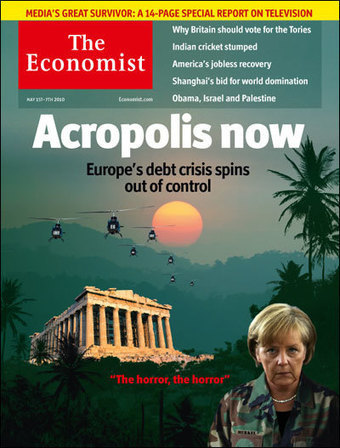
Europe is staring into a deflationary abyss. Unemployment is above 20 percent in many euro zone countries – with youth unemployment more than twice that – and imposed austerity measures are strangling the economies which are hurting most.
Scoop.it!

Spanish economist, author and complementary currency activist Susana Martín Belmonte exposes the false assumption that has led to a fundamentally misguided diagnosis of the current financial crisis; the false assumption being that money needs to exist before it can be lent, when exactly the opposite is true. After years of research into the global monetary system, Martín Belmonte concluded that what is needed is a healthy, alternative monetary and financial system that favours the real economy rather than the speculative economy. In this piece, she lists several proposals to that end, including her own, which she calls “R-economy,” a monetary system based on nominative digital money created free of interest.
Scoop.it!

The number of billionaires has doubled since the start of the financial crisis, according to a major new report from anti-poverty campaigners.
Scoop.it!

Twitter. Facebook. AirBnB. Marc Andreessen, co-founder of the $4.2 billion venture capital firm Andreessen Horowitz, has backed them all -- along with dozens of others. His latest project? Upending finance. Bloomberg Markets magazine interviewed Andreessen at the firm’s headquarters in Menlo Park, California.
Scoop.it!

The existing financial system is broken. Here's how to fix it.
Scoop.it!

My answer to Will there soon be a massive stock market crash? http://t.co/pAspZIFDAD
Scoop.it!
Spanish economist, author and complementary currency activist Susana Martín Belmonte exposes the false assumption that has led to a fundamentally misguided diagnosis of the current financial crisis; the false assumption being that money needs to exist before it can be lent, when exactly the opposite is true. After years of research into the global monetary system, Martín Belmonte concluded that what is needed is a healthy, alternative monetary and financial system that favours the real economy rather than the speculative economy. In this piece, she lists several proposals to that end, including her own, which she calls “R-economy,” a monetary system based on nominative digital money created free of interest.
Scoop.it!
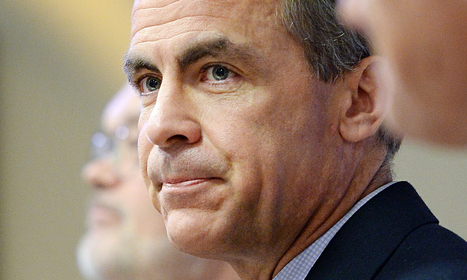
Capitalism is at risk of destroying itself unless bankers realise they have an obligation to create a fairer society, the Bank of England governor has warned.

Eli Levine's curator insight,
May 31, 2014 1:00 PM
He's right.
But will they listen?
I doubt that his American colleagues are going to be thrilled about having to do something for other people.
Petty, petulant, childish, the American banker is not interested in fulfilling his social and economic role culturally, from what we've seen.
And, thus, Capitalism collapses, either through social or environmental collapse.
Warnings unheeded.
Think about it.
Scoop.it!

Mobile technology is blurring the boundaries of traditional industry and pushing established markets into new competitive arenas. We see this happening all around us. Consider how fast Apple has become one of largest music retailers in the world. Technology’s ability to shape industry boundaries and its disruptive nature has become one of the top structural issues all businesses are confronted with today.
|




