https://www.youtube.com/watch?v=vmrGqzl96L8 I recommend this lecture by the famous Yochai Benkler (Harvard). This is spot on since it shows that P2P Cooperatives must have a SHARED CORE ( a Commons) from the start that is not centrally power-controlled (state) or commercialy exploited by selfish greed (market focus). It should be stressed that this does not mean…
Guest speaker - Michael Seid Ph.D., Professor of Pediatrics, University of Cincinnati School of Medicine, Director, Health Outcomes and Quality of Care ...
“Commons Based Peer Production (CBPP) means collaborative production and sharing of resources among peers under commons settings. From the initial cases, such as Wikipedia and FLOSS, recently there has been an expansion to other areas of activity, such as citizen science, product design, management of common spaces and open data sources.
Originally Posted on – http://commonsfest.info/en/2015/anichta-diktia-axias/ Open Value Networks and Commons-based Peer Production With the advent of the computer and the internet, we are able to communicate and coordinate with an increasing number...
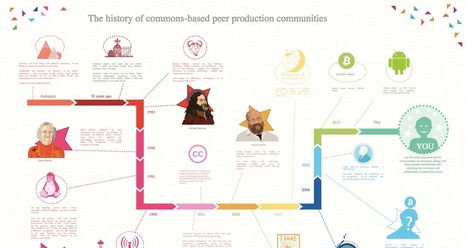
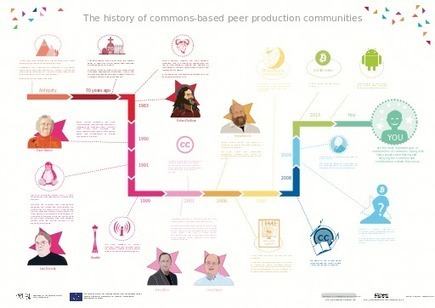
Our posters about Commons-Based Peer Production, designed by Laura Recio, are available for download below (click on each of the images to go to the downloads page on Wikimedia Commons) & used under a CC BY-SA 4.0 license . They are in English, with other languages to be added soon. Enjoy ;-)
"Commons-based peer production is a term coined by Harvard Law School professor Yochai Benkler to describe a new model of economic production in which the creative energy of large numbers of people is coordinated (usually with the aid of the internet) into large, meaningful projects, mostly without traditional hierarchical organization or financial compensation. He compares commons-based peer production to firm production (where a centralized decision process decides what has to be done and by whom) and market-based production (when tagging different prices to different jobs serves as an attractor to anyone interested in doing the job).
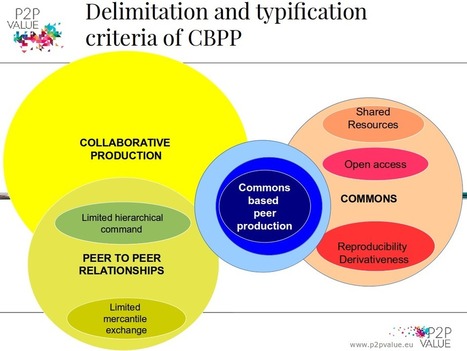
Common-based peer production (CBPP) is an emerging and innovative model of collaborative production, frequently taking place or supported through a digital platform. It aggregates a set of diverse areas of activity and cases that tend to be characterized by peer to peer relationships, and/or results in the (generally) open access provision of common resources that favour access, reproducibility and derivativeness. Well known cases are Free and Open Software projects, Wikipedia, or more recent cases such as Wikispeed, Open Source Ecology or open data commons. The presentation will first provide an overview of the phenomenon based on empirical insights regarding what characterize CBPP and how it has expanded and evolved over time. One of the characteristics of CBPP is its limited mercantile character. This point to the limitations of traditional theories of value (based on prizing) to explain value in CBPP. In this regard, the presentation will present a framework to approach value creation in CBPP, as well as empirical evidence on which factors (particularly regarding governance modality) might explain cases capacity to generate value. The research is developed in the frame of the European project P2Pvalue. The methodology is based on an statistical analysis of a sample of 300 cases. Project website: www.p2pvalue.eu
As one of the countries hardest hit by austerity politics, Greece is also in the vanguard of experimentation to find ways beyond the crisis. Now there is a documentary film about the growth of commons-based peer production in Greece, directed by...
Commons-based production generally, and commons-based peer production in particular, are the most important and surprising organizational innovation to have emerged in networked economy and society. Surprising, because throughout the 20th century our intellectual frame for understanding production was dominated by a binary vision: state and market. By the end of the last century, we had shifted from a view of state- and managerial-hierarchy-based production as dominant to a view of market- or decentralized price-based organization as the dominant model.
Commons-based peer production (CBPP) is an emerging and innovative model of collaborative production. It usually takes place through a digital platform (Benkler 2006). It is characterized by peer to peer relationships, in contrast to the traditionally hierarchical command and contractual relationships, and with limited mercantile exchange. It results in the (generally) open access provision of commons resources (P2Pvalue, 2014).
It has been for some time now that research is engaging around a fauna of new forms of production that have been progressively appearing in the sectors more intensively impacted by the Internet and the digital revolution and more dependent on knowledge, creativity and innovation. Neologisms and innovative proposals of framing proliferate.
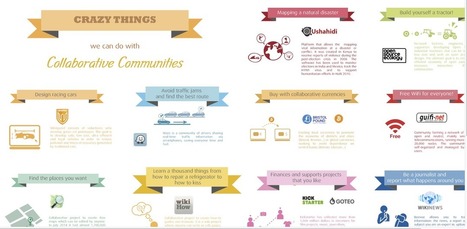
The last in the series of free posters about Commons-Based Peer Production produced by P2Pvalue & designed by Laura Recio shows some of the crazy things we can do with collaborative communities.
This article is a follow-up to The Obsolescence of Capitalism: And the Transition to a Resource Based Economy, which examined the effects of ongoing social and technological trends on the capitalist economic system, and the potential for humanity to restructure society and move from a system of scarcity to one of global abundance. While the previous article presented a long-term vision for transitioning towards an alternative Resource Based Economy of abundance, this article will examine the more immediate conditions affecting society and how, over the coming years and decades, the capitalist market will increasingly be eclipsed, circumvented and overshadowed by an emerging Collaborative Commons.
In a previous article we attempted to provide a bird’s-eye view of the political agendas of four Greek parties in relation to the digital/knowledge Commons.
Members of the P2Pvalue project recently presented papers at the Internet, Politics, and Policy (IPP) conference at the Oxford Internet Institute, University of Oxford on 25-26 September 2014.
As one of the countries hardest hit by austerity politics, Greece is also in the vanguard of experimentation to find ways beyond the crisis. Now there is a documentary film about the growth of commons-based peer production in Greece, directed by Ilias Marmaras. "Knowledge as a common good: communities of production and sharing in Greece” is a low-budget, high-insight survey of innovative projects such as FabLab Athens, Greek hackerspaces, Frown, an organization that hosts all sorts of maker workshops and presentations, and other projects.
The aim of this research consists of extracting a set of in-sights related to the dynamics, group decision making proce-dures, motivations to contribute and mechanisms employedin the coordination of Commons-Based Peer Production com-munities, using as a case study the community responsiblefor the development of the Free/Libre Open Source Soft-ware Drupal. A sociological perspective is taken for thispurpose, and a set of social research qualitative and quanti-tative methods employed for the study of online communities(virtual ethnography) are being used.
To get content containing either thought or leadership enter:
To get content containing both thought and leadership enter:
To get content containing the expression thought leadership enter:
You can enter several keywords and you can refine them whenever you want. Our suggestion engine uses more signals but entering a few keywords here will rapidly give you great content to curate.


 Your new post is loading...