Over the past century, technological advancements have massively reduced the cost and time needed to create and circulate content. Though this has liberated artists, consumers are now drowning in a virtually infinite supply of things to watch, listen to and read. The answer to a world where attention is the key constraint, not capital or distribution, isn’t Big Media – it’s the Influencer Curator.
Monnik describes a city in which productivity growth is replaced by resource distribution, and where social status is measured by 'I Am' instead of 'I Have'.
Can all human beings have access to clean water? Can we make food abundant for all human beings? Can every individual get an education? Faiza explores the wo...
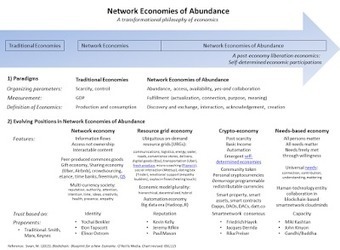
The possibility of creating true network economies of abundance and designing personalized economic systems raises a host of issues about what kinds of behavior might result from programmed economic parameters.
We need to shift the conversation about technology to one that takes into account labor markets, consumer patterns, and growth. Achieving sustainability requires new patterns of time use, which in turn alters the macroeconomic path of the economy. A trajectory of reductions in working hours both slows the untenable expansion of the economy and facilitates a transition from activities that destroy planetary and personal well-being to those that enhance it. I reject the mainstream assumption of a trade-off between protecting the environment and generating well-being for people. By contrast, I argue for a new way of living that is rich in those elements that will yield true well-being: time affluence, higher levels of self-providing, and social capital.
Sahlan Momo’s invitation to guest edit the June 2015 issue of the Spanda Journal is an honour. I chose the topic of systemic change to explore further, from a systemic perspective, with a variety of talented thinkers and doers, the theory and practice of collective intelligence and transformative action towards generating abundance of commons, which I had written about in the two previous issues.
While there is no “politics of abundance,” no theory of the State, there does exist the possibility of living in accordance with an ethic of abundance, an ethic that contributes to emancipation from scarcity and uncertainty.
A society of abundance is a society in which productivity is not separate from research, conversation and knowledge, as if they were different worlds, and knowledge itself is not divided into professional and mercantile knowledge. It is a society where community is directly productive, without divisions.
Technology advances are making amazing things possible: we finally have a chance to solve the problems that have long plagued humanity such as hunger, disease, energy, and education.
The challenges we face are now those of abundance. Indeed, when it comes to workers dedicated to our diets, we can add some of the 4% of the labor force who, working as nurses, pharmacists, and educators, help us solve problems resulting from having consumed too many calories or the wrong kinds of nutrients.
A series on true accelerationist technologies that will be instrumental against biospheric destruction. “Although we might prize scarce items highly, civilizations are built on abundance.
* The Book of Abundance. Reflections on abundance, economics, and community by the las Indias collective. Translated by Level Translation. Grassroots Economic Organizing, 2015. This excerpt was chosen by translator Steve Herrick: “Abundance exists when it becomes unnecessary to work out what is produced and what not, and above all, how much access to a …
The path towards abundance is no longer a proposal or a utopian dream. It is a real path, an economic and social movement taking place in parallel to the decomposition of the old ways, and which offers us a new promise to overcome scarcity, war and collapse.
Few ideas have been as powerful and subversive as abundance. For thousands of years, we humans have projected our desires onto it, we’ve been inspired by it to transform our forms of organizing, and we’ve raised it as the banner of a better future. Free food, the end of labor forced by need, and the end of conflicts and violence due to scarcity have been the image of the world that humans deserve to inhabit for hundreds of generations.
What if we lived in a world where everyone had enough, where every one mattered, where people lived in harmony with nature? In this interview with KPFA host Kris Welch, author Martin Adams says it’s
To gain ground against scarcity, build abundance and therefore continuously enlarge the material base of personal decision-space is the objective of the economic activity of an egalitarian community that works.
There have been and will continue to be multiple big technology revolutions, but the most impactful on human society may be the one that finally builds systems with judgment and decision-making capability more sophisticated and nuanced than trained human judgment. Machine learning, sometimes called big data or artificial intelligence, is making rapid progress in complex decision-making (for instance: driving a car was thought to be too difficult for computers even five years ago). Without speculating on what is probable, it is at least possible that such systems may even be better at creativity, emotion and empathy than human beings (for instance: writing the best music, love story or creative fiction). At the very least these systems may be able to handle much more data to which we now have access and use it to make better judgments than humans with their supposed instinct, gut, holistic and integrative decision capability. Although any one software program may not do everything a human brain can do, specialized programs will likely make decisions and predictions in their domain better than most trained humans. Many, if not most, domains will be well covered by such programs. Many problems in our work environments aren’t ones the human brain evolved to solve for in the African savannah. To achieve these goals, a machine learning system does not need to exactly replicate the brain or even use brain like techniques.
To get content containing either thought or leadership enter:
To get content containing both thought and leadership enter:
To get content containing the expression thought leadership enter:
You can enter several keywords and you can refine them whenever you want. Our suggestion engine uses more signals but entering a few keywords here will rapidly give you great content to curate.


 Your new post is loading...
 Scoop.it!