Your new post is loading...

|
Scooped by
jean lievens
February 13, 2016 9:33 AM
|
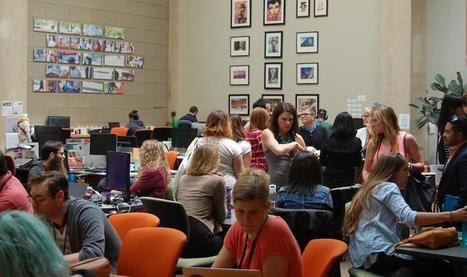
We're excited to announce three open positions at Shareable! We're looking for an operations manager, a campaign organizer, and a development manager to join our small but mighty (and fun) team.
|
|
Scooped by
jean lievens
August 9, 2015 6:35 PM
|
Transition Streets is a toolkit for neighborhood transformation—a catalyst for action, dialogue, and community building. A project of Transition US, Transition Streets is as simple as neighbors coming together for seven meetings to explore carbon-saving and resilience-building actions in the areas of food, water, waste, energy, transportation, all the while building relationships with each other and a stronger sense of community.
|
|
Scooped by
jean lievens
August 5, 2015 4:20 PM
|
On November 6-7 in Bologna, Italy, leading scholars, researchers, policymakers, practitioners and social innovators will gather to further the discussion and movement around the urban commons.
|
|
Scooped by
jean lievens
June 17, 2015 9:12 AM
|
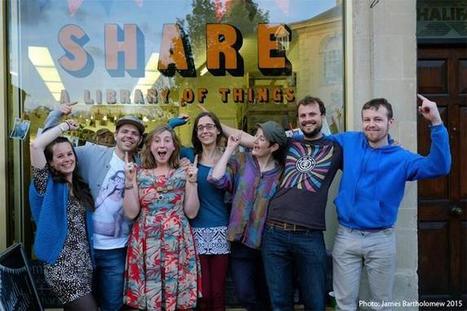
Imagine going to a shop, borrowing anything you like, and returning it when you're finished. This is the idea behind SHARE: a Library of Things. Opened in late-April in Frome, a town in northeast England, the aim of SHARE is to enable people to spend less, waste less, and connect more. The first of its kind in the U.K., SHARE has already sparked interest from other communities.
|
|
Scooped by
jean lievens
June 9, 2015 2:56 PM
|
Have you started a summer reading list? For those of us interested in the sharing economy, there is no shortage of great reads. Whether your interests lie in collaboration, sustainable cities, community-building, simplicity, or work in the new economy, there is something for everyone. We’ve rounded up the top 21 books for summer to inspire, empower, and inform.
|
|
Scooped by
jean lievens
May 19, 2015 11:42 AM
|
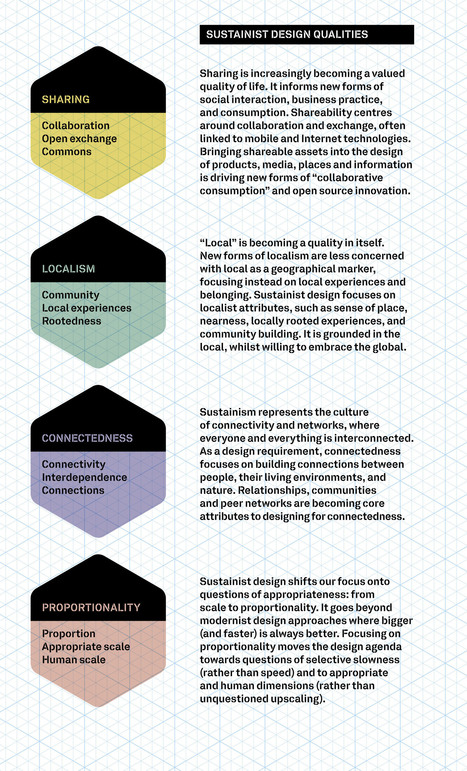
Images and excerpt from the Sustainist Design Guide: How Sharing, Localism, Connectedness, and Proportionality are Creating a New Agenda for Social Design, by Michiel Schwarz and Diana Krabbendam with The Beach Network. Design: Robin Uleman.
|
|
Scooped by
jean lievens
April 24, 2015 4:57 PM
|
How much thought do you give to pavement? Our cities are covered with it, but it’s not exactly a hot topic of conversation—though it should be. Pavement causes all sorts of problems including the fact that water can’t soak through it and instead runs across it, collecting pollutants and biological contaminants that make their way into waterways, plants, animals, and ourselves.
|
|
Scooped by
jean lievens
February 18, 2015 4:24 PM
|
Photo credit: DonkeyHotey / Foter / CC BY. Article cross-posted from On the Commons. Written by Peter Barnes.
|
|
Scooped by
jean lievens
February 18, 2015 4:20 PM
|
In a just published study, researchers investigated the motivations driving users to peer-to-peer services like timebanks. (10,000 People Blog)
|
|
Scooped by
jean lievens
February 4, 2015 5:54 PM
|
What makes a lot of people uncomfortable about a phenomenon like Uber, when you get right down to it, is how it is owned. As in other mega-Internet companies, a small number of owners poised to take over a global industry—in this case, the taxi industry with ownership currently spread out among local drivers and operators. In response to Uber’s rise, there has been a flurry of proposals for driver-owned alternatives.
|
|
Scooped by
jean lievens
January 19, 2015 4:04 PM
|
Neil Thapar first encountered seed issues in law school when he worked with the Center for Food Safety against genetically-modified food. But it was a season spent working on an organic farm in Santa Cruz, California when he began to understand, first-hand, the importance of seeds as a foundation of our agricultural system. He explains, “When I came off the farm I said, ‘If I’m going to be a lawyer, I’m going to be a lawyer doing things that I think are making a positive difference.’”
|
|
Scooped by
jean lievens
January 11, 2015 7:19 AM
|
While the struggle between taxi companies and ridesharing startups like Uber grab all the headlines, a pioneering group of cabbies are combining the best of traditional taxi service and new ridesharing systems, but with an important twist. These cabbies are creating cabby-owned taxi cooperatives, sometimes with the help of unions, and offering smartphone taxi hailing on top of a traditional service. This new setup gives drivers more job security, better pay, ownership of and a say in their company as well as the ability to offer more convenient smartphone hailing taxi service to customers. This is part of a surge of experimentation in democratizing ownership in enterprises, including, appropriately, in the sharing economy.
|
|
Scooped by
jean lievens
December 17, 2014 12:58 PM
|
With the rise of the sharing economy, people are sharing cars, houses, sports equipment, clothing, toys, meals, surfboards and much more. There's an intuition among sharers that sharing is not only good for the pocketbook, it’s good for the planet. The thinking goes that sharing helps us reduce consumption and keep usable goods out of landfills.
|
|
|
Scooped by
jean lievens
August 26, 2015 12:46 PM
|
Ten years ago this month, coworking was born in San Francisco when Brad Neuberg set up some card tables and invited people to work alongside him. There are now over 3,000 coworking spaces worldwide.
|
|
Scooped by
jean lievens
August 9, 2015 6:34 PM
|
Cooperatives represent a growing segment of the economy with an estimated 30,000 enterprises and 100 million members in the U.S. alone. A great way to bring democracy into the workplace, coops can be built from scratch, but they can also be created by converting existing businesses into worker-owned cooperatives. For retiring business owners as well as entrepreneurs, selling a business to employees is a way to strengthen the business while getting a return on investment.
|
|
Scooped by
jean lievens
August 5, 2015 4:19 PM
|
Article and image cross-posted from the SUMC blog. Photo credit: Mariordo.
|
|
Scooped by
jean lievens
June 9, 2015 2:56 PM
|
If you care about the future of public media and don't follow the work of Melody Joy Kramer, you might consider checking her out here and here.
|
|
Scooped by
jean lievens
June 9, 2015 2:53 PM
|
Tucked away in the basement of Denver’s Smiley Library Branch is the Northwest Denver Toy Library. Founded in 1980, the toy library has been serving the community entirely through donations and volunteers. Last week, I sat down with Margie Herlth, who leads the operation and has been volunteering since 1996, to learn how the toy library works.
|
|
Scooped by
jean lievens
May 19, 2015 11:39 AM
|
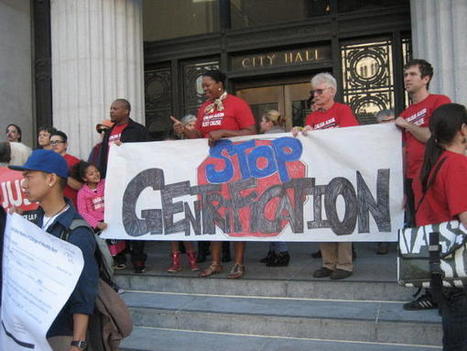
Recently, Causa Justa::Just Cause (CJJC) released a report titled Development Without Displacement: Resisting Gentrification in the Bay Area. The 112-page document, prepared in collaboration with the Alameda County Public Health Department, goes beyond describing the public health implications of gentrification to proposing steps that cities like Oakland can take to stop displacement of historic residents.
|
|
Scooped by
jean lievens
March 21, 2015 4:03 AM
|
What role do complementary currencies play in alleviating poverty, creating income equality, and building sustainable communities? According to John Boik PhD, a vital one. Founder of the Principled Societies Projectand author of the book Economic Direct Democracy: A Framework to End Poverty and Maximize Well-Being, Boik designed a multi-faceted framework for local democratic systems of which a complementary currency is a key element. A computer simulation model that describes the book’s proposed local-national currency system saw median and mean take-home family income more than double, income inequality nearly eliminated, and the unemployment rate drop to 1 percent over the 28-year simulation period.
|
|
Scooped by
jean lievens
February 18, 2015 4:22 PM
|
Rainbow over Brattleboro, Vermont. Photo credit: Professor Bop / Foter / CC BY-NC-ND. Article cross-posted from Yes! Magazine. Written by Alexis Goldstein.
|
|
Scooped by
jean lievens
February 5, 2015 2:35 PM
|
What began as a childcare coop in Seoul, South Korea has grown into a cooperative, urban village and sparked a national movement of urban villages.
|
|
Scooped by
jean lievens
January 21, 2015 1:44 PM
|
Article cross-posted from Bollier.org. It is always refreshing to read Peter Linebaugh’s writings on the commons because he brings such rich historical perspectives to bear, revealing the commons as both strangely alien and utterly familiar. With the added kick that the commoning he describes actually happened, Linebaugh’s journeys into the commons leave readers outraged at enclosures of long ago and inspired to protect today's endangered commons.
|
|
Scooped by
jean lievens
January 17, 2015 1:39 PM
|
Neil Thapar first encountered seed issues in law school when he worked with the Center for Food Safety against genetically-modified food. But it was a season spent working on an organic farm in Santa Cruz, California when he began to understand, first-hand, the importance of seeds as a foundation of our agricultural system. He explains, “When I came off the farm I said, ‘If I’m going to be a lawyer, I’m going to be a lawyer doing things that I think are making a positive difference.’”
|
|
Scooped by
jean lievens
January 5, 2015 3:05 PM
|
In The Tragedy of the Private | The Potential of the Public, a new booklet co-published by Public Services International and the Transnational Institute, Hilary Wainwright argues that now is the time to turn back the tide of public services privatization. As local authorities around the world begin to reincorporate public services outsourced during the Reagan and Thatcher years, anti-privatization activists have an opportunity not just to accelerate the trend toward public recapture, but also to democratize public services providers from within. Written primarily for union activists, the booklet asks how public services unions can accomplish these goals in the face of opposition from powerful local, national, and international actors. The answer—drawn from real-world examples of anti-privatization campaigns in South Africa, Brazil, Greece, and elsewhere—is at once straightforward and profound: Public services unions are most likely to be successful in fighting privatization when they form meaningful, lasting alliances with the communities in which they operate.
|





 Scoop.it!