


The entire editorial board of a US academic journal has resigned in protest over restrictions that would require scholars to wait up to 18 months before making their published research more widely available…...

 Your new post is loading...
 Scoop.it! The entire editorial board of a US academic journal has resigned in protest over restrictions that would require scholars to wait up to 18 months before making their published research more widely available…... 
No comment yet.
Sign up to comment
Scoop.it!
Presentation slides for the OER and MOOC workshop facilitated at Universiti Utara Malaysia (UUM) on the 25th March, 2013.
Scoop.it!

Recorded October 9, 2012 on three different but successful faculty development faculty development models for encouraging the use of open textbooks and open educational resources (OER) to improve instructional outcomes at community colleges. Models focused on finding, creating, and sharing OER for courses that are currently being taught. Presenters include a dean of online at a large community college district, a director of distance learning at a community college, and the OER Project Director at a community college.
Scoop.it!
This webinar will feature three projects where librarians are leading the way in searching, curating, and creating OER to expand student access and improve teaching practices. Paradise Valley Community College, AZ –Sheila Afnan-Manns and
Scoop.it!
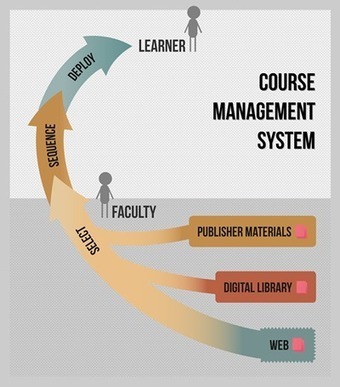
Why do the vast majority of higher education venues still depend on expensive paper texts, while most of the world's knowledge is available for free online? Why do educators not embrace the plethora of open digital educational libraries and repositories? I suspect four major hurdles to adoption. FROM ---> EDUCAUSE Review Online
Scoop.it!

Elsevier may have hushed the blogosphere when it dropped its support for the Research Works Act but Stephen Curry doesn’t see the issue of open access fading into the background. He explains why he hesitated to write for an Elsevier journal and warns researchers of the need to be wary of fragmentation of literature into institutional repositories.
Scoop.it!

Open access publishing is growing increasinly important so the Peer Project has built an observatory to investigate potential effects of a major switch to open access models. Julia Wallace finds that the scholarly web is a complex environment where author self-deposit rates are likely to be low and usage scenarios for green open access are more complex than generally acknowledged.
Scoop.it!
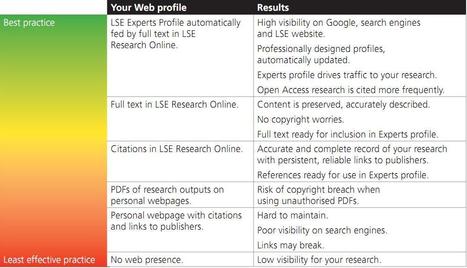
Dave Puplett demonstrates how University libraries using repository systems and the principles of Open Access can improve the discoverability, visibility, authority and thus impact of academic rese...
Scoop.it!

See how these people respond:
Curtis Bonk Iain Doherty Catherine Cronin Dimitrios Vlachopoulos John Cowan Celia Popovic Kostas Ntinas
Scoop.it!

Academics are — slowly — adopting the view that publicly funded research should be made freely available. But data released yesterday suggest that, given the choice, even researchers who publish in open-access journals want to place restrictions on how their papers can be re-used — for example, sold by others for commercial profit.
Advocates of open publishing fret that misunderstandings lead scientists to choose restrictive licenses. Via Martin Weller
Scoop.it!

PLOS has always been an organisation that we admire here at figshare, which is why we are delighted to announce today our new partnership to aid the visualisation of different types of data across the PLOS journals. figshare will host the supplemental data for all seven PLOS journals, as well as provide a widget that will enable PLOS users to view data in the articles in the browser alongside the content.
Scoop.it!

Leading historians have accused ministers of an "attack on academic freedoms" over plans to make research freely available to the public.
Scoop.it!

Ten years after its creation, governments are turning to the Creative Commons license to reform their education programs.
|
Scoop.it!

This is a list of countries where OER initiatives are known - and links to the main initiatives. It was originally prepared by Nick Jeans in mid March 2011. Work is now in progress to cross-correlate it with Sara's reports, OPAL, EDRENE, WikiEducator etc.
Scoop.it!

Welcome to the open course on open education. This open course runs over seven weeks and is focused around the subject of openness in education. It brings together students who are studying the Open University Masters-level course H817 Openness and innovation in elearning (of which this is one of four blocks) and open, informal learners.
Scoop.it!

Domitilla Enders's curator insight,
March 10, 2013 5:24 PM
"Online status drives OER usage – The primary determinant of whether the chief academic officer is aware of OER usage or not is based on whether the institution offers online courses or programs. “At schools with no online offerings, only 28 percent of chief academic officers were ‘Aware’ or ‘Very aware’ of OER compared to 59 percent of institutions with online courses and full programs.”
Scoop.it!

New taxpayer-funded research must be made available to the public free of charge within a year of its publication, the Obama administration has said.
Scoop.it!
Open access is not enough; we must learn how to communicate our research to make it truly accessible
The movement to make academic literature freely available, dubbed the Academic Spring, is gaining momentum, having recently obtained the support of both the Department of Education and Harvard University. Advocates have built a solid case, citing the burden of subscription costs borne by universities, as well as the limitations on sharing information that characterises the existing system. As proponents have rightly argued, freeing academic literature will increase readership, by some estimates up to 250%.
Scoop.it!
Hybrid gold open access and the Chesire cat’s grin: How to repair the new open access policy of RCUK
Unintended consequences of RCUK policy mean that if academics want open access publishing, publishers are happy to sell it to them, writes Stevan Harnad. He argues that researchers should not have to choose gold publishing when green open access is available.
Scoop.it!

While protecting human subjects’ confidentiality is a long-standing practice in the social sciences, new types of digital datasets present new challenges. Tensions between privacy and openness were explored in the recent International Digital Curation Conference. Limor Peer reflects on the session she chaired on participant confidentiality in a time of open research data. While community efforts on establishing best practice are well underway, questions still remain on who is responsible for data protection and whether practitioners and policy-makers could be more involved in this ‘data life cycle’.
Scoop.it!

This book presents the main outcomes of the OERtest project in six chapters. It provides the reader with the foundation for the development of envisaged framework, organised into the four topics: assessment methods; requirements and standards of resources; credentialisation, certification and recognition and inter-institutional collaboration. The third chapter is devoted to different scenarios of open learning in order to obtain in-depth understanding of the OER challenges and bring closer a basis for identifying vital differences among them to better address these challenges. This project has been funded with support from the European Commission. This website reflects the views only of the authors, and the Commission cannot be held responsible for any use which may be made of the information contained therein. Project number: 510718-LLP-1-2010-1-ES-ERASMUS-EVC This work is licensed under a Creative Commons Attribution-ShareAlike 3.0 Unported License
Scoop.it!

Activists pushing for free, open access to academic papers will eventually defeat publishers who seek to lock scholarly findings behind paywalls, the founder of the world wide web said today.Sir Tim…
Scoop.it!

A good summary/overview of CC licenses and use for photos. Via C.Rathsack, Ann Vega, NikolaosKourakos, Lynnette Van Dyke

Sarah johnstone's curator insight,
May 19, 2015 4:57 AM
Great infographic - clear and helpful rules for CC Licences for photo sharing on the net. �� Check it out! |






