Notebook or My Personal Learning Network
21.0K views | +2 today
Notebook or My Personal Learning Network
a personal notebook since summer 2013, a virtual scrapbook
Your new post is loading...
Rescooped by Gilbert C FAURE from Information and digital literacy in education via the digital path
May 4, 2019 4:26 AM
Scoop.it!

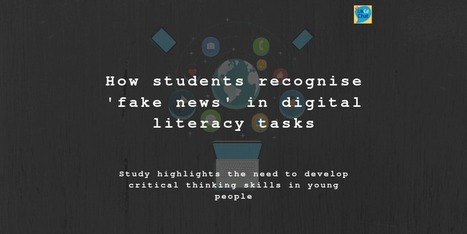
How students recognise ‘fake news’ in digital literacy tasks –

How students recognise ‘fake news’ in digital literacy tasks – | Notebook or My Personal Learning Network | Scoop.it
A recent study revealed students at an international school in Finland significantly outperformed U.S. students on tasks which measure digital literacy in social media and online news. The researchers suggest this may be due to the Finnish and International Baccalaureate curricula’s different way of facilitating students’ critical thinking skills compared to the US system and curriculum. The results of this study were published in the Journal of Research in International Education in April.

Via Elizabeth E Charles
No comment yet.
Scooped by Gilbert C FAURE
April 24, 2019 1:41 PM
Scoop.it!

Health literacy

Health literacy | Notebook or My Personal Learning Network | Scoop.it
With Public Health England, NHS England and Community Health and Learning Foundation, we have invested in an innovative project to develop, test and implement a range of strategic and practical interventions towards improving health literacy.
No comment yet.
Rescooped by Gilbert C FAURE from Information and digital literacy in education via the digital path
March 16, 2019 2:47 PM
Scoop.it!

Global Perspectives on Information Literacy

Global Perspectives on Information Literacy | Notebook or My Personal Learning Network | Scoop.it

Information literacy is a concept without geographic boundaries in librarianship. Across the world, academic librarians work toward developing students’ abilities to effectively find, evaluate, use, and create information. The approach to teaching these lifelong, cumulative skills can be designed in myriad ways throughout our global environment. This work seeks to share individual international perspectives that, through a unique voice, provide clarity toward how information literacy is viewed, taught, conceptualized, and, in general, approached internationally. The individual voices of our authors provide perspective on the unique challenges and opportunities presented in each region.


Via Elizabeth E Charles
Gilbert C FAURE's insight:

jesus lau inside

No comment yet.
Rescooped by Gilbert C FAURE from Information and digital literacy in education via the digital path
February 22, 2019 5:20 AM
Scoop.it!

2019 Key Issues in Teaching and Learning | Information Literacy Weblog

2019 Key Issues in Teaching and Learning | Information Literacy Weblog | Notebook or My Personal Learning Network | Scoop.it

EDUCAUSE have published the results of their annual survey (1,400 members of the Higher Education community - I assume North American members of EDUCAUSE) on key issues in teaching and learning. The issues are: 
1. Faculty Development and Engagement; 2. Online and Blended Learning; 3. Instructional and Learning Experience Design; 4. Digital and Information Literacy (hurrah! this was no. 5 last year); 5. Accessibility and Universal Design for Learning (UDL); 6. Competency and New Methods of Learning Assessment; 7. Learning Analytics; 8. Open Education;


Via Elizabeth E Charles
No comment yet.
Rescooped by Gilbert C FAURE from Information and digital literacy in education via the digital path
February 7, 2019 2:03 PM
Scoop.it!

How to Move from Passive to Active Learning Through Open Education Resources | EdTech Magazine

How to Move from Passive to Active Learning Through Open Education Resources | EdTech Magazine | Notebook or My Personal Learning Network | Scoop.it

Freely available, open education resources provide opportunities for college students to strengthen their critical thinking and quantitative literacy skills using sophisticated active-learning strategies.

In a 2017 Wakefield market research survey, investigators found 85 percent of college students elected not to buy one or more required hard copy course textbooks. Students also are turning more frequently to their mobile devices to complete their coursework. 

Their reasons included the high price of textbooks and the fact that they did not value textbooks as learning tools. Instead, students are enticed by online course content, which can be accessed anywhere on campuses equipped with modern network infrastructures.


Via Elizabeth E Charles
No comment yet.
Scooped by Gilbert C FAURE
January 26, 2019 2:47 AM
Scoop.it!

Information Literacy Weblog: Librarians Around the World

Information Literacy Weblog: Librarians Around the World | Notebook or My Personal Learning Network | Scoop.it
An e-book has been published, a result of the New Professionals Section of the Library Association of Latvia's project Librarian
No comment yet.
Scooped by Gilbert C FAURE
January 10, 2019 12:39 PM
Scoop.it!

Information literacy instruction for pharmacy students: a pharmacy librarian reflects on a year of teaching

Information literacy instruction for pharmacy students: a pharmacy librarian reflects on a year of teaching | Notebook or My Personal Learning Network | Scoop.it
Librarians have ever-expanding teaching responsibilities in many academic disciplines. Assessment of learning outcomes requires longitudinal evaluation to measure true retention of skills and knowledge. This is especially important in the health sciences
No comment yet.
Rescooped by Gilbert C FAURE from Information and digital literacy in education via the digital path
December 2, 2018 2:08 PM
Scoop.it!

How Students Can Use Information Fluency for Online Research Strategies

How Students Can Use Information Fluency for Online Research Strategies | Notebook or My Personal Learning Network | Scoop.it

The Internet is a swelling ocean of information, and navigating through its steady flow can often be challenging. This is certainly true for a student who is not information fluent, so what are some smart online research strategies? Luckily this question falls within the realm of Information Fluency, which involves the 5As process:

  • Asking the right questions
  • Acquiring the knowledge
  • Analyzing the content for relevancy and credibility
  • Applying the knowledge to our use
  • Assessing the effectiveness of our message

Via Elizabeth E Charles
Bianny Fernández's curator insight, December 2, 2018 9:49 AM
Internet es una herramienta que los docentes deben usar en las estrategias con sus alumnos, ya que pueden acceder a una gran diversidad de información   
Scooped by Gilbert C FAURE
October 13, 2018 1:16 PM
Scoop.it!

Metrics Literacy –

Metrics Literacy Developing online material to educate researchers and research administrators about bibliometrics, usage metric, altmetrics, and technometrics. Phase One Stefanie Haustein, Tristan…
Gilbert C FAURE's insight:

slides here

https://zenodo.org/record/1461010#.W8IolS3pNBw

No comment yet.
Scooped by Gilbert C FAURE
September 24, 2018 1:00 PM
Scoop.it!

Global Media and Information Literacy Week 2018

Global Media and Information Literacy Week 2018 | Notebook or My Personal Learning Network | Scoop.it
No comment yet.
Scooped by Gilbert C FAURE
September 19, 2018 2:11 PM
Scoop.it!

The role of MEDIA LITERACY in the promotion of COMMON VALUES and SOCIAL INCLUSION | EPALE

The role of MEDIA LITERACY in the promotion of COMMON VALUES and SOCIAL INCLUSION | EPALE | Notebook or My Personal Learning Network | Scoop.it
The role of MEDIA LITERACY in the promotion of COMMON VALUES and SOCIAL INCLUSION
No comment yet.
Rescooped by Gilbert C FAURE from Information and digital literacy in education via the digital path
August 9, 2018 8:53 AM
Scoop.it!

10 Ways Digital Age Teachers Model Digital Literacy and Leadership

10 Ways Digital Age Teachers Model Digital Literacy and Leadership | Notebook or My Personal Learning Network | Scoop.it

"In this technology-immersed world, students need to know how to navigate the digital environment safely. From discerning real news from propaganda to managing their reputation online, so much of their future is dependent on possessing digital literacy skills. Teachers have to step up to the plate and integrate digital literacy into the curriculum and model it through their actions. In this article, we will discuss 10 ways that digital age teachers model digital literacy and leadership."


Via EDTECH@UTRGV, Elizabeth E Charles
No comment yet.
Rescooped by Gilbert C FAURE from Information and digital literacy in education via the digital path
June 16, 2018 2:33 AM
Scoop.it!

Advancing Information Literacy in a Semester-Long Library Instruction Course: A Case Study /

Advancing Information Literacy in a Semester-Long Library Instruction Course: A Case Study / | Notebook or My Personal Learning Network | Scoop.it
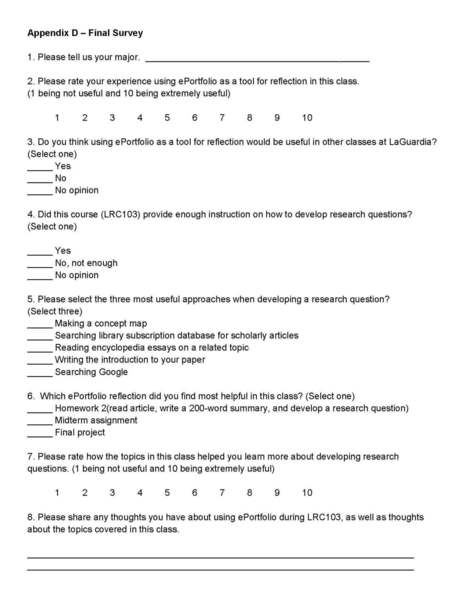
The following case study investigated the efficacy of Information Literacy (IL) pedagogy on undergraduate research in a credit-bearing library instruction class. More specifically, the study analyzed student success and sought to determine whether written reflection and practice strengthen IL skills, including the fundamental ability to develop a research question and thesis statement. Developing research questions and formulating thesis statements are among the most challenging duties of a young researcher. From high school through undergraduate, students often have minimal experience conducting research. They may not know where to begin the research process and what steps are necessary. Student frustration is exacerbated by the fact that typically IL instruction is one-shot guidance, given only once in a semester, making it difficult for a librarian to cover all that is needed. Can a semester long, credit-bearing course aid student success in research and improve IL skills? The instructors introduced several techniques to improve IL skills, and instructors evaluated three class assignments based on their college’s core competencies. Additionally, instructors collected and analyzed students’ written reflections of their progress and an end of semester survey as both qualitative and quantitative data.

Via Elizabeth E Charles
custard_cottage's curator insight, June 23, 2018 3:30 AM
Excellent article on feedback from an information literacy course. Can be adapted for schools.
Scooped by Gilbert C FAURE
April 29, 2019 3:57 AM
Scoop.it!

Teaching intelligence: digital literacy in the ‘alternative facts’ era

Teaching intelligence: digital literacy in the ‘alternative facts’ era | Notebook or My Personal Learning Network | Scoop.it
Today’s students have access to vast amounts of information, so how can academics teach them to critically assess what they read online?
Gilbert C FAURE's insight:

make them curate contents

No comment yet.
Scooped by Gilbert C FAURE
April 20, 2019 4:55 AM
Scoop.it!

World’s first global standard for digital literacy, skills and readiness launched by the Coalition for Digital Intelligence | DQ Institute

World’s first global standard for digital literacy, skills and readiness launched by the Coalition for Digital Intelligence | DQ Institute | Notebook or My Personal Learning Network | Scoop.it
No comment yet.
Rescooped by Gilbert C FAURE from Information and digital literacy in education via the digital path
March 3, 2019 1:47 PM
Scoop.it!

Self-learning of Information Literacy Competencies in Higher Education: The Perspective of Social Sciences Students | Pinto | College & Research Libraries

Self-learning of Information Literacy Competencies in Higher Education: The Perspective of Social Sciences Students | Pinto | College & Research Libraries | Notebook or My Personal Learning Network | Scoop.it
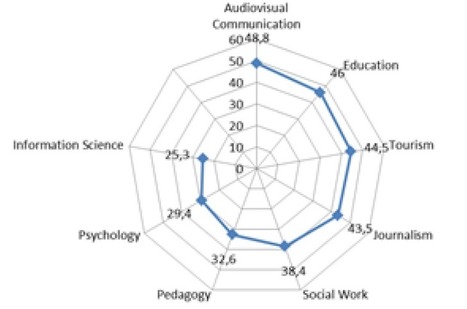
Preference for autonomous versus directed learning for the acquisition of information competencies (ICs) was analyzed among undergraduate social science students according to gender, degree program, belief in importance, and self-efficacy. Data were gathered using the IL-HUMASS (Information Literacy Humanities Social Sciences) online survey from students at five public Spanish universities enrolled in audiovisual communication, education, information science, pedagogy, journalism, psychology, social work, and tourism undergraduate programs during the 2013–2014 academic year. Mann-Whitney U, Kruskal-Wallis, and chi-square tests, as well as discriminant analysis, were performed. The results revealed a higher preference for the directed learning style in the four IL competency categories: searching, evaluation, processing, and communication-dissemination. Audiovisual communication, education, and journalism students showed a predilection for autonomous learning, whereas information science and psychology students preferred directed learning. Higher scores in belief in importance correlated with a greater preference for autonomous learning. In contrast, higher levels of self-efficacy were associated with a greater preference for directed learning.

Via Elizabeth E Charles
No comment yet.
Scooped by Gilbert C FAURE
February 11, 2019 1:33 PM
Scoop.it!

Facets of Inquiry-based Learning: the role of Information Literacy, collaboration and reflection in the support and development of inquiry-based pedagogies in Higher Education - White Rose eTheses ...

Facets of Inquiry-based Learning: the role of Information Literacy, collaboration and reflection in the support and development of inquiry-based pedagogies in Higher Education - White Rose eTheses ... | Notebook or My Personal Learning Network | Scoop.it
No comment yet.
Scooped by Gilbert C FAURE
January 29, 2019 2:30 AM
Scoop.it!

Online Search Literacy- Some Helpful Resources for Teachers and Students

Online Search Literacy- Some Helpful Resources for Teachers and Students | Notebook or My Personal Learning Network | Scoop.it
Free resource of educational web tools, 21st century skills, tips and tutorials on how teachers and students integrate technology into education
No comment yet.
Rescooped by Gilbert C FAURE from Digital Literacy in the Library
January 18, 2019 11:45 AM
Scoop.it!

Introduction to Crash Course Navigating Digital Information #1

We love the internet! It's a wealth of information where we can learn about just about anything, but it's also kind of a pit of information that can be false or misleading. So, we're partnering with Mediawise and the Stanford History Education Group to make this series on Navigating Digital Information. Let's learn the facts about facts!


Via Mary Reilley Clark
Mary Reilley Clark's curator insight, January 18, 2019 10:17 AM

This is going to be a helpful series for our upcoming media literacy unit!

Scooped by Gilbert C FAURE
December 5, 2018 1:16 PM
Scoop.it!

Skim reading is the new normal. The effect on society is profound | Maryanne Wolf | Opinion | The Guardian

Skim reading is the new normal. The effect on society is profound | Maryanne Wolf | Opinion | The Guardian | Notebook or My Personal Learning Network | Scoop.it
When the reading brain skims texts, we don’t have time to grasp complexity, to understand another’s feelings or to perceive beauty. We need a new literacy for the digital age writes Maryanne Wolf, author of Reader, Come Home
No comment yet.
Scooped by Gilbert C FAURE
October 25, 2018 1:56 PM
Scoop.it!

Media literacy in adult learning | EPALE

Media literacy in adult learning | EPALE | Notebook or My Personal Learning Network | Scoop.it
Media literacy in adult learning
No comment yet.
Scooped by Gilbert C FAURE
October 2, 2018 8:44 AM
Scoop.it!

ECIL 2018 Oulu Finland

Pechakucha at OULU, ECIL 2018 meeting
Gilbert C FAURE's insight:

http://ecil2018.ilconf.org/

Aim & Scope
Information Literacy in Everyday Life being the main theme, ECIL aims to bring together researchers,
information professionals, media specialists, educators, policy makers, employers and all other related
parties from around the world to exchange knowledge and experience and discuss current issues, recent
developments, challenges, theories, and good practices.

No comment yet.
Scooped by Gilbert C FAURE
September 21, 2018 2:39 AM
Scoop.it!

Information Literacy Weblog: Exploring people’s conceptions and experience of information literacy #REDMIL2018

This is my keynote presentation from the REDMIL doctoral summer school that I participated in last week at the Université catholique d
No comment yet.
Scooped by Gilbert C FAURE
September 6, 2018 2:37 PM
Scoop.it!

Media Literacy – Literacy for the 21st Century | EPALE

Media Literacy – Literacy for the 21st Century | EPALE | Notebook or My Personal Learning Network | Scoop.it
Media Literacy – Literacy for the 21st Century
No comment yet.
Scooped by Gilbert C FAURE
August 9, 2018 6:15 AM
Scoop.it!

Help us share the new CILIP Definition of Information Literacy! – Information Literacy Website

Help us share the new CILIP Definition of Information Literacy! – Information Literacy Website | Notebook or My Personal Learning Network | Scoop.it
No comment yet.