If you’ve spent any time on the Internet in the last year, you’ve probably heard the term “curation.” A curator is traditionally defined as an individual who selects items for inclusion in museum exhibits, determines how and where the items are to be displayed, and provides text and other aids to explain or give context... Read more »
When it comes to creating content, marketers and publishers face a number of challenges. For example, the Content Marketing Institute’s annual survey of B2C content marketers had some trouble with…
The Ultimate List of Content Curation Tools and accompanying map, is comprised of both business grade tools that support organizations’ content marketing strategies, as well as personal curation tools that can be used by individuals for hobbyist or...
Online content curation is a hot trend as business owners and professionals realize that content is vital to add value to their customers and prospects. The trend was already evident in 2011 but 2012 saw an outright explosion of the phenomenon.
Téléchargez gratuitement ! J'ai eu le plaisir de collaborer à cet ouvrage collectif concernant la curation de contenus. J'y développe l'angle psychologique des enjeux de l'infobésité. Je vous invit...
When it comes to writing content, there is no doubt that you want your content to be interesting and memorable. Hopefully, you are publishing a combination of original and curated content. That gives your readers interesting articles to read and a wider, more unique perspective. However, your curated content will not be valuable to your business if you don’t add your personal spin.
I always used to save items of interest that I happened upon online as favourites. However despite creating folders, in using this system I found retrieving something became harder and harder and I was not always able to find what I was looking for. Add the fact that I tend to use commuting time to and from work to access information via my phone, I was initially sending items by email, to then have to add them as favourites once I got back to my desk top.
Are you constantly looking for content to share with your class? There are a lot of sources of information out there: databases, blogs, wikis, videos, images, etc.
Original content is vital in marketing. But producing original content is a significant investment, and doing so day after day can mean sacrificing other important aspects of your business.
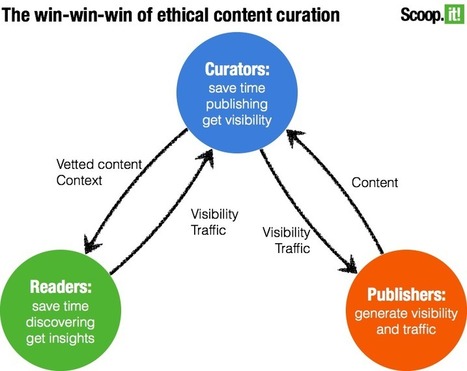
Ever since we started to work on Scoop.it, we’ve had this question: is it fair to use other people’s content for your own good: in other words, how ethical is content curation? Is it even legal? A quick look at history clearly shows that artists and scientists never created in a vacuum but have always leveraged pre-existing work to develop their own. And that’s for the greater good. Closer to us, there is a multitude of online media sites which embraced content curation as an alternative or a complement to the content they produce: the Huffington Post is a famous example but Upworthy and BuzzFeed are others and even the respected New York times started doing it. Of course, such an answer won’t satisfy your legal department or your own need to have a more pragmatic answer. So as we’ve now been arounds for several years and, more importantly, have seen millions of users publish more than 100 million pieces of content, we feel we can not only give you a recap of the facts that make content curation ethical but also back that out with data. Continue reading →
To get content containing either thought or leadership enter:
To get content containing both thought and leadership enter:
To get content containing the expression thought leadership enter:
You can enter several keywords and you can refine them whenever you want. Our suggestion engine uses more signals but entering a few keywords here will rapidly give you great content to curate.


 Your new post is loading...