Nonprofit Capacity Building and Training
5.6K views |
+0 today
Training Techniques to Make Nonprofits More Effective
Curated by
Beth Kanter
 Your new post is loading...
 Scoop.it!
Beth Kanter's insight:
I facilitated peer groups for NYFA from 1999-2003 and was trained by Carter McNamara. This was face-to-face and over past five years experimenting with bringing the technique online. I have found a good mix of technology platforms to support this, but most importantly is that people understand the nuances of peer learning. So, far for the Knight Foundation Peer Exchange I'm working on now has worked fantastically. The pure model works best, although have had success with blending some content delivery and this approach. Methodology for peer coaching based on Carter McNamara "How To Coach Others"

Scoop.it!

Who's the better quarterback, Drew Brees or Peyton Manning? Perhaps a more compelling question for you, the developing leader, is this: How did these guys — and all the great performers you m...
Beth Kanter's insight:
Two types of Coaching: Coaching can be either directive or nondirective. Directive coaching involves listening to your client and then offering advice from your own experiences or knowledge base. Nondirective coaching requires listening to your client’s problems, but instead of then offering advice, asking questions that encourage your client to reach solutions independently. Asking good questions helps your client achieve greater self-understanding. Both forms of coaching can be effective; the preferred type depends on what your client needs
Scoop.it!

This new eBook is just what educators need to create a personalized plan for implementing flipped instruction at the pace of their choosing. The Flipped
Scoop.it!

In the war against waning attention spans, teachers have enlisted the unlikeliest of allies: their students’ once-distracting tablets and smartphones.
Beth Kanter's insight:
Justin Reich is a fellow at Harvard’s Berkman Center for Internet and Society, and the founder of EdTechTeacher, a professional development consultancy that trains teachers to use tech effectively. The goal of flipping a classroom, he says, is not to bend education to the digital proclivities of kids, but to maximize student-teacher interaction during the most demanding lessons. “It’s about how we use our time more than how we use our technology,” Reich says.
Educators like Reich, who advocate for tech in the classroom, say that the first step in rethinking how we teach should be a renewed examination of how kids learn. Before we fall down the techno–rabbit hole and demand tablets in every classroom, we need to seriously reconsider, for example, whether teaching content, as opposed to cognitive skills, can adequately prepare our children for 21st-century professions. In other words, our nation’s educational mindset—one that traditionally uses fact-regurgitation as a marker of success—desperately requires a reboot.
Scoop.it!

TOUCH this image to discover its story. Image tagging powered by ThingLink
Scoop.it!

The term “most connected” typically heralds those on Twitter who share just as much as they read. They have hundreds, even thousands of followers. They comment often and are heard by many Via Stephanie Sandifer
Beth Kanter's insight:
This article made me wonder if there are different social online learning styles. I know for myself, I learn best when engaging with conversation with others - esp when I can use my network to reach to someone who may know more than me. I don't always learn best by reading and watching from the sidelines, I have to experience it. This post argues that some educators learn by lurking on social channels like Twitter: "The term “most connected” typically heralds those on Twitter who share just as much as they read. They have hundreds, even thousands of followers. They comment often and are heard by many. But when we think of “connected” educators, we often forget those out there listening, watching, and observing the flurry of tweets. The reality is that not every teacher interacts in a dual or multi-conversational way. There exist a group of educators who silently watch, read and soak in the experiences of others through shared postings, blogs and recorded chats. We call these educators, lurkers. While ‘lurkers’ are not necessarily sharing ideas, they are still very much connected. They are out there listening, learning and growing, going undetected by most Twitter feeds."

Jose Cabanas's curator insight,
October 3, 2013 5:13 AM
Lurkers are out of co-operative knowledge building, and consequently will be unable to develop "2.0" skills
Scoop.it!

Recently Brent Schlenker returned to blogging after a year back in the corporate training world, and he talked about some of his experiences. At the end of his post he made an interesting – if not ...
Beth Kanter's insight:
Interesting thoughts about the willingness to learn and the ability to learn by one's self.
Scoop.it!

Salman Khan's educational website of 2,400 video lessons could be the solution to middle-of-the-class mediocrity.
Beth Kanter's insight:
Teachers have long known that one-on-one tutoring is effective, but in 1984, the education scholar Benjamin Bloom figured out precisely how effective it is. He conducted a metastudy of research on students who’d been pulled out of class and given individual instruction. What Bloom found is that students given one-on-one attention reliably perform two standard deviations better than their peers who stay in a regular classroom. How much of an improvement is that? Enough that a student in the middle of the pack will vault into the 98th percentile. Bloom’s findings caused a stir in education, but ultimately they didn’t significantly change the basic structure of the classroom. One-on-one instruction, after all, is insanely expensive. What country can afford one teacher per student?
Scoop.it!
This interdisciplinary research network is dedicated to understanding the opportunities and risks for learning afforded by today's changing media ecology, as well as building new learning environments that support effective learning and...
Scoop.it!
Recently Brent Schlenker returned to blogging after a year back in the corporate training world, and he talked about some of his experiences. At the end of his post he made an interesting – if not ...
|
Scoop.it!

Once hyped up as the next big thing, the social media job market has recently undergone a considerable slowdown, according to newly released stats from career site Indeed.com. Growth in positions
Beth Kanter's insight:
Why training skills are really important.
Scoop.it!

How do you begin to identify your Social Media & PR Strategy? You need to first identify your client's business goal within a relative time frame. Ask them, what are are your business goals wit...
Beth Kanter's insight:
college course and exercise on developing strategy
Scoop.it!
Okay, let's say you and a few colleagues or friends have formed an informal peer coaching network dedicated to helping each other improve performance. What's next? As I described in my last post, y...
Beth Kanter's insight:
Having observed colleagues in nonprofit field do "coaching" - most of their technique is directed. I'm mostly interested in non-directed approach and love these questions. All can be adapted to communications strategy as well. What’s the problem? As a coach, basic questions to ask to increase awareness are: -As you think about your goals, what’s not working well in your life? Why bother? -Looking ahead, what will happen if you don’t change? What’s your decision? -What have you decided to do differently and why? What steps exactly? -What exactly will you do, and when will you do it? Are you really in? -What if this is harder than you think? How will you sustain it? -What impact has your new behavior had on you and others?
Scoop.it!
Beth Kanter's insight:
Good teachers know how to be reflective and perhaps that why I typically find that experienced trainers in the nonprofit sector really understand the technique of peer coaching. There is an excellent example of peer coaching questions - although no difference between directed and non-directed.
Scoop.it!
So I think with the recent San Jose State news people may finally start to pay attention to the use of MOOCs and MOOC-like things to support blended learning, a match-up we've been supporting here ...
Beth Kanter's insight:
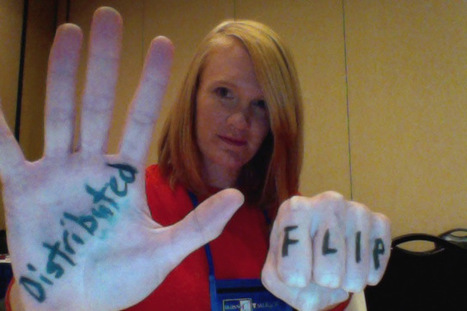
A distributed flip goes further. In a distributed flip content curation is distributed. Sequencing is distributed. Community may be distributed. There are in fact (at least) two separate streams of the course, each coherent in itself, with (at least) two separate curators, sequencers, creators, assessors working independently of one another. The person offering the face-to-face course has to sync up, at least partially, with the other stream or streams. But control over almost every aspect of the course can be distributed through multiple providers using a somewhat looser coupling than traditional digital materials.
Scoop.it!
Post by bryannalexander. Academic question: who's more likely to flip their classes, tenure-track or adjunct faculty?
Beth Kanter's insight:
Discussion about the flipped classroom
Scoop.it!

The future belongs to the curious. The ones who are not afraid to try it, explore it, poke at it, question it and turn it inside out.
Beth Kanter's insight:
A platform that facilitates courses where instructors share materials but the learning takes place from student to student.
Scoop.it!

The introduction of learning technology and the changing workplace recently increased the importance of adult learning. However, there comes the problem of motivating adult learners.
Beth Kanter's insight:
This is for unwilling and directed learners
Scoop.it!

Cut development time and improve design with professional elearning templates.
Beth Kanter's insight:
Don't build your next eLearning course from scratch. Our professionally designed templates look great and save you time. All of our templates are built in the native programs you build your courses in, so there's no nasty XML or Flash code to modify to make them work. Click on any of the tools below to see the designs available, or scroll down below to see sample screen shots of each product.
Scoop.it!
Thursday, Sept 26, 5-6:30pm PT Conversation with John Seely Brown and Amin Saberi, moderated by Anya Kamenetz Scientist, artist and strategist, for two decad...
|