Borough council could be just days away from moving ahead with a new ordinance setting up a “Human Relations Commission” for Lansdale.
“We’ve had a lot of discussion about this. We’ve had a separate meeting on it, that I thought went extremely well,” said Councilman Leon Angelichio.
“We have taken a lot of questions, we’ve eased a lot of concerns, and we are at a point where it can move forward,” he said.
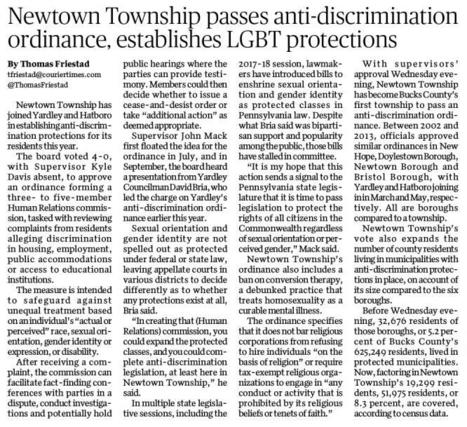
Borough council has discussed for two months whether the town should pass a new ordinance setting up a volunteer commission assigned to hear and attempt to mediate any complaints from residents, visitors or business customers who experience discrimination in the borough. The proposed “human relations ordinance” would add gender identity and LGBTQ status to the list of “protected classes” able to appeal any instance of alleged discrimination to the commission for mediation, groups that are not currently protected by state or federal law.
Council discussed that proposed code at length in May and June, and heard additional feedback from the public in a special meeting on June 26. During council’s July 3 committee meetings, Angelichio and borough staff fielded several additional questions that built on those earlier discussions.
Who would serve on the board?
“Any resident or business owner that volunteers to serve on that board, and I would love to find that we have an overabundance of qualified volunteers,” Angelichio said.
“It is open to anyone. It would seem kind of foolish that it wouldn’t be inclusive of the groups that we’re trying to put an ordinance forward to protect,” he said.
Council President Denton Burnell said if and when council votes to establish the commission, members would submit letters of interest and resumes to council’s appointments committee, which would evaluate those candidates as they do for any other post.
“They will receive all of those applications, they will vet, probably do some initial interviews, and make recommendations, but ultimately all of council will have to approve the five people that are selected,” Burnell said.
Would the code apply to local schools? Mayor Garry Herbert said he has had early talks with a North Penn school board member about whether the code would apply, and said he was told that in Philadelphia, the school board and that city’s human relations commission work together to address any complaints.
“The issue may be brought to the (commission), but they come together and say ‘How can we work together to solve it?’” Herbert said.
Herbert added, in a post on his blog, that the proposed ordinance and commission would likely not change hearts and minds, nor would it impact any residents’ freedom of speech or religion.
“Nothing in the ordinance keeps people from attending and participating in the religious doctrines of their choosing. In fact, the legislation is designed to have all religions treated exactly the same,” he said.
“In the creation of this ordinance Lansdale is declaring that it is a community that is dedicated to, and values, its diversity and that we will continue to march toward a better tomorrow for all the residents of our borough,” Herbert said.


 Your new post is loading...


















Meanwhile, Supreme Court’s conservative majority prepared to rule against conversion therapy.
This CNN article reports on a significant Supreme Court case, Chiles v. Salazar, where the conservative majority signaled it is likely to rule against Colorado’s ban on conversion therapy for minors.
The core conflict hinges on whether state regulations of "talk therapy" for licensed professionals violate the First Amendment rights of the counselor challenging the law. Much of the debate centered on whether this therapy should be treated as regulated medical conduct or as protected speech, with conservative justices emphasizing that professional speech should still maintain constitutional protections.
The potential outcome could have sweeping implications for similar bans across nearly half of US states, raising questions about the role of judicial review versus medical consensus in regulating therapeutic practices.
Related Content:
In addition to the article cited above, the following documents were used as sources for this "Deep Dive" podcast: