Your new post is loading...

|
Scooped by
Patrick H.
November 1, 2014 2:55 AM
|
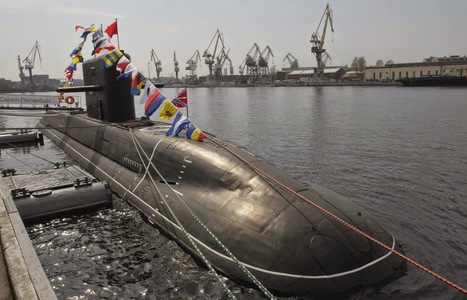
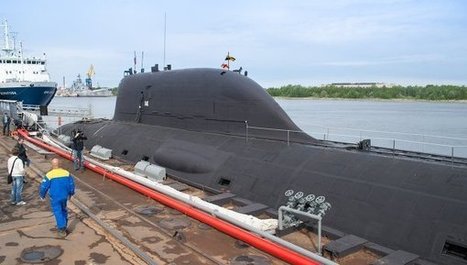
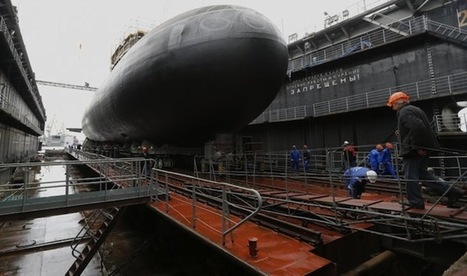
The second Project 677 diesel-electric submarine for the Russian Navy, "Kronshtadt", will be launched in late 2015. Admiralty Shipyards general director Aleksandr Buzakov informed TASS about this at Euronaval-2014. Previously it was reported that work on the submarine "Kronshtadt" should be completed in 2017.
"There is still a year before the launch of 'Kronshtadt'," said Buzakov. "Everything will depend on equipment delivery timelines, and not timelines for conducting factory work. When the equipment shows up, we can talk about more precise timelines for a launch," he added.
The general director reported that one quarter of the hull work on "Kronshtadt" has been completed.
Construction of a third submarine
Admiralty Shipyards has begun construction of a third Project 677 diesel-electric submarine for the Russian Navy, although a contract has not yet been signed. The submarine has been named "Sevastopol", Buzakov explained. "A final contract has not been signed, but the cost and a number of other contract parameters have been agreed to. That is to say, at the present time, several formalities are proceeding to completion. Therefore, part of the work on the submarine is already underway," Buzakov explained, noting that a small percentage of hull work has already been completed as part of the submarine's construction.
The general director noted that the first three Project 677 diesel-electric submarines will not be equipped with air-independent propulsion (AIP). "This will be a series of three submarines that will not be equipped with AIP. The lead unit, "Sankt-Peterburg", is undergoing trial operations. On the other two submarines, everything will be verified in terms of quality and other parameters, which must be raised to the level of the design," Buzakov said.
AIP allows non-nuclear submarines to operate under the water for long periods without having to surface.
Project 677 (Lada) diesel-electric submarines were developed to combat surface ships and were designed for antisubmarine warfare, destruction of enemy naval bases, facilities and sea lines of communication, as well as for intelligence and patrol missions.
|
|
Scooped by
Patrick H.
October 31, 2014 4:41 PM
|
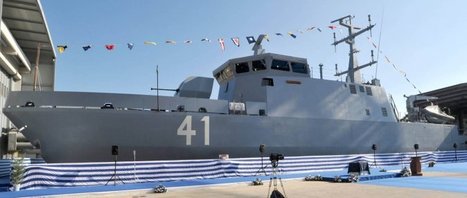
Algeria has signed a contract for a new mine countermeasures vessel (MCMV), with an option for a second, as it continues a major fleet modernisation effort. As part of its undertaking the country has introduced a new landing platform dock (LPD) vessel from Italy's Fincantieri, and ordered two frigates from Germany's ThyssenKrupp Marine Systems and corvettes from China. The corvettes are to be outfitted with Western combat systems locally. Italy's Intermarine was reported to be in negotiations with Algeria regarding the MCMV in the second half of 2013, with senior officials of holding company Immsi indicating that a contract was close to being finalised.
|
|
Scooped by
Patrick H.
October 31, 2014 4:05 PM
|
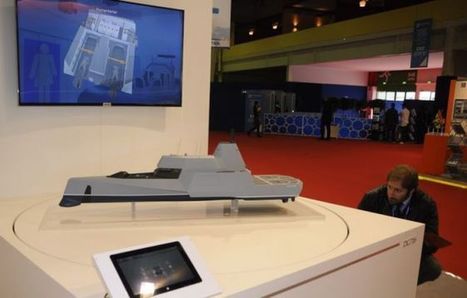
DCNS présente lors du salon Euronaval un "concept ship" baptisé "Xwind 4000". Celui-ci comprend une série d’innovations que l’on pourrait retrouver bientôt sur des navires de surface comme la future frégate de taille intermédiaire. Tel qu’il est présenté, ce "concept ship" ressemble quelque peu au LCS américain de la classe Independence avec sa forme de trimaran. "Mais il ne faut pas s’attacher à cette forme extérieure, indique Hervé Boy, responsable ligne de produit frégates chez DCNS. L'essentiel, ce sont les grandes innovations au nombre de huit qu'intègre ce concept ship."
L’innovation la plus visible est le "topside intégré". C’est-à-dire des superstructures qui intègrent l’ensemble des émetteurs et senseurs du navire, dont des radars à panneaux fixes. Cette conception conjugue furtivité, efficacité et accessibilité de ces équipements. Cette frégate modulaire comprend une zone située à l’arrière du navire permettant une adaptation aux missions à accomplir. "Les équipements sont embarqués par les côtés en roll on-roll off, ce qui permet de passer rapidement d'une configuration à une autre", indique Hervé Boy. La propulsion hybride repose sur deux "boxes" associant moteur électrique, diesel de propulsion et réducteur. L'appoint d'un hydrojet en plus des deux hélices permet d'atteindre la vitesse de 30 noeuds. Le moteur électrique est réversible, ce qui permet d’optimiser le fonctionnement des machines tournantes.Le navire peut naviguer une heure sur batterie, ce qui peut être utile pour éviter la menace d'un champ de mines ou pour traverser une zone sensible sur le plan environnemental. Autres innovations: un "Cloud" informatique avec deux datas centers pour le stockage des données, un central opérations permettant une forte interaction entre les opérateurs, une passerelle de combat offrant une vision sur 360° jour et nuit grâce à la réalité virtuelle... Le "Xwind 4000" n'est pas destiné à naviguer. Mais il donne une idée des solutions techniques sur lesquellles travaille DCNS en matière de navires de surface. Bon nombre d'entre elles pourraient être reprises dans le programme de frégate de taille intermédiaire. Celui-ci pourrait être lancé dès 2016 pour répondre aux besoins de la Marine nationale.
|
|
Scooped by
Patrick H.
October 31, 2014 9:08 AM
|
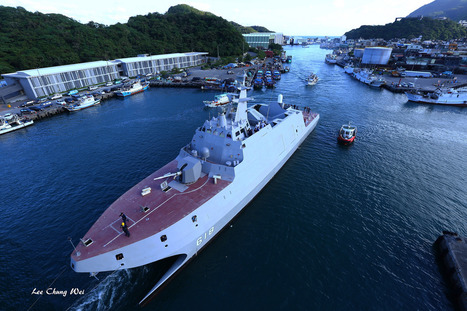
Premier voyage réussi pour la nouvelle perle de la marine nationale, la corvette lance-missiles furtive Tuo Chiang (ou Tuo River), qui a pris la mer hier depuis le port de Su’ao, dans le district d’Yilan, sur la côte est. Elle a longé la côte jusqu’à Hualien, plus au sud, où elle a testé avec succès ses systèmes de propulsion. Ce bâtiment à double coque de 500 t, qui avait été baptisé en mars dernier, est le premier d’une série de huit à douze corvettes dont la marine envisage de s’équiper. D’une longueur de 60,4 m et d’une largeur de 14 m, il peut atteindre la vitesse de 38 nœuds (70 km/h) et a une autonomie de 2 000 milles (3 740 km). Sa vitesse et sa furtivité en font une arme idéale pour l’attaque des porte-avions, disent les experts. La Tuo Chiang peut emporter un équipage de 41 personnes et sera armée de missiles antinavire Hsiung Feng II et Hsiung Feng III. Ces armements devraient être installés sur la corvette prochainement pour un test en mer. Si tous les essais sont concluants, elle sera mise en service d’ici la fin de l’année, selon une source militaire.
|
|
Scooped by
Patrick H.
October 31, 2014 8:58 AM
|
La Marine russe se dotera du sous-marin nucléaire Kazan, tête de série du projet 885M Iassen-M, en 2016, a annoncé mardi à Paris Nikolaï Novosselov, directeur général adjoint du bureau d'études Malakhit de Saint-Pétersbourg qui a conçu le sous-marin. "Nous remettrons à la Marine le sous-marin Kazan, tête de série du projet 885M Yasen-M, en 2016", a indiqué M.Novosselov lors du salon du naval de défense Euronaval 2014. Le projet Yasen-M est une version modernisée du projet 885 Yasen. Selon les experts, ces sous-marins sont "les plus modernes et les moins bruyants de fabrication russe". Le Kazan est encore plus silencieux que son prédécesseur, le Severodvinsk (projet 885 Yasen), qui a été remis à la flotte du Nord russe au début de 2014. Le sous-marin du projet 885M est en outre doté de nouveaux équipements de guerre électronique.Yasen/885M Yasen-M (Granay, selon le code de l'Otan), ont un déplacement de 8.600/13.800 tonnes et peuvent plonger à 600 mètres de profondeur. Leur vitesse est de 16/30 nœuds. Dotés de missiles supersoniques de croisière de type Oniks et Kalibr et de torpilles universelles à guidage automatique, ces sous-marins pourront détruire des cibles terrestres à une distance de 1.500 km des côtes.
|
|
Scooped by
Patrick H.
October 26, 2014 12:07 PM
|
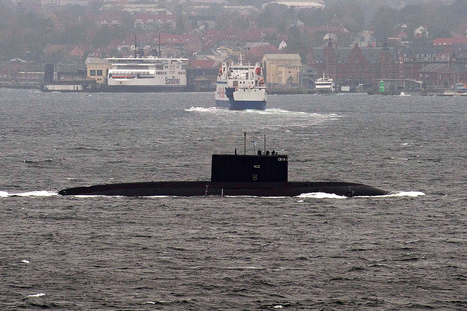
Diesel-electric submarine of large 06,363 B-261 "Novorossiysk" October 24, 2014 was held on the surface Baltic straits, heading around the Scandinavian Peninsula in Northern Fleet, which will host a two-week trial deep. After that, the boat will return to St. Petersburg, where the end of the year on inland waterways will be transferred to the Black Sea.
Solemn ceremony to lift built by JSC "Admiralty Shipyards" submarine B -261 "Novorossiysk" Russian naval flag was held in St. Petersburg, August 22, 2014.
|
|
Scooped by
Patrick H.
October 25, 2014 10:15 AM
|
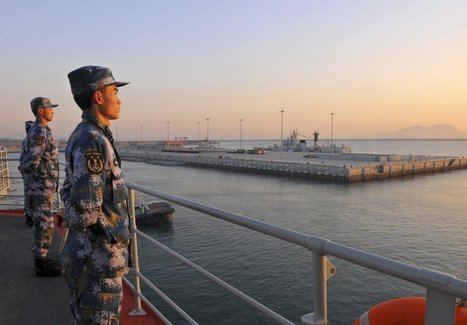
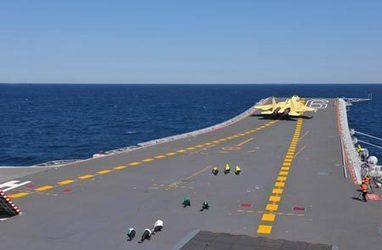
China has developed some impressive defense capabilities in recent years. But one of its flagship achievements has had some notable technical problems in recent weeks. As Robert Beckhusen explained at War is Boring, the Liaoning, China's sole aircraft carrier, unexpectedly powered down during a sea trial last week. The vessel "appeared to suffer a steam explosion which temporarily knocked out the carrier’s electrical power system," Beckhusen wrote, citing a Chinese-language media report (which is summarized at Asia Defense News). Beckhusen notes these sorts of failures aren't unheard of on Soviet-built carriers of the late 1980s — before it was the Lianoning, China's carrier was called the Varyag, and carriers of its class haven't aged particularly well. "The 40,000-ton displacement Indian carrier Vikramaditya—first a Soviet Kiev-class carrier commissioned in 1987 and sold in 2004 — temporarily shut down at sea after a boiler overheated two years ago," Beckhusen recalls, adding that "the 50,000-ton Russian carrier Admiral Kuznetsov goes nowherewithout a tug escort in case her engines break down while underway."
The Lianoning's troubles reveal an important tension within China's defense outlook.
China wants to be a major conventional power. No country goes through the trouble of acquiring a half-operable carrier, or developing simultaneous models of stealth jet, if it doesn't have hopes of becoming one of the globe's leading military powers. Simply pursuing these sorts of projects reveals an undeniable depth of commitment towards keeping pace with the US, which has multiple carrier groups in the Pacific at a given time, and has been developing its own advanced fighter, the troubled F-35, for years.
But China's current military advantages are actually asymmetrical. In other words, capabilities meant to quickly and expediently close the gap between China and the US without having to build up China's order of battle to identical level, even if that means breaking some broadly-accepted rules of how states should behave.
So China's military hacks cyber targets throughout the world, and builds weaponry that few other countries would — things like anti-satellite systems, or missiles capable of carrying nearly a dozen nuclear warheads.
The fact that China even has an aircraft carrier is a reminder that Beijing wants to be a conventional power on par with the US. But the Lianoning's recent problems also show China is still far behind the US as a military power — something that might only make its actions less predictable and more worrisome as Beijing progresses towards super-power status.
|
|
Scooped by
Patrick H.
October 24, 2014 4:05 AM
|
La nouvelle embarcation des commandos marine français sera l’une des grandes attractions d’Euronaval, qui ouvre ses portes lundi au parc des expositions du Bourget, près de Paris. Concepteur et fabriquant de l’ECUME NG, Zodiac Milpro exposera sur le salon le premier modèle de cette nouvelle génération de semi-rigides spécialement développée pour les besoins des forces spéciales.... Lire l'intégralité de l'article sur Mer et Marine : http://www.meretmarine.com/fr/content/lecume-ng-presente-euronaval
|
|
Scooped by
Patrick H.
October 24, 2014 4:00 AM
|
China is capable of completing construction on its first Type 001A aircraft carrier within just six years according to Kanwa Defense Review, a military magazine operated by Andrei Chang, a military analyst in Canada who is also known as Pinkov. To celebrate the Liaoning's second year of service with the People's Liberation Army Navy, the Sina Military Network based in Beijing displayed photos of the ship. A defense expert told the London-based News of the World that China's Type 001A aircraft carrier will look very similar to the Liaoning, however, it will likely be larger. The Kanwa Defense Review said that the Dalian Shipyard has already begun construction on the Type 001A carrier. The shipyard has been working on the project for ten years. For security reason, a 400-meter long indoor building berth was built. The article said that the aircraft carrier will likely be equipped with a steam turbine designed in Harbin in northeastern China and the steel plates for the ships will be mostly sourced from Shanghai. Like the Liaoning, the Type 001A has a ski-jump ramp. The magazine said that the Jiangnan Shipyard in Shanghai is designing a second domestic aircraft carrier as well. This new ship is likely to be fitted with a catapult similar to US carriers. The Washington-based Strategy reported that the ship will have four catapults and three escalators on board.
|
|
Scooped by
Patrick H.
October 24, 2014 3:36 AM
|
The U.S. Navy is starting early preparation work to design a new nuclear attack submarine to replace the Virginia-class boats (SSN-774) in the 2030s. The new attack boat would become operational in 2044 after the last Block VII Virginias are built. “The long range shipbuilding plan is for a new SSN authorized in 2034 in lieu of the eighth block of Virginia-class,” Rear Adm. Dave Johnson, Naval Sea Systems Command’s program executive officer for submarines told the Naval Submarine League Symposium in Falls Church, Va., on Thursday
“2034 may seem far off, but the design research community needs to take action now.”
There will likely be an analysis of alternative for the new submarine—which has tentatively dubbed SSN(X) — in about 10 years or 2024. That, Johnson said, leaves nine years to identify, design and demonstrate the new technologies the new attack boat will need. Johnson said that he has formed a small team to work on a five-year plan to begin to do some of that work. The team will consult with industry and will identify the threat environment and technologies the submarine will need to operate against in the 2050 plus timeframe, Johnson said. One of the areas Johnson has already indentified as critical for SSN(X) is integration with off-board systems. Vice Adm. Mike Connor, Commander of Submarine Force, Atlantic (COMSUBLANT), said that future submarine weapons for both the Virginia and the future SSN(X) would be networked extremely long-ranged weapons. Some of the concepts include a new prototype torpedo propulsion system from Pennsylvania State University — a torpedo could hit targets that could hit targets more than 200 nautical miles away. “I’m not sure I’m mentally prepared to employ a 200-mile torpedo, but I’m going to put some thought into that,” Connor said. Connor said that while an attack boat like the Virginia or SSN(X) might launch a torpedo, the targeting data might come from another platform. Those other platforms could include an aircraft like an unmanned aerial vehicle launched from the submarine or something like a Boeing P-8 Poseidon. In fact, in the submarine might not even guide the weapon to its target in the terminal phase of the engagement, Connor said.
|
|
Scooped by
Patrick H.
October 23, 2014 4:45 PM
|
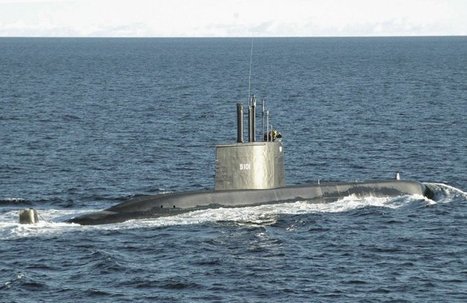
SAS Manthatisi (S 101), the first of three Type 209 submarines acquired by the South African Navy as part of the 1999 Strategic Defence Procurement Package, has re-entered service after a major refit and is participating in the biannual Exercise 'Ibsamar IV' in Cape waters with the Brazilian and Indian navies. Commissioned in November 2005, the submarine has been subject to much speculation and disinformation since it was withdrawn from service in 2007. Its withdrawal after less than two years prompted criticism from some commentators that South Africa had wasted its money on a non-operational submarine. However, the move was in line with the South African Navy's intention to operate two of the three submarines at any one time and keep one in reserve: the same operational cycle used with the Daphné-class submarines that the Type 209s replaced.
|
|
Scooped by
Patrick H.
October 23, 2014 11:13 AM
|
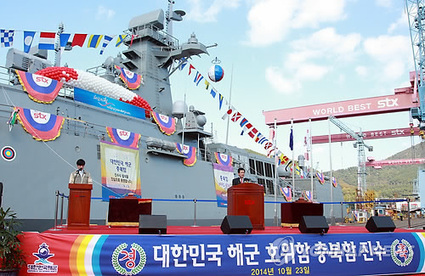
CHANGWON, 23 oct. (Yonhap) -- Une nouvelle frégate de 2.300 tonnes, baptisée Chungbuk, a été lancée aujourd’hui au cours d’une cérémonie à laquelle ont assisté le chef adjoint des opérations navales, Jung Ho-sup, et d’autres officiels de la marine. La cérémonie s'est déroulée sur le chantier naval de STX Offshore & Shipbuilding Co. à Changwon, dans le sud du pays. Il s’agit de la cinquième livraison effectuée dans le cadre du projet visant à moderniser la flotte de la marine sud-coréenne. Le premier bateau, l’Incheon, a été livré en 2011. Le projet prévoit le lancement d’un total de 20 bateaux à l’horizon de 2020. Le Chungbuk est long de 114 mètres et peut accueillir jusqu’à 120 personnes et naviguer à une vitesse de 30 nœuds (55,5 km/h), a-t-il été précisé. Il est aussi équipé d’un radar trois dimensions, d’un système de détection des torpilles et de missiles antiaériens, antinavires et anti-sous-marins. Cette nouvelle frégate sera livrée à la marine à la fin de 2015 et se joindra à sa flotte en 2016.
|
|
Scooped by
Patrick H.
October 23, 2014 4:53 AM
|
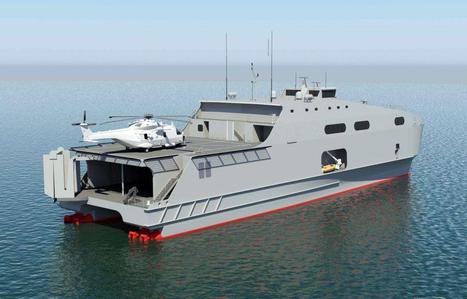
C’est à Oman qu’Austal a vendu deux navires rapides de transport de troupes et de matériel. Le constructeur australien, qui avait annoncé en mars dernier cette commande sans préciser l’identité de son client, a levé le voile sur le contrat et le design des bâtiments qui seront construits pour la marine omanaise. Inspirés des Joint High Speed Vessel (JHSV) développés pour l’US Navy, qui en fait construire 10 exemplaires chez Austal à Mobile (Etats-Unis) , les High Speed Support Vessels (HSSV) commandés par le sultanat mesureront 72.5 mètres de long pour 18.2 mètres de large, avec un tirant d’eau de 3.2 mètres. Affichant un port en lourd de 320 tonnes, ils seront armés par un équipage de 69 marins et pourront atteindre la vitesse de 35 nœuds avec 200 tonnes de charge. La propulsion comprendra quatre moteurs diesels MTU 20V 4000 M93L et quatre hydrojets Rolls-Royce 80S3. Lire l'intégralité de l'article sur Mer et Marine : http://www.meretmarine.com/fr/content/deux-navires-de-transport-rapide-pour-la-marine-omanaise
|
|
|
Scooped by
Patrick H.
October 31, 2014 5:00 PM
|
In another step forward for the Russian navy's ambitious rearmament plans, the keels of two more "Improved Kilo-class" diesel-electric submarines were laid at the Admiralty Shipyards in St. Petersburg on Thursday, Interfax reported. The new submarines are destined to join Russia's Black Sea Fleet upon completion in 2016. Kilo submarines are extremely quiet compared with nuclear submarines, the mainstay of many submarine fleets, because they use diesel engines rather than nuclear reactors for power. They also play a very different combat role. While nuclear attack submarines are designed for long-range deployments in the ocean depths, diesel-electric submarines are intended to sink surface vessels and other submarines in shallow waters closer to land. The submarines under construction are the last of an order of six from the Russian navy. The first has already joined the fleet, while the second two are undergoing trials. A fourth vessel is still under construction. The boats are called Improved Kilo-class submarines according to NATO guidelines, but are known in Russia as Type-636 submarines. The Admiralty Shipyards may also be set to start work on yet more submarines. "We are waiting for new orders for the construction of a series of diesel-electric submarines for the Russian navy," Admiralty Shipyards head Alexander Buzakov was quoted by Interfax as saying at the ceremony celebrating the start of construction on the new vessels. He did not specify what kind of submarines would be ordered, but suggested that they may be of a new design. Russia's navy is one of the prime beneficiaries of President Vladimir Putin's 20 trillion ruble ($500 billion) rearmament program through 2020, with new submarines and surface ships of all types set to roll out of Russian shipyards over the coming years. The Admiralty Shipyards, according to Buzakov, have benefitted from the consistent pace of naval shipbuilding orders, growing their workforce by 800 employees due to the Kilo submarine order. "The Type-636 [submarines] have been the engine that allowed us to develop not only the capacity of the Admiralty Shipyards, but of our suppliers as well," Buzakov was quoted as saying. On top of its new Kilo submarines, Russia is building new nuclear powered missile carrying submarines and attack submarines, known as Borei- and Yasen-class subs. Russia has ordered a total of eight of each class, and several are already in service with the navy.
|
|
Scooped by
Patrick H.
October 31, 2014 4:34 PM
|
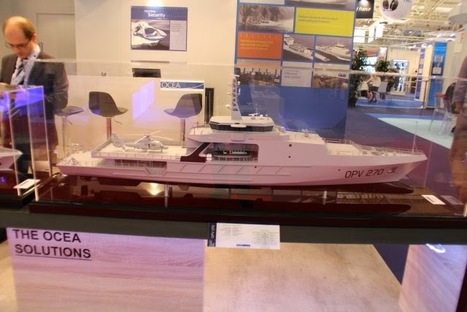
The Philippines Coast Guard will receive a new 82 m offshore patrol vessel (OPV) by around 2016, shipbuilder OCEA told IHS Jane's at the Euronaval exhibition in Paris. A EUR90 million (USD113 million) contract for five vessels from France was announced by Philippine coastguard chief Rear Admiral Luis Tuason in 2012. At Euronaval in 2012, OCEA confirmed that four OCEA 24 m FPB 72 patrol boats similar to units delivered to Nigeria and Surinam would partly fulfil this requirement, although whether the final vessel would be a larger OPV was still to be finalised at that time. The larger unit is now confirmed to be based on the company's new OPV 270, with the baseline design featuring an aluminium hull with twin diesel propulsion for speeds of more than 25 kt.
|
|
Scooped by
Patrick H.
October 31, 2014 9:13 AM
|
Le sous-marin nucléaire Iouri Dolgorouki a effectué avec succès un tir d'essai du missile balistique Boulava en mer de Barents vers le polygone de Koura, au Kamtchatka, a annoncé mercredi le ministère russe de la Défense dans un communiqué. Le missile a été tiré par le sous-marin en immersion. "Selon les informations confirmées, les ogives du missile ont frappé les cibles désignées sur le polygone de Koura", lit-on dans le communiqué. Le missile R30 3M30 Boulava-30 (code OTAN SS-NX-30, dénomination internationale RSM-56) doit constituer l'arme principale des forces stratégiques navales russes. Le Boulava est un missile à trois étages à propergol solide destiné à équiper des sous-marins. D'une portée de 8.000 km, il peut intégrer dix ogives nucléaires hypersoniques de 100 à 150 kilotonnes ayant chacune une trajectoire indépendante.
|
|
Scooped by
Patrick H.
October 31, 2014 9:01 AM
|
À l’occasion de l’édition 2010 du salon Euronaval, une convention fut signée pour permettre à la Marine nationale de disposer, pendant 3 ans, du nouveau patrouilleur hauturier de la gamme Gowind développé par DCNS. Long de 87 mètres et disposant d’un équipage réduit (32 marins), ce patrouilleur hauturier a une autonomie de 8.000 nautiques et peut naviguer à la vitesse de 21 noeuds. Armé de canons de 20 mm et de mitrailleuses de 12,7 mm et doté de divers capteurs, il est en mesure de mener plusieurs types de missions, allant de la police des mers à la surveillance en passant par la lutte contre les trafics. Il embarque en outre un drone. Cet accord conclu en 2010 était gagnant-gagnant. D’un côté, la Marine nationale gagnait un patrouilleur supplémentaire, alors qu’elle n’en avait pas de trop, et l’industriel obtenait le label « sea proven », c’est à dire un argment commercial supplémentaire pour l’exportation de son navire. C’est ainsi que, à partir de 2011, l’Adroit fut mis en service au sein de la Marine nationale. Par la suite, il prit part à de nombreuses missions, comme FRONTEX (surveillance de l’immigration illégale) ou Atalante (lutte contre la piraterie dans l’océan Indien). En septembre 2013, le chef d’état-major de la Marine nationale, l’amiral Bernard Rogel, s’était très satisfait de la mise à la disposition de ce patrouilleur de la gamme Gowind, dans la mesure où cela a permis de préparer le programme BATSIMAR (bâtiments de surveillance et d’intervention maritimeà), dont on ignore quand il sera lancé et d’expérimenter l’emploi du drone S-100 du constructeur Schiebel. Seulement, en juin dernier, l’on apprenait que la convention liant la Marine nationale à DCNS n’allait pas être reconduite. En réponse à une question écrite qui avait été adressée par le député François Cornut-Gentille, le ministère de la Défense expliqua que l’essentiel des tests prévu sur L’Adroit ayant été réalisé, sa restitution devait « intervenir le 21 octobre 2014″. Et d’ajouter : « C’est donc dans le contexte d’un besoin en personnel qu’il a été récemment décidé de dissoudre l’un des deux équipages du patrouilleur ». Mais ça, c’était avant… Car 4 mois plus tard, cette fois en réponse à une question écrite posée par le sénateur François Grosdidier, qui s’inquiétait de la flotte de patrouilleurs hauturieurs de la Royale, le ministère de la Défense a indiqué que, finalement, L’Adroit allait jouer les prolongations. « En ce qui concerne la mise à disposition du patrouilleur hauturier ‘L’Adroit’, le partenariat conclu entre la société DCNS et le ministère devrait être prolongé jusqu’à l’été 2015, en vue de permettre à la marine de poursuivre ses expérimentations à bord et à l’industriel d’approfondir ses prospections commerciales lors d’escales ciblées », a ainsi répondu le ministère de la Défense, le 9 octobre. « Cet accord n’a toutefois pas vocation à perdurer, dans la mesure où ‘L’Adroit’ est un bâtiment prototype susceptible d’être vendu ou désarmé à brève échéance », a-t-il précisé. Interrogé au sujet de L’Adroit lors de son audition en commission élargie, le 23 octobre, le ministre de la Défense, Jean-Yves Le Drian, a confirmé que sa « mise à disposition a été étendue ». Et d’ajouter : « Il faut prêter une grande attention à ce patrouilleur, car c’est une bonne vitrine à l’exportation : ce modèle, qui se situe en dessous des FREMM [ndlr, Frégates Multimissions] sur le plan du coût et de la technologie, intéresse aujourd’hui une dizaine de pays ».
|
|
Scooped by
Patrick H.
October 26, 2014 4:27 PM
|
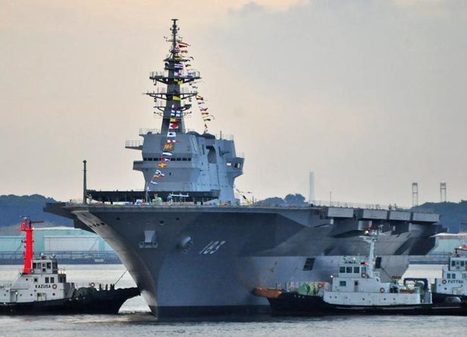
Japan's new Izumo-class helicopter carrier currently undergoing sea trials is expected to be commissioned in 2015. The new carrier will dramatically increase Japan's force projection in the Pacific Ocean and the Sea of Japan, raising concern in China. The new Izumo-class helicopter carrier is undergoing extensive sea trials since late September, in preparation of the acceptance of the new carrier by Japan’s Self Defense Forces Navy. JDS Izumo helicopter carrier is the first of two 30,000 ton (full load) Izumo-class ‘helicopter carrier destroyer’ (DDH) class vessels to be commissioned next year. Unveiled last month at the Yokohama port, south of Tokyo, JS-183 Izumo, is the biggest warship in Japan’s fleet since World War II, has been described by the Chinese media as an “aircraft-carrier in disguise”. Although the is configured with a large flight deck and hangars, designed to accommodate up to 28 helicopters, Izumo does not have catapults or arresting cables nor a ‘ski jump’ curved deck, assisting short take off of conventional aircraft. The Japanese Navy is highlighting the vessels’ ability to quickly respond to emergency or natural disasters. The construction of the first ship of the class began in 2011 at an IHI Marine United shipyard in Yokohama, at a cost of $1.5 billion (113.9 billion yen). Commissioning of the first of class is currently scheduled for 2015 with the second ship of the class, yet unnamed, to follow in 2017. Once commissioned, these Izumo-class vessels will more than double the current anti-submarine, anti-ship, and amphibious assault capabilities of the Chinese Navy, over the current force consisting of two helicopter carriers, operating the Shirane-class helicopter carrying destroyers, accommodating 9-10 helicopters. Those vessels are planned for decommissioning soon. The Japanese navy also operates two 20,000 ton Hyūga-class helicopter destroyers – Hyūga and Ise, commissioned in 2009 and 2011. Each is configured to carry up to 18 helicopters. These vessels typically operate three SH-60K and one MCH-101 mine sweeping helicopters. Hyūga class carriers are also equipped with Mk 41 VLS common launcher, armed with ESSM anti-air and ASROC anti-submarine weapons. Izumo class has more sensors and electronic warfare assets, designed for anti-submarine warfare and border-area surveillance missions, its self-defense capabilities are limited to close-in weapon systems (CIWS) such as the PHALANX and SEARAM. In addition to the larger capacity, the flight of JDS Izumo deck has 5 helicopter landing spots enabling simultaneous landings or take-offs. On deployments JS Izumo will carry a typical complement of 14 helicopters, seven ASW helicopters and two SAR helicopters. In addition, the ship will be able to transport 400 marines, 50 trucks and supplies. Some analysts have speculated the Izumo could be adapted to carry F-35B (STOVL) and V-22 Osprey tilt-rotor aircraft, but sofar official Japanese authorities have not addressed these speculations. A similar platform designed to operate those aircraft is twice as large as the Izumo – American LHA-6 – USS America – has recently been commissioned with the US Navy.
|
|
Scooped by
Patrick H.
October 26, 2014 7:12 AM
|
SHAH ALAM: We have heard statements regarding work on the first LCS had started but none of the traditional “steel cutting” which usually mark the first steps in building a new ship. Talks about the manufacture of the LCS usually involved CAD/CAM work of the LCS by BNS together with the installation of a SETIS CMS on the ground for testing. Running a CMS for testing prior to installation is of course not new, the same thing was done during the manufacture of the Kedah class. But the start of any work at BNS shipyard in Lumut would have been preceded by a ceremony of some sort. A recent visit by RMN Chief Admiral Tan Sri Aziz Jaafar to DCNS yard in Lorient, France, had changed my understanding of the so called”manufacture” of the LCS. The release by TLDM (here) does not say much, but based on my checks with industry sources, it is likely that the first LCS is being built in Lorient. I am not sure whether they will complete the full hull and out-fit it here in Malaysia or they are only building the various blocks before it is welded together in Lumut. It is likely however they will complete the hull first in France before the ship is towed back to Malaysia for final fitting. Nonetheless what ever method they choose, I expect the first LCS is being built jointly by BNS and DCNS personnel. The BNS personnel involved in the first LCS project will then lead the building of the second vessel and the rest in Lumut under the supervision of DCNS personnel. Using this method, they will reduced the risk for all the parties involved namely RMN and the builders BNS and DCNS. BNS personnel will also greatly increased their skills by working with DCNS personnel at the Lorient yard. Furthermore, once work starts in Lumut, BNS can reduced the number of DCNS personnel involved in the project in Malaysia. But why have they not confirmed it instead of releasing ambiguous statements? I suspect that BNS (and the government) is fearful of being criticised especially when the government had touted all of the six LCS will be built locally. Is building at least one of the LCS overseas wrong? Of course, not!. We all realised that BNS had not been building new ships since the end of the NGPV (Kedah Class) project hence they will lack the skills to embark on a project like building the LCS. Like other manufacturing project, ship building skills are lost when a project ends. Even in a more industrialised country like Australia this thing happens. That is why some countries like France and the UK, ship building projects are financed by the government to ensure that the yards continue to have work and did not have to fire highly skilled workers who are the main factor in production quality ships. South Korea yards in the meantime, maintained their workers by building civil ships in between the naval ship building projects
|
|
Scooped by
Patrick H.
October 24, 2014 3:19 PM
|
Details are slowly coming to light of the mystery Indian Navy (IN) vessel being built under the secretive Ocean Surveillance Ship (OSS) project at the Ministry of Defence-owned Hindustan Shipyard Limited (HSL). IHS Jane's understands that the OSS project is managed by the Indian Prime Minister's Office (PMO) in a similar manner to the Arihant nuclear submarine project. The layout of the ship - a long open deck with space for several tracking antennae aft of the forward superstructure - suggests it could be a ballistic missile tracking ship operated by the IN for the Defence Research and Development Organisation (DRDO).
|
|
Scooped by
Patrick H.
October 24, 2014 4:03 AM
|
C’est l’une des grosses surprises d’Euronaval, que nous vous révélons en exclusivité dès aujourd’hui. Plus grand bâtiment de combat développé jusqu’ici par CMN, le C Sword 90 est aussi l’un des plus novateurs du moment. Bénéficiant d’études poussées en matière de furtivité, cette corvette de 95 mètres de long pour 15.7 mètres de large adopte un design de coque très travaillé, permettant d’offrir une excellente tenue à la mer, ainsi que des performances élevées en matière de vitesse et d’autonomie.... Lire l'intégralité de l'article sur Mer et Marine : http://www.meretmarine.com/fr/content/c-sword-90-cmn-devoile-sa-nouvelle-bete-de-guerre
|
|
Scooped by
Patrick H.
October 24, 2014 3:56 AM
|
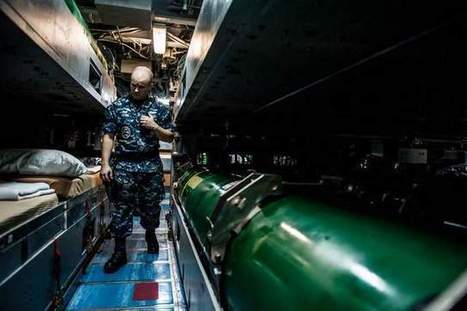
Sub designers are puzzling out how to fit enlisted women into the berthings on the Virginia-class attack submarines already in the force. “Right now we are doing the work to do the design changes for the in-service Virginias,” said Rear Adm. David Johnson, the program executive officer for submarines, in a Thursday speech. “Frankly the tough part is to integrate the enlisted berthing and the chief's quarters. The officers are fairly easy to adapt to, but the enlisted berthing and the chief’s quarters you have to do a little bit of work on the ships and we're trying to do that as affordably and non-disruptively as possible,” Johnson said. Johnson, speaking at the Naval Submarine League’s annual conference in Fairfax, Virginia, said that getting mixed-gender crews on as many subs as possible was a priority. The sub force began its integration in late 2011 with the arrival of female officers — roughly 50 of them now serve aboard 14 boomer crews — and officials are now moving towards the next steps of integrating attack boats and enlisted crews. “We are looking forward to mixed-gender officer, chief petty officers and enlisted on our submarines going forward,” Johnson said. “It's a must, it's the right decision and we're moving forward.” A task force led by the recently disbanded Submarine Group 2 recommended that enlisted women and chief petty officers begin serving on attack boats as the Block IV Virginia-class subs begin fleet service around 2020; these vessels are being designed with fully integrated crews in mind. Rear Adm. Phillip Sawyer, head of Submarine Force Pacific, said retooling the current Virginias would not move up the timeline for getting women into attack boat crews. The first Virginia-class attack subs to be integrated are the Virginia and Minnesota, which are slated to receive female officers in early 2015. Enlisted women will begin serving on the Ohio-class boomers as soon as 2016.
|
|
Scooped by
Patrick H.
October 24, 2014 3:11 AM
|
The Navy’s top maintenance official warned that the service is “in a tail-chase” to get submarines and ships the overhauls they need, with some running much longer than foreseen. Vice Adm. William Hilarides said the yards got backed up because of budget cuts and a hiring freeze that left thousands of jobs unfilled at Naval Sea Systems Command, which Hilarides leads. “We found ourselves almost 2,000 people behind out of a workforce of 30,000, on an increasing workload ... and we fell behind,” he said. Hilarides, who spoke Wednesday at the annual Naval Submarine League symposium in Northern Virginia, said that the attack boats had seen the longest delays. “They are significantly behind and we will not catch back up,” said Hilarides, a career submariner who has commanded the attack sub Key West. Hilarides said workloads have continued to increase as the ballistic missile subs hit their mid-life refueling, as well as the increased demand of having 11 carriers, which wasn’t the case until the George H.W. Bush entered the fleet in 2009. Hilarides also discussed the impact of last year’s shootings in Building 197, NAVSEA’s headquarters, saying his staff is getting geared up to reenter the building next February. “They are beginning to come to terms with the idea of coming back to the building,” he said. Hilarides said workers have been shown pictures of what the building and their desks look like now after the renovation and many have visited. The building will be ready Feb. 1, which is a Sunday. NAVSEA will have a ceremony marking the renaming of the building after renowned ship builder Joshua Humphreys, who designed the Navy’s first six frigates, including the USS Constitution.
|
|
Scooped by
Patrick H.
October 23, 2014 12:44 PM
|
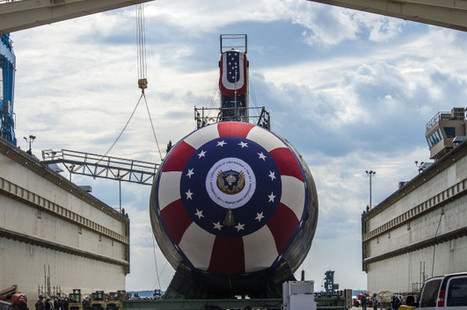
Une cérémonie se déroulera samedi 25 octobre. Le North Dakota est un nouveau sous-marin nucléaire d’attaque américain qui doit être officiellement livré cette semaine à l’US Navy. La cérémonie se tiendra sur la base des sous-marins à New London. L’USS North Dakota a vu sa construction débuter en 2009. Le submersible est le 11e exemplaire de la classe Virginia des sous-marins nucléaire d’attaque visant à renouveler la flotte de sous-marins au sein de la marine américaine. Il est surtout le premier des huit sous-marins du block III de la classe Virginia. De nouveaux tubes lance-torpilles ont été installés à bord des Virginia Block III. L’amiral, Jonathan Greenert, Chief of Naval Operations, prononcera un discours d’ouverture au cours de cette cérémonie officielle rassemblant plusieurs hauts responsables militaires impliqués dans ce programme d’armement crucial pour le futur de la sous-marinade américaine. 2400 invités sont attendus pour cet évènement.
|
|
Scooped by
Patrick H.
October 23, 2014 5:02 AM
|
As the Chinese national day golden week passed, a lot of really high quality photos from PLAN bases were posted online. As newer ships get commissioned and the oldest ships get retired, many other ships get moved between different flotillas. In the past year, the main mass produced ships have been the type 052C/D series destroyers and the type 056 light frigate. It has certainly been a busy year when we factor in the other new ships. This past month, we are seeing what appears to be the modules of the 4th Type 071 LPD really taking shape at Hudong shipyard. On top of that, production for the smaller Type 072A landing ships have restarted and the first one has launched at WuChong Shipyard as No. 981.
Type 071 can be effectively used for South China Sea and Taiwan scenarios, but provide the additional blue water capabilities that Chinese navy never had. The restart of Type 072 series is aimed at either replacing older landing ships or responding to the increased tension in South China sea. Either way, it shows that Chinese navy will continue to have landing ships of this class for green water missions. PLAN has taken the approach of continuing to build modern littoral ships like Type 056 and Type 022 series while it is building up its blue water navy. The restart of Type 072A seems to be a continuation of this approach of building cheaper and less capable surface combatants for traditional missions. PLAN's identity certainly has not transformed to that to a power projecting blue water navy like USN. We first started to see photos of Type 071 under construction in 2006 and it was launched by the end of that year. It was commissioned by the end of 2007, but the process of learning to operate this new behemoth has been ongoing since. The second and third Type 071s launched in quick succession in late 2010 and 2011 while joining service a year later. There were speculations of modules for a 4th Type 071 at the time 3rd one was launched, but were proven to be false.
So, why have we not seen more Type 071 until now? There is both the human factor and also the supporting system factor. In the former case, PLAN and PLAMC have really just started operating something with the size ond blue water projection of Type 071. No. 998 was sent out on to Gulf of Aden relatively early on and other Type 071 units have been sent since. Most recently this year, all 3 Type 071s were out on different missions at the same time showing their value of this blue water asset to PLAN. It seems like at the time that PLA really needed more units of this class. Even so, only in the past couple of years have we seen the marine corp starting to conduct large scale amphibious exercises in South China Sea involving Type 071 + helicopters/hovercrafts/boats operating from it. All of this shows that it really takes time to recruit the personnel and train the crew member and the new marines to operate something like Type 071. At the same time, all 3 Type 071s have been assigned to the Zhanjiang naval base and there is probably a limit to how many Type 071s that base can handle before needing further expansion. So even if Hudong shipyard is capable of building one a year, PLA may not be able to accept them at that pace even if it has high need for this series. I don't see this as a problem, since it just gives them more time to identify problems and make incremental updates to the ship. Lire la suite sur Information Dissemination : http://www.informationdissemination.net/2014/10/more-amphibious-ships-for-chinese-navy.html
|