Your new post is loading...

|
Scooped by
Patrick H.
October 19, 2013 12:17 PM
|
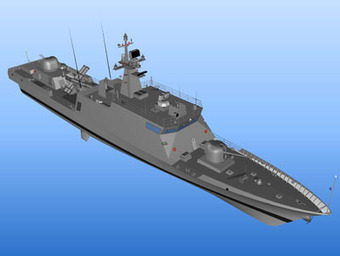
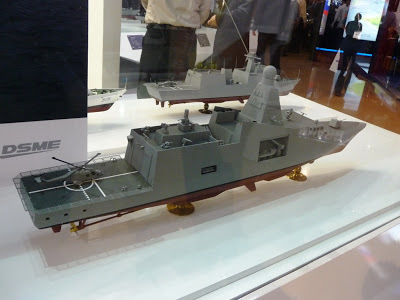
Based on this scale model, Incheon Batch II Frigates will be fitted with a 127mm main gun, a Phalanx CIWS, 16x KVLS cells, Sonata detection system, 3D and 2D radar, tracking radar, EOTS system, Sonata jamming system, MASS, torpedo tubes, 8x antiship launchers.
(Picture: Internet)
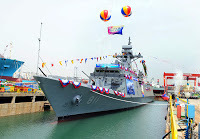
The scale model of the Incheon class frigate Batch II was unveiled by DSME in the 63rd anniversary festival of the Incheon landing operation in the Korean War. Key updates of the Batch II over the ASW-focused Batch I include VLS and full electric propulsion system, as well as a larger hangar that can accomodate a 10-ton helicopter (Batch-I has hangar for lighter helicopters like AW159). About 8 ships of Batch II are going to be built in pairs by DSME until 2018. Some items like the MT30 gas turbine engines for the new propulsion system are already being delivered. It seems like DSME kept in mind growth space for the future evolution of the Batch-II design. They will be able to put in more VLS on the frigate if they need them for Batch III ships, possivly 48 cells in total if 2x16 VLS are placed side by side behind the existing module. Meanwhile, Batch II seems to retain most sensors from Batch I: the AESA surveillance radar, a fire director radar plus EOTS. A mast MFR will eventually replace these piecemeal sensors from Batch III. LIG Nex1 will provide a range of ship-launched SAMs which will see their first use with FFX Batch II (and with LST-II and MLS-II that use the same sensors as FFX or PKX). There was an opening ceremony of the new missile production facility recently.
The FFX VLS will also be able to employ VLS-launched variants of Haesung-I and Haesung-II series missiles (short-range tactical missile and long-range 'strategic' missile). Lastly, the Red Shark VL-ASROC will be added to Incheon's existing ASW kit.
|
|
Scooped by
Patrick H.
October 16, 2013 3:16 AM
|
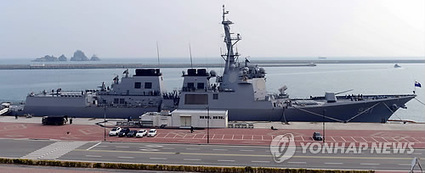
SEOUL, 16 oct. (Yonhap) -- La marine nationale a adressé l'an dernier à l'état-major interarmées une demande pour trois destroyers Aegis dont elle a besoin, a-t-on appris ce mercredi auprès d'une source militaire. «La marine a fait une demande pour trois destroyers Aegis à l'état-major interarmées il y a un an», a déclaré la source sous couvert d'anonymat. «Cette demande sera mise à l'ordre du jour de la réunion de l'état-major interarmées du mois prochain», a-t-elle précisé. Si le projet de construction de trois destroyers Aegis est approuvé lors de la prochaine réunion de l'état-major interarmées, la construction de ces bâtiments de guerre sera lancée au milieu de l'année 2020. La marine vise à remplacer progressivement sa flotte vieillissante de navires d'escorte et de destroyers KDX-I par de nouveaux destroyers Aegis. «Le Parlement a subventionné une recherche à l'Université de défense nationale de Corée (KNDU) en débloquant 500 milliards de wons (468.000 dollars) de son budget réservé à la recherche», a noté un officiel de la marine, ajoutant que cette recherche commandée par l’Assemblée nationale a exercé une influence sur la demande de la marine. Un autre officiel de la marine a expliqué que la construction de trois destroyers Aegis ne serait pas destinée à constituer une flotte pour les îlots de Dokdo ou Ieodo mais à répondre au besoin de nouveaux destroyers équipés d'une capacité antibalistique en remplaçant des vieux bâtiment de guerre. La marine nationale possède actuellement trois destroyers Aegis.
|
|
Scooped by
Patrick H.
October 3, 2013 11:08 AM
|
Defence and security company Saab has signed a contract with Daewoo Shipbuilding and Marine Engineering Korea, for development and integration of combat management and radar systems on a new frigate for the Royal Thai Navy. The order amounts to MSEK 850. The contract comprises of combat management system and radar system. Saab is the combat system integrator. In addition to the supply of its own systems, Saab is also responsible for procurement and integrations of third-party systems. Deliveries of ship equipment are scheduled to commence in 2016 and production will take place in Sweden, Denmark,Thailand and Australia. Saab serves the global market with world-leading products, services and solutions ranging from military defence to civil security. Saab has operations and employees on all continents and constantly develops, adopts and improves new technology to meet customers’ changing needs.
|
|
Scooped by
Patrick H.
September 18, 2013 4:37 AM
|
|
|
Scooped by
Patrick H.
September 14, 2013 12:02 PM
|
At least 24 minesweepers needed; and at one time, Indian Navy had 18 of them.Even after completing the contract negotiations with a South Korean shipyard for building eight minesweepers for the Indian Navy, bureaucratic red tape and procedural wrangle have over the past one year have delayed inking the deal as the files are still doing the rounds in the Defence Ministry. The process to acquire badly needed minesweepers for the Navy was initiated 13 years ago and the Government is yet to sign the deal with the South Korean firm Kangam which had emerged as the lowest bidder. As a result, Navy’s wait to add to its already depleted strength of minesweepers still continues and the already negotiated deal, estimated to be worth Rs. 24,000 crores, appears to be in a state of limbo. Though the deal with South Korea denotes New Delhi’s “strategic” partnership with Seoul, the uncertainty in signing the deal is only adding to the woes of the South Korean firm which had emerged as L1 or the lowest bidder in the tendering process in April last year, highly placed sources in the Navy said. Kangam had beaten Italian firm Intermarine and won the bid. According to the deal, first two minesweepers also called Mine Counter Measure Vessels (MCMV) will be constructed at Pusan, South Korea and the remaining six will be built at the Goa Shipyard through the route of technology transfer. Each of the specialised vessel is likely to cost around Rs. 3,000 crore. The Navy needs at least 24 minesweepers and at one time had 18 of them. Minesweepers are specialised warships which are used in clearing the sea mines. These vessels are capable of acting as minesweepers and mine hunters. Informed sources said the contract could not be signed after Intermarine of Italy, the Kangam’s competitor, approached the Central Vigilance Commission (CVC). Senior Navy officials say the CVC was informed about the selection process of Kangam and it was thought that the matter has been settled. Navy officials say that India’s ports face the threat of undersea mines that could be planted, putting merchant ships at risk and affecting the trade route that could cripple the country’s economy. “The role of Navy during the conflict is to also ensure free flow of trade. If harbours are not clear of undersea mines, you can imagine how badly it will hit the country’s economy,” a senior official said. MCMVs are needed to provide safe passage at exit and entry points to a harbour which is critical to Naval operations. Under water mines can be laid easily and these self-contained explosives can pose grave threat to warships and merchant vessels. India boasts of 186 ports of which 13 are major ports. Minesweepers or the MCMVs use specialised composite material and high grade steel and are equipped to detect all kinds of underwater mines. The Indian Navy operates 12 minesweepers of the Pondicherry and Karwar class but these vessels have become outdated. “If the deal is signed today, Kangam will deliver the first two MCMVs by 2017 and it will take another three or four years for the Goa Shipyard to build its first minesweeper after getting the technology. After that the shipyard can deliver one vessel every year,” sources said.
|
|
Scooped by
Patrick H.
September 10, 2013 10:46 AM
|
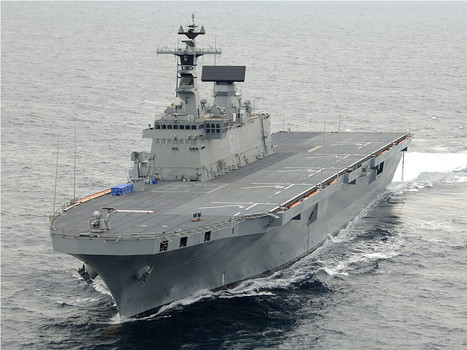
SEOUL, Sept. 10 (Yonhap) -- The generator room of the Navy's 14,000-ton ship caught fire while the ship was sailing off the west coast of the Korean Peninsula Tuesday, causing a duty officer to suffer second-degree burns. Restoration work is currently underway. A fire broke in the engine room of the Dokdo-class amphibious assault ship which was sailing near the western port of Gunsan around 10:45 a.m. Crew members immediately put out the fire, but a 23-year-old petty officer first class, who was on duty in the engine room, got second-degree burns in the process of containing the blaze, according to Navy officers. "Among two generators in the ship, the burned one broke down, and the other stopped after sea water flowed in during the process of extinguishing the fire," a Navy officer said. "The ship currently remains in the same spot. Repair works will continue late into the night." Named after the easternmost islets of Dokdo in the East Sea, lhe lead ship in its class was built by Hanjin Heavy Industries
|
|
Scooped by
Patrick H.
September 8, 2013 6:06 AM
|
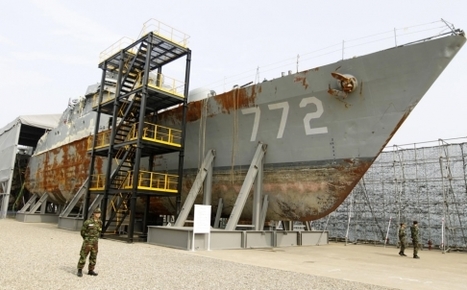
A South Korean court yesterday rejected an attempt to ban a documentary film which questions Seoul's claim that North Korea was behind the 2010 sinking of the warship Cheonan. The corvette sank with the loss of 46 lives on the night of March 26, 2010, near the South's disputed Yellow Sea border with the North. An investigation by a South Korean-led international commission concluded it had been sunk by a torpedo from a North Korean submarine - a charge Pyongyang angrily denied. The film highlights theories that cast doubt on the commission's findings. It cites experts who question the findings of the investigation, including one who suggested the warship probably sank after colliding with a submarine of unknown origin. Project Cheonan angered the military, and three naval officials - together with two relatives of sailors who died on the Cheonan - filed an injunction last month to ban the documentary. But the court at Uijeongbu near Seoul rejected the injunction, saying the movie had not distorted facts or tarnished the reputation of the victims as claimed by the complainants.
|
|
Scooped by
Patrick H.
September 3, 2013 10:42 AM
|
September 3, 2013: South Korea recently launched the first of a second batch of six Type 214 submarines. This one was built by Daewoo Shipbuilding & Marine Engineering. The first three were built (from German components) by Hyundai Heavy Industries. Much to the chagrin of the South Koreans, who are trying to develop their own submarine building capability, the first three Type 214s had quality problems. Mostly it was defective components and poor construction techniques that left the three boats noisy and easier to detect. The first three Type 214 subs were out of action for most of 2010 because of these problems. This was very embarrassing, as these subs were built in South Korea and that was a big deal in South Korea. Building submarines is a very specialized and exacting type of manufacturing, and South Korea has only been doing it for less than a decade. The first subs built in South Korea were these three German Type 214s, and the first of those entered service five years ago. The boats were built using licensed technology from the German developer (HDW) and many of the components were manufactured in South Korea as well. But then metal bolts in the Type 214s began coming loose or breaking seven years ago. The problem was traced to the South Korean supplier of the bolts which were not, it turned out, manufactured to the German specification. Eventually, German specialists were called in, and by 2011 the problem had been fixed. South Korea went ahead with plans to build six additional Type 214 subs over the next 12 years. South Korea already had nine 1,100 ton Type 209 subs, designed and built in Germany. The Type 214 boats use fuel cells, enabling them to stay underwater for up to two weeks. The Type 214 is a 1,700 ton, 65 meter (202 foot) long boat, with a crew of 27. It has four torpedo tubes and a top submerged speed of 35 kilometers an hour. Maximum diving depth is over 400 meters (1,220 feet). AIP boats go for up to a billion dollars each. The second batch of South Korean 214s will have an improved AIP system, which is apparently more reliable, and provides a small increase in time underwater. South Korea will probably become a supplier of AIP systems as well, because they now have the industrial expertise for this sort of high tech. The latest Type 214 boat is important because if it proves to be flawless it will make South Korea a contender in the international submarine market.
|
|
Scooped by
Patrick H.
August 23, 2013 5:49 AM
|
OTTAWA, Aug. 21 (UPI) -- Acoustic processor systems from General Dynamics Canada have been chosen for use in an aircraft upgrade program for the Navy of the Republic of Korea. Making the selection of the company's Vpx ENhanced Open architecture Multi-static -- VENOM -- sonobuoy processors was Korean Air Lines Co. Ltd, the prime contractor to modernize the Korean Navy's P-3C Orion maritime patrol aircraft. "Acoustic operators face considerable challenges detecting today's stealthy submarine threats, and the sheer volume of sensor data that they must manage and analyze in order to develop a complete situational awareness picture can be overwhelming," said David Ibbetson, vice president, General Dynamics C4 Systems-International. "This new, advanced generation of acoustic processors helps operators handle their complex tasks more effectively and efficiently than ever before." The VENOM system -- compact and modular -- is an advanced acoustic processor for underwater acoustic signal acquisition and processing that helps acoustic operators quickly and accurately detect, classify and track submarines in complex undersea environments. The value of the 10 units ordered and their delivery schedule were not detailed.
|
|
Scooped by
Patrick H.
August 4, 2013 4:18 PM
|
The Navy recently revealed the Type 214 submarine -- the third of its kind in operation since 2010 -- to give the public a very rare insight into various aspects of its weaponry, machinery, confined spaces and life aboard.
The atmosphere in the unit is derived not only from the nature of its missions, which require about 40 men to remain together underwater in an iron tube for many long days, but also because very few soldiers serve in the unit.
Secrecy and noise reduction is important to the submarine crew so they won't be detected by the sonar of other submarines. Wearing boots with layers of soft-cushions on the heel is one way they reduce noise.
The Diesel submarine is operated by Air Independent Propulsion (AIP), which extends the ship's submerged endurance compared to conventional submarines. The AIP system enables the crew to carry out underwater missions for several weeks without the need to access atmospheric oxygen.
It is equipped with ship-to-land missiles and torpedoes as well as an advanced sonar system for anti-submarine warfare, surveillance and reconnaissance missions.
South Korea currently operates over 10 submarines, including 1,200-ton Type 209 subs and 1,800-ton Type 214 subs.
The Navy plans to acquire nine 3,000-ton level heavy-attack submarines after 2020 with significant improvements in their radar and armament systems compared to their predecessors. A total of nine 3,000-ton submarines are expected to be built in South Korea with indigenous technologies, according to officials. By 2020, there will be over 20 ships operated by the Navy.
As the flotilla is expected to receive more ships in coming years, it is due to become South Korea's submarine headquarters in 2015.
The procurement plan reflects the intensifying hidden underground battle with North Korea after a South Korean corvette Cheonan was sunk by a suspected North Korean submarine attack in March 2010. A total of 46 sailors were killed in the incident.
Navy officials stressed the need to beef up the submarine capabilities, citing growing naval tensions around the Korean Peninsula that could turn into an armed conflict.
China's growing naval presence and Japan's military build up to counter it also highlight the need for better anti-submarine warfare capabilities, they said. "We will play a key role in deterring North Korea's naval provocations and protect national interests in the deep sea," Hyun said.
The biggest challenge for that goal is attracting and retaining skilled officers and crew members, as fewer cadets have applied for the intense submarine unit in recent years as the recruiting system was changed.
When the flotilla was first launched two decades ago, top-ranking cadets were selected for the submarine program and joined the ranks of the submarine flotilla to operate strategic naval weapons against North Korea. The communist country has operated a large submarine fleet since the 1960s.
After the recruiting system came under criticism for depriving cadets the opportunity to choose other units, the Navy now accepts applications for volunteers who want to become submariners. Instructors say they have difficulties enticing cadets and non-commissioned officers in joining the crew.
To tackle the manpower problem, the Navy is seeking to increase the pay of submariners, but receiving more government funding is no easy task, said a Navy captain in charge of the submarine training unit.
"We need more crew with in-depth knowledge and passion for the role submarines are expected to play in maritime strategy," Hyun said.
|
|
Scooped by
Patrick H.
July 26, 2013 10:01 AM
|
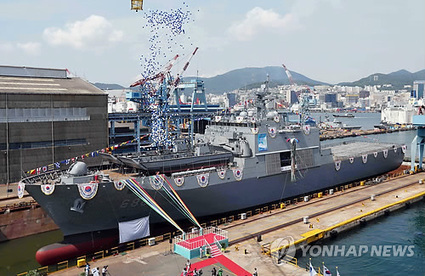
SEOUL, July 25 (UPI) -- South Korea has launched its second Incheon-class FFX coastal defense vessel, Yonhap News Agency reported. The chairman of the Joint Chiefs of Staff and senior naval officials attended the launching ceremony for the 2,300-ton frigate Gyeonggi at Hyundai Heavy Industry's shipyard in the southeastern city of Ulsan. The Incheon, lead vessel in the class, was designed under the government's Future Frigate Experimental program and launched in January. Yonhap reported naval officials said the Gyeonggi -- named after Gyeonggi province that surrounds Seoul -- will be delivered to the navy next year and deployed for operation in 2015. The Incheon is expected to be commissioned next year. About 20 frigates will be built to replace the country's aging Ulsan and Pohang patrol escort ships by 2020. The vessels were built between the early 1980s and the early 1990s. The Pohang-class vessels were built by Korea Shipbuilding Corp., Hyundai Heavy Industries, Daewoo Shipbuilding and Korea Takoma. Hyundai Heavy Industries also built the Ulsan guided missile ships. The Incheon and Gyeonggi vessels are South Korea's first coastal patrol vessels built after the sinking of the patrol ship Cheonan -- a Pohang-class ship -- allegedly by North Korea in March 2010. The incident raised many questions by South Korean politicians and defense analysts about the condition of the navy's equipment. The 1,200-ton naval corvette Cheonan sank rapidly after an explosion from a suspected torpedo ripped the vessel in half. It sank just more than 1 mile southwest of Baeknyeong Island near the de facto sea border with North Korea. North Korea consistently denies it had anything to do with the sinking. The South Korean government also became concerned the country's maritime protection was left wanting in the face of increasing intrusions by foreign fishing ships, especially Chinese and North Korean, into its economic zones. In December 2011, then-South Korean President Lee Myung-bak called for "strong" measures to protect the country's coast guard sailors during an increasing crackdown on illegal fishing by Chinese boats. Lee said he wanted no repeat of the attack earlier that month on two coast guard sailors during a raid on a Chinese boat suspected of fishing illegally in South Korean waters earlier. A coast guard officer allegedly was stabbed by the captain of the Chinese fishing boat and died shortly after in hospital. Another coast guard member was stabbed but lived, Yonhap reported. The confrontation between the coast guard and Chinese fishing vessel was one of the most difficult in years, said the team that boarded the ship, a report in Joongang Daily said at the time.
|
|
Scooped by
Patrick H.
July 2, 2013 3:27 PM
|
BMT Defence Services Ltd, a subsidiary of BMT Group Ltd, has announced that it has been confirmed as design contractor for the Norwegian Defence Logistics Organisation’s (NDLO) logistics and support vessel (LSV), supported by sister companies BMT Reliability Consultants Ltd and BMT Isis Ltd. The new logistic support vessel will be built by Daewoo Shipbuilding and Marine Engineering (DSME). The LSV contract is worth an estimated GBP140 million, with a proportion going to the three BMT Group defence subsidiaries who will work together with DSME to deliver the vessel. The auxiliary vessel, designed to cover a multitude of roles and to be built by DSME in their Okpo yard, will measure 180 metres in length, 26 metres in beam, and have a displacement of over 26,000tonnes. This new addition to the fleet is due to be delivered to the Royal Norwegian Navy during October 2016. The LSV project will benefit from leveraging the economic efficiencies of the world’s premier shipbuilder combined with the UK’s pre-eminent capability in naval ship design and engineering. It will strengthen DSME and BMT’s synergistic relationship since a derivative of Bath-based BMT Defence Services’ AEGIR® replenishment vessel design was selected for the UK MARS (Military Afloat Reach and Sustainability) tanker programme in 2012. Between the three companies, BMT will provide the programme with, amongst other services, basic design, requirements analysis and acceptance planning, Integrated Logistics Support (ILS), the management, assessment and optimisation of the Supportability, Availability and Reliability as well as safety and environmental analysis and management.
|
|
Scooped by
Patrick H.
May 26, 2013 12:20 PM
|
By Kim Eun-jung
SEOUL, May 26 (Yonhap) -- The South Korean military has approved a plan to buy 20 maritime patrol aircraft to improve the Navy's surveillance capabilities of North Korea, a military source said Sunday.
The Joint Chiefs of Staff has recently approved the Navy's request to add 20 maritime patrol aircraft to supplement the aging squadron of 16 Lockheed Martin P-3C Orions. "The Defense Acquisition Program Administration is currently working on a plan, which is likely to be an overseas purchase program," the source said, asking for anonymity as it is not yet open to the public. The budget for the project is estimated at 1 trillion won (US$889 million). Among the potential candidates are Airbus Military's C-295 MPA, Boeing's P-8 Poseidon, Lockheed Martin's SC-130J Sea Hercules, according to officials.
The U.S. Navy has recently received the seventh production of Boeing's P-8 Poseidon to replace its P-3Cs.
Separately, a naval modernization program has been underway to upgrade P-3C's radar and censor system by 2016.
Deployed in 1995, the maritime aircraft is capable of conducting various operations in anti-submarine and anti-ship warfare. It is armed with Harpoon Block II air-to-ground missiles and a tactical information system interoperable with the KF-16 fighter jet.
The latest decision comes as Seoul has been putting more resources into coastal warfare and defense capabilities in frontline border islands in the face of North Korea's growing threat near the tensely guarded western sea.
North Korea has a large fleet of submarines, and one of them is blamed for torpedoing the South Korean warship Cheonan in the Yellow Sea in March 2010, killing 46 sailors. The North also shelled a South Korean border island later that year, killing four people.
|
|
|
Scooped by
Patrick H.
October 17, 2013 2:29 AM
|
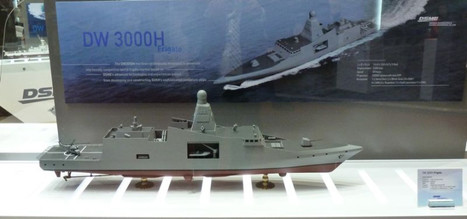
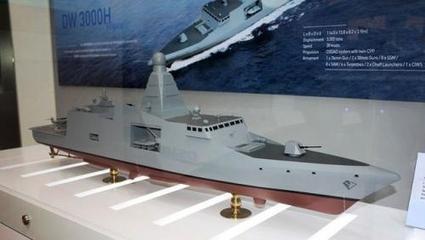
Le mât intégré développé par Thales est visible sur un nouveau design de frégate conçu par Daewoo Shipbuilding and Marine Engineering (DSME) pour le marché export. Il s’agit du type DW3000 H, exposé par le constructeur sud-coréen lors de récents salons navals. Longue de 114 mètres pour une largeur de 13.8 mètres, cette frégate légère présente un déplacement de 3000 tonnes en charge. Dotée de formes furtives, elle peut atteindre la vitesse de 28 nœuds avec une propulsion axée uniquement sur des moteurs diesels et dispose d’un hangar pour un hélicoptère. L’armement comprend 8 missiles antinavire, un système surface-air avec 8 cellules de lancement vertical, une tourelle de 76mm, un système multitubes Phalanx, deux canons de 30mm et 6 tubes lance-torpilles. Mais ce qui frappe évidemment, c’est la présence sur la superstructure d’un mât intégré de la gamme I-Mast développée par Thales Nederland. Ce nouvel équipement..n’a pas encore été vendu à l’export par le groupe d’électronique. Lire l'intégralité de l'article sur Mer et Marine : http://www.meretmarine.com/fr/content/les-sud-coreens-proposent-une-fregate-dotee-de-li-mast-de-thales
|
|
Scooped by
Patrick H.
October 15, 2013 12:23 PM
|
NEW DELHI — India’s Defence Ministry has decided to award a US $1.2 billion contract to Kangnam Corp. for eight mine-countermeasure vessels in India’s first big-ticket defense program with South Korea. The deal has been cleared ahead of Indian Defence Minister A.K. Antony’s planned visit to Seoul later this year, and will help boost defense ties with South Korea, an Indian MoD official said. The finalization of the contract was delayed after Italy’s Intermarine, which was competing for the contract, approached India’s anti-fraud agency, the Central Vigilance Commission (CVC), with issues related to the transparency of the procurement. The CVC cleared the purchase last year, but the MoD has since dragged its feet in deciding to award the contract, the source said. India is reaching out to friendly nations in the region, including Japan and South Korea, as part of its Look East policy in a bid to contain the rising influence of China, said defense analyst Mahindra Singh. The Indian Navy is likely to give additional orders to the South Korean company for the countermine ships, since the service has a requirement for more than 24 minesweepers, an MoD source said. The Indian Navy operates 12 aging Pondicherry and Karwar-class minesweepers. The purchase of the new countermine ships is part of a long-term plan to acquire vessels for littoral warfare, including large landing platform decks, fast attack craft and advanced offshore patrol vessels. In 2008, India sent bids for the countermine ships to Kangnam, Intermarine, Northrop Grumman, Izhar of Spain and DCN International of France. The Navy has wanted new minesweepers for more than 13 years, but delays in procurement due to bureaucratic red tape have been holding back the order. According to the deal, the first two minesweepers will be constructed at Pusan, South Korea, and the remaining six will be built at the Goa Shipyard through technology transfers. South Korea has become a big-ticket supplier of weapons to India — along with Russia, Israel, the United States and France — and is aggressively tapping India’s $100 billion weapons market. Samsung has jointly developed a howitzer gun with Indian private-sector company Larsen & Toubro, and it is likely to put up a tough fight against Russia’s Rosoboronoexport in the quest to supply 155mm/52-caliber tracked guns. The Larsen & Toubro-Samsung team is competing with Rosoboronexport, and with state-owned Bharat Earth Movers Ltd. (BEML), which has partnered with Slovakian company Konstrukha. The Indian Army wants to buy 100 tracked guns valued at more than $750 million. The tender, issued in 2011, was a rebid of a 2007 tender, which went to India’s Tata Power SED, Larsen & Toubro, BEML and Rosoboronexport. South Korean firm Doosan has also been given a tender this year for the purchase of 104 self-propelled gun missile systems to replace aging Russian Kvadrat systems. Indo-South Korean defense ties began in 2005, when the two countries signed a memorandum of understanding on defense logistics and supplies. In 2007, the defense ministers of the two countries met to hash out a defense cooperation plan, which was followed in 2010 by the signing of a declaration of strategic partnership.
|
|
Scooped by
Patrick H.
September 23, 2013 9:11 AM
|
23/09/2013 (Infodefensa.com) P. Watson, Lima - the Peru Navy (MGP) has selected the patrol that comes closest to your present and future requirements, the design presented by the South Korean shipbuilder STX Offshore & Shipbuilding. By international contest in which also participated Damen Shipyards Group (The Netherlands), Daewoo Shippbuilding & Marine Engineering (South Korea), Shipyards and Slipways Cardama, Gondan Shipyards, shipyard Murueta, Navantia (these four organizations being shipyards Spain), Constructions Mécaniques de Normandie (France), Marine Division Rolls Royce (UK), Swiftships Shipbuilder (United States) and Fassmer GmbH (Germany). From the yard above, Damen has sold patrol boats to several Caribbean nations and Honduras (lease to own), Navantia has placed on Venezuela surveillance vessels and patrol coastal ocean (in a configuration that allows a simple upgrade to a model with more weapons, sensors and combat management systems), STX Offshore has placed in patrol boats Colombia and Germany has sold his design Fassmer OPV-80 in Chile (that as construction progresses improvement program equipping the patrol), Colombia and Argentina . According to a report in the local newspaper La República , the financial proposal of the Korean STX was lower, reaching a total of U.S. $ 16,450,000, the price offered by Damen were two thousand dollars more than the previous high and supply the shipyard French narrowly surpassed the 22 million, considerably more expensive. The Koreans also took first place after the technical evaluation of proposals. The concession obtained by STX Offshore & Shipbuilding allows the construction of a first batch of five patrol boats, which can be extended to a second batch of the same number if the Peruvian Navy budget permits. The MGP planning includes a requirement for 10 patrol approximate displacement of 500 tons, enough to patrulllar the country's maritime domain. The winning design is a derivative of the Class Gumdoksuri (shown in image below) of the South Korean Navy a fast attack boat of 570 tons displacement fully loaded, adapted to the needs of patrol and maritime surveillance MGP. To do this, you have a main gun 30-mm, two guns of 12.7-mm (both powered by the ship's systems), two rubber boats RHIB rigid, range 3,600 nautical miles, top speed of 23 knots, length of 54.5 meters and marine crew of 25 more infants detachment of about 14 members. The company that will build the state patrol is the shipyard SIMA Peru , which provides for the delivery of the first two units within 18 months. It should be noted that the Korean shipyard Hanjin Heavy Industries won a first contract for the South Korean Navy for the construction of a first batch of armed patrol boats Gumdoksuri class, but subsequently, DAPA (purchasing organization for the Defence of China also assigned building units STX shipyard guy.
|
|
Scooped by
Patrick H.
September 15, 2013 2:14 AM
|
SEOUL, 15 sept. (Yonhap) -- La marine sud-coréenne a procédé aux derniers tirs d’essai d’un missile anti-sous-marin développé localement, et un engin sur quatre a manqué sa cible, a déclaré ce dimanche l’Administration du programme d'acquisition de défense (DAPA). Selon un officiel de la DAPA, la marine avait procédé depuis le mois de juillet aux tirs du missile Hongsangeo (requin rouge) dans la mer de l'Est et trois engins ont atteint la cible mais un l'a manquée. L'Agence publique pour le développement de la Défense (ADD) avait développé durant plus de neuf ans ce missile léger à longue portée mer-mer à partir de 2000, avec un budget de 100 milliards de wons (92 millions de dollars) afin de l'utiliser sur les destroyers sud-coréens les plus récents dont le KDX II. La DAPA avait donné son feu vert pour la production des premiers missiles en 2009, dans la mesure où le prototype avait réussi trois tirs d'essai sur quatre, soit un taux de réussite de 75%. Lors de ce dernier test, le taux a atteint 75% mais lors des tests précédents le taux de réussite n'a pas été concluant ainsi, la DAPA est indécise quant à la reprise de la production du missile Hongsangeo.
|
|
Scooped by
Patrick H.
September 12, 2013 2:21 AM
|
SEOUL, 11 sept. (Yonhap) -- La Corée du Sud a dévoilé ce mercredi son premier bâtiment de débarquement amphibie construit dans un chantier naval du pays, qui sera déployé pour les opérations de débarquement et de transport de la marine nationale en 2015, a annoncé ce mercredi la marine sud-coréenne. Le vaisseau de 4.500 tonnes baptisé du nom du plus haut sommet du mont Jiri, Cheonwangbong, a été construit par Hanjin Heavy Industries & Construction Co. avec des technologies purement locales. Une cérémonie de lancement a eu lieu sur un chantier de Hanjin, situé à Busan, en présence de l'amiral Choi Yoon-hee, le commandant en chef de la marine nationale, de Lee Ho-yeon, commandant du corps des Marines et d'autres officiels du gouvernement. «Le navire d'une mobilité et d'une capacité de charge avancées jouera un rôle principal dans les opérations de débarquement pour améliorer la capacité de guerre amphibie de notre armée», a déclaré Choi dans un discours prononcé au cours de la cérémonie. Le vaisseau, long de 126 mètres pour une largeur de 19 mètres, aura une vitesse de croisière de 23 nœuds et pourra accueillir jusqu'à 300 soldats entièrement armés, des chars amphibies et deux hélicoptères. Le bâtiment sera livré à la marine sud-coréenne au deuxième semestre de l'année prochaine et sera déployé pour des missions de transport et de maintien de la paix en 2015, ont noté des officiels.
|
|
Scooped by
Patrick H.
September 9, 2013 4:57 AM
|
SEOUL, 09 sept. (Yonhap) -- L'entreprise de défense sud-coréenne LIG NEX1 a lancé ce lundi la construction d'une usine pour fabriquer des intercepteurs de missile antinavire avec des technologies locales pour l'achever d'ici 2015, a déclaré l'entreprise. LIG Nex1 travaillera avec l'Agence pour le développement de la défense (ADD) et construira des antimissiles sol-air guidés par un système de navigation inertiel, qui seront installés sur des destroyers de la marine sud-coréenne, a déclaré la société. Le missile, appelé Haegung, sera lancé d'une plate-forme verticale à partir d'un destroyer. Son système de radar pourra détecter plusieurs cibles simultanément avec des ondes haute fréquence et détecteurs d'images infrarouge. Le missile guidé pourra intercepter des missiles ennemis et atteindre des avions et navires.
|
|
Scooped by
Patrick H.
September 5, 2013 3:14 AM
|
Philippine Parliament voted to allocate $403 million for the purchase of two new light frigates. This order will be a very important one for Korean Hyundai Heavy Industries since it will establish the Incheon class as a viable candidate on the international market.
|
|
Scooped by
Patrick H.
August 31, 2013 10:30 AM
|
The contracting parties, KOTRA (Korean Agency for the Promotion of Trade and Investment, Daewoo International (a major international trading platforms China) and SIMA Peru (Peruvian state shipyard) have officially launched the project to build two multipurpose vessels for Peru Navy and valued at approximately $115 million and that the practice began with the laying of the keel of the first multipurpose vessel last July in the spring of SIMA shipyard shipbuilding. Multipurpose vessels and amphibious assault ships or landing platform dock , commissioned by the MGP have the primary objective of providing support to local and regional civilian population in case of natural disasters, such as in the earthquake in Pisco city in the August 2007. At that time, the media were transported more help just type the antiquated ships LST (Landing Ship Tank) Peruvian Navy. A second mission is to support peacekeeping missions of the United Nations, not forgetting its purpose as amphibious assault platform, for which it has by design with the ability to transport aboard armored vehicles, amphibians, marine completely equipped, landing craft and will have its own defense weaponry, among them Oto Melara cannon and two 76 mm anti-aircraft guns Oto Melara 40/70 mm. The Korean shipyard design Dae Sun Shipbuilding is a class derived from Makassar , adapted to the requirements of the MGP. The construction project includes the construction of two units, which are expected to be sufficient to replace the four units LST Peruvian naval institution, as part of the larger project of modernization of the South American country's military cap
|
|
Scooped by
Patrick H.
August 13, 2013 2:04 PM
|
GEOJE ISLAND, South Korea, Aug. 13 (Yonhap) -- South Korea's Navy launched its fourth 1,800-ton Type 214 submarine in a ceremony here on Tuesday as part of efforts to boost its underwater warfare capabilities against North Korean submarines. The ship, named after Korea's famous independence fighter Kim Jwa-jin (1889-1930), is the fourth of its kind in operation since 2010. Kim is Korea's first general of independence fighters who led the Cheongsan-ri battle to defeat 3,300 Japanese soldiers in China's northeastern region in 1920. President Park Geun-hye, Defense Minister Kim Kwan-jin and senior military officials attended the ribbon-cutting ceremony held at Daewoo Shipbuilding & Marine Engineering's shipyard in Geoje Island, close to the southern port city of Busan. The late general's daughter Kim Eul-dong, an incumbent lawmaker of the ruling Saenuri Party, and actor Song Il-kook, his grandson, also attended the ceremony. The ship can hit 300 targets simultaneously, and is equipped with ship-to-land missiles and torpedoes as well as an advanced sonar system for anti-submarine warfare, surveillance and reconnaissance missions. The diesel-powered submarine is operated by Air Independent Propulsion (AIP), which extends the ship's submerged endurance compared to conventional submarines. The AIP system enables the crew to carry out underwater missions for several weeks without the need to access atmospheric oxygen. The Navy will take delivery of the attack submarine in late 2014 and deploy it in 2015 for naval operations, officials said. South Korea currently operates over 10 submarines, including 1,200-ton Type 209 subs and 1,800-ton Type 214 subs. The Navy plans to acquire nine 3,000-ton level heavy-attack submarines after 2020 with significant improvements in their radar and armament systems compared to their predecessors. North Korea is known to have about 70 submarines, one of which is suspected of having torpedoed a South Korean corvette in the tensely guarded western sea in March 2010. A total of 46 sailors were killed in the incident.
|
|
Scooped by
Patrick H.
July 30, 2013 3:53 AM
|
The cabinet is on Tuesday expected to approve the navy's plan to procure a new frigate worth 14.6 billion baht from South Korea, a navy source said. Prime Minister and Defence Minister Yingluck Shinawatra reportedly backs the plan and met navy commander Adm Surasak Rounroengrom last Friday to discuss it, the source said. Under the proposal, the navy will contract Daewoo Shipbuilding and Marine Engineering to build the frigate that will include stealth technology. The frigate will be completed within 1,800 days after the signing of the contract, the source said. The scheme is part of the navy's plan to procure two new frigates with a budget of 30 billion baht to replace HTMS Phutthayotfa Chulalok and HTMS Phutthaloetla Naphalai, which will be decommissioned in 2015 and 2017, respectively. The cabinet approved in principle the navy's plan to buy the frigates late last year.
|
|
Scooped by
Patrick H.
July 20, 2013 6:27 AM
|
The Peruvian Navy laid down the keel for its first 7,300-ton Makassar-class amphibious warfare ship during a ceremony at the navy-run SIMA shipyards in Callao on 12 July. The new ship is being built under license from Dae Sun Shipbuilding and Engineering Co. It is to be capable of transporting up to 450 marines, operating two medium-size helicopters and two landing craft, or up to 14 amphibious assault vehicles. A second ship is also on order and both are scheduled to be delivered in 2015. Parallel to the keel-laying ceremony, the navy took delivery of six new five-ton MGP-2000 Zorritos-class patrol craft and two four-ton Mantilla-class harbour monitors.
|
|
Scooped by
Patrick H.
June 12, 2013 5:48 AM
|
SEOUL, June 12 (Yonhap) -- South Korea will arm its Aegis destroyers with the surface-to-air Standard Missile 6 (SM-6) starting 2016 as part of efforts to bolster its missile defense against North Korean threats, a senior government official said Wednesday.
The SM-6, which is suitable for low-altitude sky defense with a maximum range of 320-400 kilometers, is an upgrade of the SM-2 by U.S. defense firm Raytheon.
The South Korean military has sought to upgrade its SM-2 missiles deployed on one of its three Aegis destroyers as they are considered ineffective in shooting down North Korea's ballistic missiles due to their short range.
The decision to buy the newest naval missiles is part of Seoul's plan to develop an independent, low-tier missile shield called the Korea Air and Missile Defense System (KAMD). "The defense ministry and the Joint Chiefs of Staff will prepare a plan to develop the KAMD system to deter North Korea's missile and nuclear weapons by the end of this year," the official said, asking for anonymity as he is not allowed to talk to media.
The KAMD involves early warning radars, ship-to-air and land-based missile defense systems, arming Seoul with the ability to track and shoot down the North's low-flying, short- and medium-range missiles, with help of U.S. early warning satellites.
The KAMD plan includes purchasing hundreds of rounds of Patriot Advanced Capability-3 (PAC-3) missiles and additional PAC-2 missiles for deployment from next year, as well as development of mid- and long-range surface-to-air missiles in the next decade.
For that goal, the South Korean military has jointly formed a working group with its U.S. counterparts to conduct a study on the Korean missile defense system, the official said.
"We will operate a working group with the U.S. to analyze the KAMD program," he said. "The research is expected to be completed around February 2014."
The latest move, however, sparked further speculation that Seoul is preparing to join the U.S.-led missile defense system that involves ground-based interceptors and the X-band radar.
|