 Your new post is loading...

|
Rescooped by
Kim Flintoff
from Learning & Technology News
April 14, 2017 7:31 PM
|
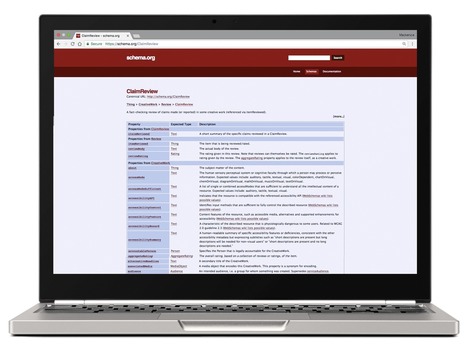
After assessing feedback from both users and publishers, we’re making the Fact Check label in Google News available everywhere, and expanding it into Search globally in all languages. For the first time, when you conduct a search on Google that returns an authoritative result containing fact checks for one or more public claims, you will see that information clearly on the search results page. The snippet will display information on the claim, who made the claim, and the fact check of that particular claim.
Via Nik Peachey
|
|
Scooped by
Kim Flintoff
April 9, 2017 7:45 PM
|
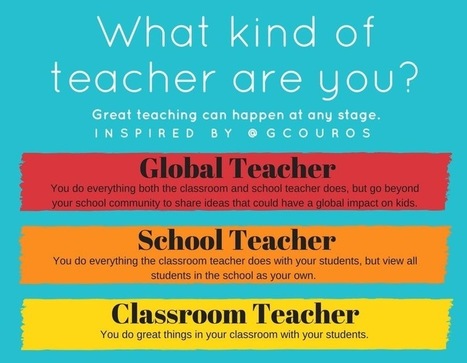
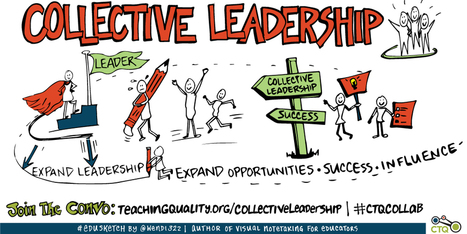
I love this image created by David Carruthers during #IMMOOC because I truly subscribe to Global Teacher mindedness.
Using technology and social media to reach beyond our classroom walls is both a passion and an obsession of mine. It is also the very anchor of student Digital Leadership. But this week has really given me pause to think about not only the importance of global connectedness, but also the nature of Innovation.
I co-moderate a book club at my school and my students always want to not just read books but do something to promote a love of reading. We have been talking about sharing our love of children’s books and the students really wanted to reach out to the local daycare or local elementary school to read to the kids. Unfortunately, there seem to be lots of road blocks preventing this from happening.
|
|
Scooped by
Kim Flintoff
April 5, 2017 9:47 PM
|
Scores of men are responding to an alleged attack on a gay couple in the Netherlands... by holding hands.
Jasper Vernes-Sewratan and his husband, Ronnie Sewratan-Vernes, were reportedly attacked early Sunday by a group of six to eight teenage boys, RTL Nieuws reports. The men said they were returning to their Arnhem home hand-in-hand from a party at the time of the attack.
The incident sent shockwaves through the Netherlands’s LGBTQ community, and was reportedly condemned by Dutch Prime Minister Mark Rutte. But two of the country’s other lawmakers went a step further, showing solidarity for the couple by holding hands as they arrived at a government meeting Monday.
|
|
Scooped by
Kim Flintoff
April 2, 2017 8:34 PM
|
FREE Seminar Prof John Fischetti Newcastle University Every Child Deserves the Education that is Right for Them: The Challenge of Learning Differences and Equity CLICK TO VIEW
|
|
Scooped by
Kim Flintoff
March 21, 2017 7:44 PM
|
This approach to teaching critical thinking (CT) makes use of the ‘descriptive-not-prescriptive’ principle I introduced in this article for Innovate My School. In other words: teach by showing them (the students) what they already do rather than telling them what they should be doing but aren’t. Though I will talk about philosophy sessions, as that is my background, the principles and procedure that you will find outlined here apply to any teaching context where the teaching of CT skills will be of value, whether maths, English or P.E.
In my work I have long advocated a dispositional approach to critical thinking over a skills-based approach. The idea is that if we give the children the opportunity to think through issues together they will, without instruction, employ CT skills. By doing philosophy regularly, the aim is that the children learn to naturalise and internalize making use of those skills so that they are disposed to use them in situations where CT skills are called for. And it is anecdotally true to say that children, during philosophy sessions, make use of many CT skills such as recognising an infinite regress, identifying and challenging assumptions, drawing distinctions, providing counter-examples, spotting some formal and informal fallacies etc. There is an extent, however, to which I have taught CT skills making use of my knowledge of CT by modeling and highlighting how to approach CT. Here is an account from a colleague of mine, Miriam Cohen Christofidis, about how she does this
|
|
Scooped by
Kim Flintoff
March 21, 2017 12:23 AM
|
The focus of W4A2017 will be ‘The Future of Accessible Work’
With expanding globalisation, work is becoming less of a local activity, with many now working on teams spread over great distances. Inclusive work environments have the potential to greatly improve the ability of people to obtain and maintain meaningful employment, despite disabilities or other impairments. Organisations and employers are also embracing the benefits of being more inclusive in their human resource management. More flexible working arrangements — such as telecommuting for remote employees, better access to remote work technologies, access to better data platforms, and employees using their own devices (BYOD) — are just a few of the possibilities that employers are exploring.
|
|
Scooped by
Kim Flintoff
March 21, 2017 12:21 AM
|
The 26th International World Wide Web Conference returns to Australia for the first time since 1998 and will be hosted by Perth, a beautiful, progressive city and one of Australia’s major gateways to Asia and the world.
WWW2017 will include a three-day technical program, two days of workshops and tutorials, a poster display and hands-on developer day plus broad alternate tracks, keynote speeches and invited talks, seminars and panel discussions.
The main technical program of WWW2017 will consist of the W3C track, 11 core tracks, and three alternate tracks which will give conference attendees an opportunity to learn about ongoing research projects through conference sessions, panel discussions and informal interactions.
|
|
Scooped by
Kim Flintoff
March 21, 2017 12:17 AM
|
The Bytes and Rights 2017 conference is being held as part of the Festival of the Web, an 8-day series of international conferences in early April in Perth.
See the full program of Festival of the Web events.
Bytes and Rights is a conference focused on the many issues around how society responds to changing technology, especially technology related to the Internet.
We will discuss legal, policy, regulatory and social responses to issues such as human rights, intellectual property enforcement, security and harassment. We aim to bring together experts including academics, lawyers, commercial practitioners, technologists, and civil society groups in a open dialog that cuts across specific disciplines.
|
|
Scooped by
Kim Flintoff
February 22, 2017 7:56 PM
|
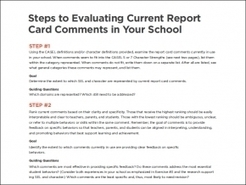
Based on content from The Other Side of the Report Card: Assessing Students’ Social, Emotional, and Character Development, this guide helps educators identify better ways to assess and report on students’ social-emotional skills and character development within school report cards. Learn more about this approach in Maurice Elias' blog post, "How Do We Measure Social and Emotional Learning?"
|
|
Scooped by
Kim Flintoff
February 6, 2017 8:09 PM
|
The report found students who were quietly disengaged did just as poorly as those who misbehaved – typically falling up to two years behind their peers – and all disruptive behaviour reduced how much other students learned.
A third of teachers say they’re highly stressed by the challenges of keeping students engaged in learning and most new teachers said their training didn’t prepare them adequately to deal with behavioural issues.
Students avoiding school work, disrupting the lesson and being disengaged were nominated as the most difficult issues to manage. The poor behaviour and disengagement happened more often in disadvantaged schools.
|
|
Scooped by
Kim Flintoff
February 6, 2017 6:15 PM
|
An alternative is to recognise that the fundamental purpose of assessment is to establish and understand where individuals are in their long-term learning progress at the time of assessment.
This usually means establishing what they know, understand and can do – something that can be done before, during or after teaching, or without reference to a course of instruction at all.
Underpinning this alternative is a belief that every learner is capable of further progress if they can be engaged, motivated to make the appropriate effort and provided with targeted learning opportunities.
This is a more positive and optimistic view than a belief that there are inherently good and poor learners as confirmed by their performances on year-level expectations.
|
|
Scooped by
Kim Flintoff
February 2, 2017 10:11 AM
|
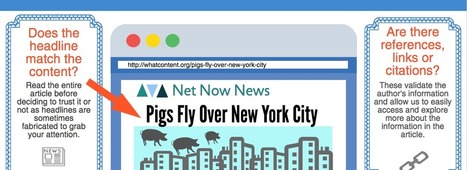
Introducing our infographic to help students identify fake news articles. Looking for more resources? We’ve listed some of our favorites below!
|
|
Scooped by
Kim Flintoff
January 25, 2017 4:06 AM
|
To help you take your students' writing to the next level, this FreeBook brings together a selection of resources from the latest Descriptosaurus books.
Get Your FreeBook
Each chapter in the FreeBook focuses on a different genre, which we've selected from Alison Wilcox's Descriptosaurus writing guides. These new guides were written following a competition organised by the National Literacy Trust and Routledge.
|
|
|
Scooped by
Kim Flintoff
April 12, 2017 7:47 PM
|
Fletcher Previn could be one of th
|
|
Scooped by
Kim Flintoff
April 8, 2017 2:44 AM
|
Collective leadership represents the recognition that we can operate in one of two ways: as a human-centered enterprise or as a sterile system. Systems can be very mechanical; they have interchangeable cogs. But education is a human-centered enterprise. We cultivate the minds, hearts, and emotional well-being of students and staff. Human-centered efforts focus on people, so the system operates more like an organism and less like a machine.
The analogy I would use is an amoeba under a microscope. Think about the amplified image of a needle poking the amoeba and the entire thing moves. It is so interdependent that touching one part has a ripple effect across the whole.
Collective leadership can be represented in that way. There is recognition that no one person has all the knowledge, talent, skills, and experience to meet the needs of everyone in the system. You need to have collective leadership to be highly effective. If you’re about cultivating success of all kids, then you have to recognize that it is impossible to do it alone.
|
|
Scooped by
Kim Flintoff
April 3, 2017 8:21 AM
|
In our case, the participating college professor entertained the participating high school students with his own evolution from a disinterested high school student to successful college professor. Participants demanded at each session’s conclusion that College Mentoring 2.0 “should happen more often.”
High school teachers and college professors are encouraged to apply ubiquitous 21st century access and technologies to reinvent the dated methods of communication between high school and college students. College Mentoring 2.0 may not only be a futuristic college recruitment method, it may also be a new methodology for college students to impact the commitment, performance, and success of high school students.
Finally, College Mentoring 2.0 may assist those who are seeking more immediate advice on how to be successful in today’s schools and communities.
|
|
Scooped by
Kim Flintoff
March 24, 2017 10:13 PM
|
Zehra Doğan's has been sentenced to prison for a painting depicting the destruction caused by Turkish security forces in a Kurdish region.
The Turkish-Kurdish painter and journalist Zehra Doğan has been sentenced to 2 years, nine months, and 22 days in prison for creating a painting which depicted the destruction caused by Turkish security forces in the Nusaybin district of Mardin province, a Kurdish region in Turkey. According to Turkish daily Cumhuriyet, the Mardin Second High Criminal Court in Turkey handed down the sentence because she drew Turkish flags on buildings destroyed by Turkish forces. However, according to Artforum, the court expressed that Doğan’s sharing of the image of her work, featuring current military operations, was the cause for her prison sentence.
|
|
Scooped by
Kim Flintoff
March 21, 2017 12:25 AM
|
Our Exciting Program
The Festival of the Web runs from Sunday 2 April, to Sunday 9 April.
This program shows the major conference and co-located events running over this 8-day period. In addition, we will be offering a wide variety of Keynote speakers, panel sessions and sundowners, and invited speakers on current and controversial topics.
Each day there will be an additional set of smaller events to interest you, opportunities to meet and mingle with local and international experts, and a range of high-quality social events.
To cap it all off, we are planning cultural activities in and around the city for delegates to enjoy after the daily program concludes.
Download an A4 version of this program overview [1 Mb].
|
|
Scooped by
Kim Flintoff
March 21, 2017 12:22 AM
|
Bringing together academic and industry leaders in the big data space to share the state of the art and its successful application in business.
Many of today’s most successful enterprises – in business and in science – are built on the collection and analysis of data. The sheer volume and richness of these data sets has stimulated a massive wave of innovation. In addition, this revolution has also sparked important debate on data privacy policies, ethics and governance.
BIG2017 (The BigData Innovators Gathering) will focus on Deep Learning and Big Data Analytics. This event will be co-located with WWW conference for the fourth time. The gathering will consist of keynotes from visionaries in the field, a panel on hot topics, and talks on successes and best practices.
|
|
Scooped by
Kim Flintoff
March 21, 2017 12:20 AM
|
It is with great pleasure that we invite you to participate in the 5th International Conference on Serious Games and Applications for Health, IEEE SeGAH 2017, to be held in Perth, Western Australia, from 2 - 4 April 2017, at the Perth Convention and Exhibition Centre, co-located with 26th International World Wide Web Conference, 2017.
The authors of SEGAH 2017 proceeding papers are invited to submit extended versions of their papers to the special issue “Serious games and Applications for Health” from the Information — Open Access Information Science Journal
The 5th IEEE edition of SEGAH also features a special-topic workshop on Augmented Reality, Virtual Reality and Wearable Technologies. See topics here
David Gibson confirmed as keynote speaker. David Gibson is Curtin University’s Director of Learning Futures. He is also the UNESCO Chair of Data Science in Higher Education Learning and Teaching and the Education Theme Leader of the Curtin Institute for Computation.
Rudy McDaniel confirmed as keynote speaker. Rudy McDaniel is Associate Professor of Digital Media at the University of Central Florida. His research focuses on narrative, digital ethics, digital badges, and game-based learning.
|
|
Scooped by
Kim Flintoff
February 25, 2017 8:39 PM
|
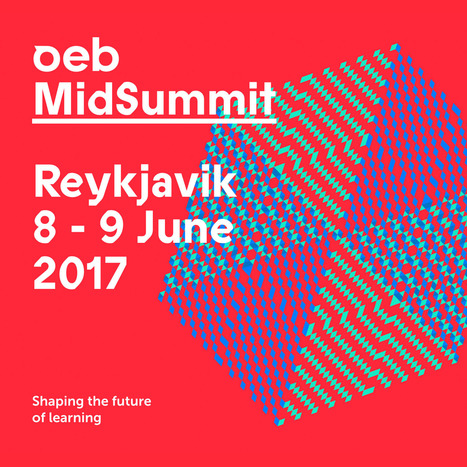
OEB MidSummit is a two day Mid-Atlantic event which will explore the complexity of learning in the digital era through multidisciplinary perspectives.
It will bring together leading experts, thinkers, innovators and practitioners from North America and Europe to examine and discuss the future of learning.
|
|
Scooped by
Kim Flintoff
February 9, 2017 8:10 AM
|
By now, the 4Cs–communication, collaboration, critical thinking, and creativity–are part of most educators’ vocabulary. But it isn’t always easy to put these concepts into practice, especially when the 4Cs can look vary depending on students’ age and ability.
At TCEA 2017, Donna Lusby, the K-6 instructional technology coordinator in the Lovejoy ISD shared how her district moved from what she characterized as “hesitant technology integration” to teachers embracing the 4Cs in their lessons.
|
|
Scooped by
Kim Flintoff
February 6, 2017 8:08 PM
|
Ophthalmologists are calling on parents to ensure their children’s eyes are properly protected while they’re at school, and for schools to help out.
The Royal Australian and New Zealand College of Ophthalmologists has issued a statement saying that schools should implement a ‘no hat, no sunglasses, no play’ policy for children. Student sunglasses are mandatory in the Education Department regulations of various states. But many schools don’t adhere to them.
|
|
Scooped by
Kim Flintoff
February 3, 2017 7:18 PM
|
DOWNLOAD PAPER
EXECUTIVE SUMMARY
This playbook shares the findings of three researchers who set off to discover what K–12 schools can learn from the best-run organizations in America. Why are companies such as Zappos, Geico, and Google continually ranked among the best places to work if you want to be happy and successful? Could classroom teachers use similar strategies to improve their students’ happiness and performance, not to mention their graduates’ readiness to work in America’s top organizations someday?
The researchers—all of whom are former K–12 teachers—began by searching for strategies that successful managers in today’s well-regarded organizations have in common. They found that the best managers in leading organizations do at least three things extraordinarily well: they empower their teams and do not micromanage, they are great coaches, and they emphasize accountability.
|
|
Scooped by
Kim Flintoff
January 30, 2017 12:02 AM
|
With the Muslim ban, Trump has shown that the worst fears about his Presidency are true. Add your voice to the open letter below to join the resistance — then spread it far and wide:
----
Dear Mr. Trump,
This is not what greatness looks like.
The world rejects your fear, hate-mongering, and bigotry. We reject your support for torture, your calls for murdering civilians, and your general encouragement of violence. We reject your denigration of women, Muslims, Mexicans, and millions of others who don’t look like you, talk like you, or pray to the same god as you.
Facing your fear we choose compassion. Hearing your despair we choose hope. Seeing your ignorance we choose understanding.
As citizens of the world, we stand united against your brand of division.
Sincerely,
[Add your name!]
|





















An interesting attempt from Google to help stamp out fake news.