Your new post is loading...

|
Scooped by
Douglas Eby
February 23, 2013 2:51 PM
|
“I’m not crazy, I’ve just been in a very bad mood for 40 years.” Ouiser Boudreaux (Shirley MacLaine), in Steel Magnolias (1989). In his book The Art of Happiness, The Dalai Lama claims “Whether one believes in religion or not, the very purpose of our life, the very motion of our life is towards happiness.” But many of us aren’t so sure about that notion.
|
|
Scooped by
Douglas Eby
February 21, 2013 2:40 PM
|
A significant study from Duke, out today, provides the best evidence we’ve had thus far that bullying in childhood is linked to a higher risk of psychological disorders in adulthood. The results came as a surprise to the research team.
|
|
Scooped by
Douglas Eby
February 16, 2013 2:02 PM
|
Can such a profoundly challenging mental health issue like depression actually have some benefit for the many creative people who suffer from it?
|
|
Scooped by
Douglas Eby
February 15, 2013 12:06 PM
|
|
|
Scooped by
Douglas Eby
February 13, 2013 10:34 PM
|
Can such a profoundly challenging mental health issue like depression actually have some benefit for the many creative people who suffer from it? “The only thing I could do was write. I used to crawl from the bedroom to the computer and just sit and write, and then I was alright, because I was not present. ‘Sense and Sensibility’ really saved me from going under, I think, in a very nasty way.” - Emma Thompson on her depression in the past.
|
|
Scooped by
Douglas Eby
February 11, 2013 1:08 AM
|
|
|
Scooped by
Douglas Eby
February 9, 2013 3:53 PM
|
Certain painful experiences are more likely to precede depressive episodes than others. And some forms of loss can trigger depression more quickly than previously realized... Among 100 people who had been diagnosed with major depressive disorder, those who had experienced greater adversity in their childhoods and who had a longer history of depression were more likely to have had episodes of depression triggered by relatively minor forms of loss.
|
|
Scooped by
Douglas Eby
February 8, 2013 10:45 PM
|
"I was feeling so sad all the time, and I couldn’t shake it. I started burying my feelings, and it got to a point where I couldn’t even tell my family or my friends, ‘I’m twisted,’ or ‘I’m exhausted,’ or ‘I’m so angry.’” Alicia Keys added, “I became a master of putting up the wall so that I was unreadable.” Eric Maisel, PhD writes in his book The Van Gogh Blues: “The cliche is that creativity and depression go hand-in-hand. Like many cliches, this one is quite true. “But creators are not necessarily afflicted with some biological disease or physiological disorder… They experience depression simply because they are caught up in a struggle to make life seem meaningful to them.
|
|
Scooped by
Douglas Eby
February 6, 2013 1:55 PM
|
Effexor is prescribed for depression, but a group of U.K. librarians have another suggestion: reading. // A good book is like good medicine. This is the message that comes to us from assorted British health professionals, and reiterated last week by the U.K.’s leading librarians.
|
|
Scooped by
Douglas Eby
February 5, 2013 6:27 PM
|
Personality traits like high sensitivity, and issues such as self esteem, self-doubt, anxiety, depression and other challenges, impact our creativity.
|
|
Scooped by
Douglas Eby
January 23, 2013 3:05 PM
|
Pretty much all of us experience some kind of trauma in life; how does creative expression help people recover? "I think I’ve spent my adult life dealing with the sense of low self-esteem that sort of implanted in me..." Halle Berry
|
|
Scooped by
Douglas Eby
January 19, 2013 7:02 PM
|
“Writing is so difficult, that if it doesn’t heal you in the doing of it it isn’t worth the trouble.” That is a quote by massage therapist, author, artist and teacher Cynthia Waring. In her book and one-woman play, both titled “Bodies Unbound”, she relates the story of her life and growth as a therapist and artist, her journey of self-discovery and healing from childhood trauma and abuse.
|
|
Scooped by
Douglas Eby
January 10, 2013 6:57 PM
|
Research and historical studies show there are high rates of bipolar disorder among people in the arts, including visual artists, musicians, poets and writers. In her Psych Central article The Link Between Bipolar Disorder and Creativity, Jane Collingwood notes an Oregon State University study that “looked at the occupational status of a large group of typical patients and found that ‘those with bipolar illness appear to be disproportionately concentrated in the most creative occupational category.’ In the same article, Collingwood writes that Katherine P. Rankin, Ph.D. and colleagues at the University of California-San Francisco comment that bipolar patients can show unusual brain anatomy, specifically “diminished frontal regulation of subcortical affective systems involving the amygdala and striatum, which may increase their affective instability as well as their compulsiveness.”
|
|
|
Scooped by
Douglas Eby
February 22, 2013 3:44 PM
|
Self-care is often the last thing on your mind when you’re struggling with depression. It takes energy and “a sense that you want to be around tomorrow” Deborah Serani, Psy.D, a clinical psychologist who’s experienced depression since childhood, described the fatigue as a “knuckle-dragging, heavy-limbed, bone-weary, energy-zapping exhaustion.” Depression also causes groggy and slow thinking, “which makes it hard to kick-start problem solving skills.”
|
|
Scooped by
Douglas Eby
February 19, 2013 3:50 PM
|
Main topics:
Personality: High Sensitivity | Self Concept / Self Esteem
Mental Health: Anxiety | Depression | Trauma
|
|
Scooped by
Douglas Eby
February 15, 2013 11:33 PM
|
In his article Existential Depression in Gifted Individuals, James T. Webb, Ph.D. writes : “It has been my experience that gifted and talented persons are more likely to experience a type of depression referred to as existential depression."
|
|
Scooped by
Douglas Eby
February 14, 2013 11:40 AM
|
Many creative people experience depression. It is vital to get help, but also to consider how we label and respond to mental health challenges.
|
|
Scooped by
Douglas Eby
February 13, 2013 4:52 PM
|
If I can give just one person hope that there's an end to depression, that it is treatable, then that made it worth it for me to write the book.
|
|
Scooped by
Douglas Eby
February 9, 2013 9:40 PM
|
“Though my dark side is dormant right now, it continues to play a big role in whatever capacity I have to be creative.” Jessica Lange
Can such a profoundly challenging mental health issue like depression actually have some benefit for the many creative people who suffer from it?
|
|
Scooped by
Douglas Eby
February 8, 2013 11:19 PM
|
Depression can be a profoundly damaging and disrupting condition, spiritually and psychologically corrosive, preventing us from living fully and realizing our talents. But a number of people also say the experience has had real value for them.
|
|
Scooped by
Douglas Eby
February 7, 2013 10:52 PM
|
Excerpt from radio program hosted by Michele Rosenthal. "Is there a correlation between trauma and creativity? Can creativity actually help you overcome trauma? If you’re not a ‘creative person’, can you utilize elements of creativity in recovery?"
|
|
Scooped by
Douglas Eby
February 6, 2013 1:18 PM
|
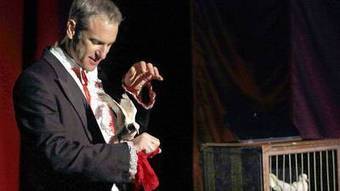
"Albie Selznick's career has been a long, tiring and, at times depressing trip through comedy, music and acting....The actor-magician says his show, which draws heavily from his childhood struggles to cope with his father's death by using magic, is a story about overcoming fear."
|
|
Scooped by
Douglas Eby
January 24, 2013 1:58 PM
|
In addition to all the destructive consequences that may follow traumatic experience, some people say it also has power to encourage creative expression.
|
|
Scooped by
Douglas Eby
January 23, 2013 3:02 PM
|
A new study suggests there may be a connection between creativity and posttraumatic stress disorder [...]
|
|
Scooped by
Douglas Eby
January 10, 2013 9:53 PM
|
By Cat Robson Just what is 'normal' for a creative person? After trying clumsily to conform to what others consider normal for much of my life, I'm beginning to appreciate my own moods and personality. Are creative people like us ‘abnormal’? In his paper The Abnormal Psychology of Creativity, Steven James Bartlett writes….
|