A broad selection of articles, talks and ideas for Maths teachers from the Internet, brought to you courtesy of the Rondebosch Boys' High School Library (If you would like to receive a weekly newsletter of the latest items in this Scoop just mail me at library@rondebosch.com)
Published on Feb 25, 2015 Discover how to make love hearts from Mobius strips, 4d frames from drinking straws and pipe-cleaners, and other maths tricks in this entertaining talk by comedian and mathematician Matt Parker. Matt explains how to know when someone's throwing a 4d cubes at you and also what happens when your mum knits a three dimensional shadow of a four dimensional donut - to wear on your head, in this fun talk on the challenges of visualising the fourth dimension.
Published on Mar 29, 2015 From the "Interactive Media & Games Seminar Series": A Stanford mathematician & Co-founder/Executive Director of the H-STAR Institute, Keith Devlin addresses insights of creating mathematics based learning video games gleaned from his work with the educational technology company BrainQuake.
The CK-12 Foundation, a nonprofit organization that develops open source software for education, has introduced free math and science adaptive practice apps for iOS and Android devices, expanding the platform beyond its existing Web apps for Windows 8 and Chromebooks.
TACOMA, Wash. -- How about this for a movie script: A man who hates math gets punched in the face and turns into a math savant. It's not Hollywood -- it's real. In fact, experts say it could happen to any of us.
Published on Mar 3, 2015 The Mathemagician explains how multiplying numbers from left-to-right in your head (instead of right-to-left, as you do it on paper), makes mental math easier, and multiplying any 3 three-digit number a breeze.
Over the past decade, the free instructional website Khan Academy has transformed how tens of millions of students across the globe perceive and approach math. Now, it’s pursuing a bigger aim: transforming how students perceive themselves.
Published on Feb 19, 2015 What is it about Euclid's infinite primes that rocks Simon Singh's world? What makes math different from the rest of the sciences? Listen as he and mathematician Marcus du Sautoy explain why, to them, math is a language of beauty, creativity, and immortality—for its unshakable proofs allow you to truly stand solidly on the shoulders of giants.
Published on Feb 19, 2015 How do mathematicians work? Is it like the movies, where a tortured professor scribbles equations all over a blackboard before falling into despair? Probably not. The problems of mathematics are becoming increasingly complex, and while some mathematicians prefer to work alone, more find it to be a group effort.
Mountain View's Auto Math class teaches students the same concepts they would have learned in other advanced math classes, like Algebra III or Pre-Calculus. But instead of solving for A, B or X, students apply the concepts they learn to auto mechanics.
A typical problem: "Find the airflow for a six-cylinder Aston Martin with a bore of 91.0 mm and stroke of 83 mm when it is idling at 860 rpm and the throttle is open 16 percent with 87 percent volumetric efficiency."
Published on 13 Feb 2015 Professor David Eisenbud - director of MSRI - on the amazing 17-gon and its link to Gauss. See end of this video for a bit MSRI's address at 17 Gauss Way!
Published on Jan 16, 2015 Marcus Du Sautoy investigates the writings of Argentine master, Jorge Luis Borges, seeking its mathematical underpinnings. Looking both at the life of the man and his texts, specifically ‘The Library of Babel’ Professor Du Sautoy shows how this singular author has found a way to describe the shape of an infinite universe that eerily mirrors the thinking of modern mathematicians.
Published on Feb 10, 2015 Austrian logician Kurt Gödel’s incompleteness theorems showed us the limitations of mathematics within mathematics. While math is still useful for proving scientific theorems, Gödel transformed the perception of pure mathematics in a way that still makes modern mathematicians uncomfortable. Here, leading thinkers—a mathematician, a philosopher, and a physicist—wrestle, almost literally, with the implications of Gödel’s legacy.
NPR Ed is celebrating 50 Great Teachers. Today: The story of a young algebra teacher in Oklahoma oil country, who has taken an unorthodox approach to classroom math.
Although powered by simple rotary engines, these kinetic sculptures by Netherlands-based sculptor Jennifer Townley are dizzying in complexity. Repetitive patterns twist, merge, and cascade as individually sculpted elements rotate on a single axis, an intricate fusion of art and mathematics.
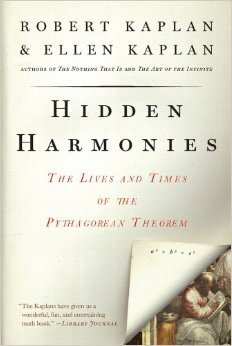
A squared plus b squared equals c squared. It sounds simple, doesn't it? Yet this familiar expression is a gateway into the riotous garden of mathematics, and sends us on a journey of exploration in the company of two inspired guides, acclaimed authors Robert and Ellen Kaplan. With wit, verve, and clarity, they trace the life of the Pythagorean theorem, from ancient Babylon to the present, visiting along the way Leonardo da Vinci, Albert Einstein, President James Garfield, and the Freemasons-not to mention the elusive Pythagoras himself, who almost certainly did not make the statement that bears his name.
Published on Mar 5, 2015 Is the number 1.618033987, otherwise known as the golden ratio, the secret to perfection? Or is it just a load of old nonsense? Hannah Fry sets out to explain all...
Published on Feb 19, 2015 Is it possible to deduce the shape of the universe without stepping outside of it? Henri Poincaré thought so. Similar to how the Greeks were able to discern the spherical nature of the earth using mathematics, he proposed that we should be able to make conclusions about our universe. Stanford University mathematician Keith Devlin explains the Poincaré Conjecture, which became a legendary problem in mathematics, with the help of a short animation.
Published on Feb 19, 2015 Look around you. Underlying every aspect of the world is a language that we all know, though our use and expertise may vary. This language, mathematics, can be used to describe everything from the proliferation of waves through a medium to how many seeds will fit on a sunflower. The harder scientists look at the natural world, the more they find it can be described with mathematics.
Published on Feb 19, 2015 Normally, when you think about math, the word "creativity" doesn't readily come to mind. Playing his best devil's advocate, Robert Krulwich challenges the panel to explain the "beauty" of a formula or the "elegance" of a proof. Is math a kind of art? Can a great mathematical idea be compared to a work of Shakespeare? Can it be poetry in numbers, or ideas?
Published on 13 Feb 2015 Finding the right mate is no cakewalk — but is it even mathematically likely? In a charming talk, mathematician Hannah Fry shows patterns in how we look for love, and gives her top three tips (verified by math!) for finding that special someone.
Published on 16 Feb 2015 Max Tegmark visited Google's Cambridge, MA office to discuss his book, "Our Mathematical Universe: My Quest for the Ultimate Nature of Reality". The book describes his quest to explore the ultimate nature of reality, from the microcosm to our universe and beyond.
Dr. Tegmark is an MIT physics professor who loves thinking about life's big questions. He is author or coauthor of more than two hundred technical papers, and his work with the Sloan Digital Sky Survey collaboration on galaxy clustering shared the first prize in Science magazine's "Breakthrough of the Year 2003".
Published on Feb 10, 2015 Basic researchers working in pure mathematics often develop fundamental laws, even entire branches of math, without any specific application in mind. Yet, as Mario Livio points out here, many of these posited laws turn out—sometimes centuries later—to perfectly describe the behavior of the real world with remarkable precision. This phenomenon was best articulated in the early 1900s by the Hungarian physicist Eugene Wigner as the "unreasonable effectiveness of mathematics." And it begs the question: What gives mathematics this power? Cognitive scientist Marvin Minsky provides an interesting, if wry, answer: if it were not the case, there would be no one to notice.
To get content containing either thought or leadership enter:
To get content containing both thought and leadership enter:
To get content containing the expression thought leadership enter:
You can enter several keywords and you can refine them whenever you want. Our suggestion engine uses more signals but entering a few keywords here will rapidly give you great content to curate.


 Your new post is loading...
 Scoop.it!