Imagine taking an online class with approximately 2,500 students from all over the world. What if no credits were awarded, it was on-demand whenever time permitted and the structure allowed participants to choose their own adventure? Welcome to a Massive Open Online Class (MOOC). The topic of the latest MOOC is the current state of online education and its future trajectory.
Dave explains Knowledge in a MOOC. Written and Narrated by Dave Cormier Video by Neal Gillis Researchers: Dave Cormier Alexander McAuley George Siemens Bonni...
Is MOOC the solution to future learning, especially online education and learning in Higher Education? Our past experience with MOOC has interesting results. There are huge potential in its use...
MOOC Mythbuster – What MOOCs Are and What They Aren't. Debbie Morrison / Posted on May 29, 2012 “Welcome to the college education revolution. Big breakthroughs happen when what is suddenly possible meets what ...
I suspect that I’m not the only one who has been ‘disengaged’ from the online world of online learning for the past few weeks, in my case for minor medical reasons, and in your case I hope enjoying sun, sand and socializing. So in this post I’m going to pull together a number of recent publications in the blogosphere which taken together, suggest that there are deep rumblings in North America’s public post-secondary education systems, if not outright panic in the streets. Or it may just be summer madness and too much heat. I’ll leave you to judge.
I came up with 12 types of MOOCs that are possible or that might be employed in the coming years. When done, I sent them off to my friend Jay Cross over in Berkeley for review and went off running. During that run, I came up with four more MOOC-related ideas, all of which started with an "R" word. And so my list stood at 16 types, targets, or intents of MOOCs. As per usual, fantabulous Jay wrote me back a few hours later. He had found my list and questions to him "interesting" and suggested four additional ideas which brought my list up to 20.
If you’re even casually aware of what is happening in higher education, you’ve likely heard of massive open online courses (MOOCs). They have been covered by NY Times, Chronicle of Higher Education, TV programs, newspapers, and a mess or blogs. While MOOCs have been around since at least 2008, the landscape has changed dramatically over the past 10 months. In this timeframe, close to $100 million has been invested in corporate (Udacity) and university (EDx and Coursera) MOOCs . And hundreds of thousands of students have signed up and taken these online course offerings.
Created through funding received by the University of Prince Edward Island through the Social Sciences and Humanities Research Council's "Knowledge Synthesis Grants on the Digital Economy"
The University of Washington plans to offer “enhanced” versions of the massive open online courses (MOOCs) it will develop through a partnership with Coursera, according to the university’s provost.
The "enhanced" versions will add a number of features designed to make them more closely resemble conventional online courses -- including more assessments, direct interaction with instructors, and the opportunity to earn a certificate that hypothetically could be redeemed for course credit.
In November, Wolfram Burgard, a professor of computer science at the University of Freiburg, in Germany, administered an online midterm exam for a course in artificial intelligence to 54 students. The test-takers sat in the lecture hall, spaced at least a meter apart, with proctors roaming the aisles to make sure nobody was looking up clues or chatting online with co-conspirators.
Princeton University, the University of Pennsylvania and the University of Michigan at Ann Arbor have teamed up with a for-profit company to offer free versions of their coveted courses this year to online audiences. By doing so, they join a growing group of top-tier universities that are embracing massively open online courses, or MOOCs, as the logical extension of elite higher education in an increasingly online, global landscape.
Constructivist is what constructivist explores I am in the process of constructing a week of activities on ICT4D (and Mobile for Development-M4d) for the next installment of the MobiMOOC scheduled ...
Massive Open Online Courses (MOOCs) are getting lots of press. The 3/4/12 issue of the NYTimes declares that "Instruction for Masses Knocks Down Campus Walls". 160,000 learners participate in Stanford's AI course, which begets a whole new crop of MOOCs in everything from natural language processing to game theory.
Should your university offer its own MOOC? Probably not. Higher ed is a "me too / follow me" business. We are risk adverse because most of us have lots to lose. So when an MIT does an OpenCourseWare / MITx or a Stanford does a MOOC we are all much more likely to follow along. But offering open course materials or learning environments may not make sense for your institution.
A description of the five steps that will help you succeed in a MOOC. Written and Narrated by Dave Cormier Video by Neal Gillis Researchers: Dave Cormier Ale...
Stephen's Web, the home page of Stephen Downes, with news and information on e-learning, new media, instructional technology, educational design, and related subjects...
As part of a seismic shift in online learning that is reshaping higher education, Coursera, a year-old company founded by two Stanford University computer scientists, will announce on Tuesday that a dozen major research universities are joining the venture. In the fall, Coursera will offer 100 or more free massive open online courses, or MOOCs, that are expected to draw millions of students and adult learners globally.
…a short course on becoming a great internet searcher
Google Search makes it amazingly easy to find information. Come learn about the powerful advanced tools we provide to help you find just the right information when the stakes are high.
This entry is part of a reflective series of posts/questions relating to online learning, MOOCs, and openness.
MOOCS are everywhere nowadays. Coursera, Udacity, EdX, the connectivist MOOCs (e.g., #ds106, Change11), etc, depending on what lens one is using to examine them, are generating hope, excitement, uneasiness, and frustration. An important question that one needs to ask is: What is the purpose of a MOOC?
Now I am going to warn you, I have drunk deeply from the MOOC cool-aid - my experience in Connectivism and Connective Knowledge changed how I work, and how I engage with faculty and students in some very positive, deep, and profound ways. I don't agree with everything that Siemens or Downes has written, they would be the last ones on earth to expect that, but there are no learning theories out there that can contend with, or account for, the rapid changes that are going on in education and technology than Connectivism. Interestingly enough, I think the success of MOOCs counts on an understanding of those principles.
If you visit this wiki, you probably want to register for the free, open and online MobiMOOC course which will run from Saturday 8 September - Sunday 30 September 2012 and will focus on learning/training with mobile devices (mLearning). You can register for the course by becoming a member of the Google group here.
Forget free content repositories; the Massachusetts Institute of Technology wants to deliver “interactive” elite education to the masses, complete with credentials certifying “mastery” of MIT-grade coursework.
In the latest boon for the “open education” movement, the engineering mecca on Monday announced a new online learning initiative, called MITx, that will give anyone the opportunity to work through MIT course material and earn a certificate of achievement.
The question arose in the fall, when a handful of professors at Stanford University decided to teach free courses onlineto tens of thousands of students who were not enrolled at the elite California university. The students would receive no Stanford credit; only a signed letter by the instructor, acting apart from the university.
Case in point: Know Labs seems to be skimming the cream of its first crop of students in hope of filling vacancies on its own staff. In December, Thrun sent an e-mailto the top performers in the artificial intelligence course, inviting them to apply for openings at Know Labs.
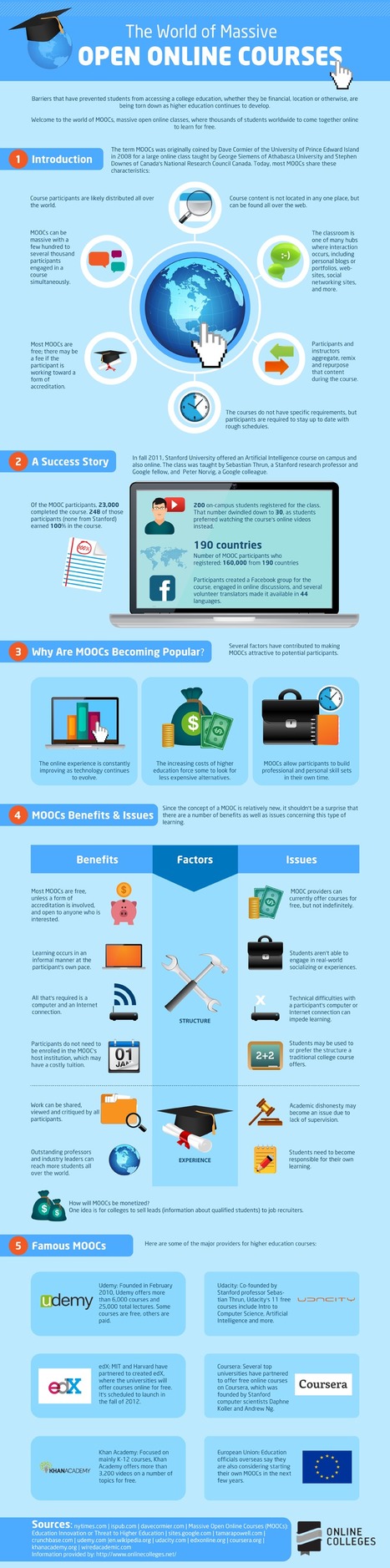
Here’s an Infographic that walks you through the dramatic changes happening in the world of online learning – the rise of the massive open online course, aka the “MOOC.” From edX at MIT and Harvard to Coursera from Stanford, top schools and shrewd entrepreneurs are getting into the business of teaching the world for free via digital technology. Take a look at how these online courses are causing a wave of disruption in education.
To get content containing either thought or leadership enter:
To get content containing both thought and leadership enter:
To get content containing the expression thought leadership enter:
You can enter several keywords and you can refine them whenever you want. Our suggestion engine uses more signals but entering a few keywords here will rapidly give you great content to curate.


 Your new post is loading...