Your new post is loading...

|
Scooped by
Christophe Fourtet
April 8, 2012 11:22 AM
|
|
|
Scooped by
Christophe Fourtet
February 18, 2012 4:50 AM
|
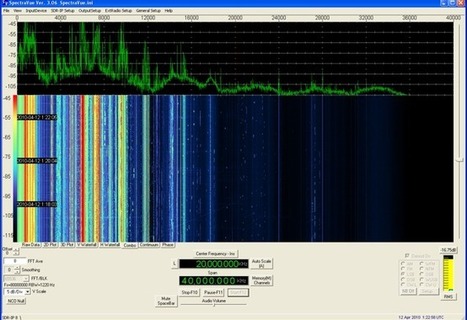
When I presented you the well-known RF-Space company http://www.rfspace.com ... I definitely forgot to mention their SDR receiving Software "SpectraVue". It has indeed been designed for their Harware, but it will work with many other Hardware, particularly common I/Q systems ... And it is 100% free ... And it is working exceptionally well under Windows platforms ! Try it, and adopt it !
|
|
Scooped by
Christophe Fourtet
February 8, 2012 11:50 PM
|
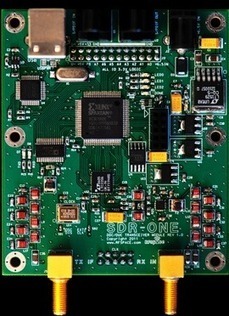
The SDR-ONE is a low cost, high performance transmit / receive module for experimentation and integration into products. The module can be used stand alone or plugged into other products. It offers very high performance with the use of a 14 bit ADC/DACs. The SDR-ONE RX/TX module offers 48,96 and 192 KHz receive bandwidths over I2S, optical audio (S/PDIF) and IQ analog out. In addition, up to 40 KHz of BW can be transmitted at a 48 Khz sample rate. The SDR-ONE sets the RX sample rate of the sound-card when using the S/PDIF or I2S outputs. In TX, I/Q signal is received via the IQ analog input or the I2S master port. The FPGA and flash memory can be reprogrammed over the built in USB port in seconds without the need of a special programming cable. The FPGA UCF file and code examples are supplied for those willing to write their own code.
|
|
Scooped by
Christophe Fourtet
January 23, 2012 3:53 AM
|
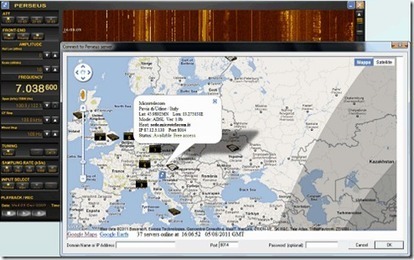
PERSEUS SDR software version 4.00b is released.
|
|
Scooped by
Christophe Fourtet
January 20, 2012 11:01 PM
|
Baudline is a time-frequency browser designed for scientific visualization of the spectral domain. Signal analysis is performed by Fourier, correlation, and raster transforms that create colorful spectrograms with vibrant detail. Conduct test and measurement experiments with the built in function generator, or play back audio files with a multitude of effects and filters. The baudline signal analyzer combines fast digital signal processing, versatile high speed displays, and continuous capture tools for hunting down and studying elusive signal characteristics. Source code is available.
|
|
Scooped by
Christophe Fourtet
January 20, 2012 10:21 PM
|
|
|
Scooped by
Christophe Fourtet
January 20, 2012 8:16 PM
|
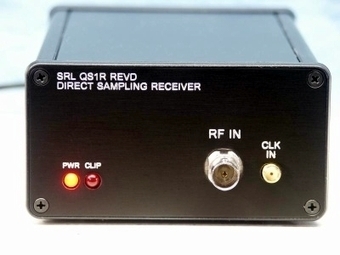
QS1R from Software Radio Laboratory LLC, is a direct sampling SDR receiver covering 10 KHz to 62.5 MHz. It is based on LTC2208 16 bits 130 MS/s A2D associated to a Cyclone III FPGA. Connected to a PC through its USB 2.0 interface, it can be operated with its software companion "SDRMAX" http://www.srl-llc.com/qs1r_latest/index.html or with HDSDR or Winrad (see previous articles for those softwares). It has to be noticed that SDRMAX source code is available...
|
|
Scooped by
Christophe Fourtet
January 18, 2012 10:25 PM
|
DSPRX was designed by Michael Keller in 2001, and as such, was one of the first SDR software available on internet ! I and Q signals are classically fed into right/left channel of a soundcard. DSPRX is realy simple, and will run on a 500MHz AMD ! Amplitude balance and constant time delay between right/left channel can be trimmed. DSPRX software + TinySDR hardware + 500 MHz AMD PC...Probably the cheapest SDR setup you can imagine !!!
|
|
Scooped by
Christophe Fourtet
January 18, 2012 9:38 PM
|
If you want to make your own GSM station, with an SDR hardware and an open software ... Here is a page for you !
|
|
Scooped by
Christophe Fourtet
January 18, 2012 8:33 PM
|
If your ambition is to develop your own SDR software or application, whatever your expertise level, from newbee to old fox, you'd better visit "GNU Radio" ! GNU Radio is a free software development toolkit that provides the signal processing runtime and processing blocks to implement software radios using readily-available, low-cost external RF hardware and commodity processors. It is widely used in hobbyist, academic and commercial environments to support wireless communications research as well as to implement real-world radio systems. GNU Radio applications are primarily written using the Python programming language, while the supplied, performance-critical signal processing path is implemented in C++ using processor floating point extensions where available. Thus, the developer is able to implement real-time, high-throughput radio systems in a simple-to-use, rapid-application-development environment.
|
|
Scooped by
Christophe Fourtet
December 28, 2011 7:12 AM
|
Pieter-Tjerk is a PhD, now assistant professor in the Design and Analysis of Communication Systems (DACS) group at the Electrical Engineering, Mathematics and Computer Science department of the University of Twente.
...But he is also an amateur (PA3FWM), and as such, with his strong scientific background, has created WebSDR that we already presented... Here is his (very informational) page on his SDR developments. You can also see his main personal page here : http://wwwhome.ewi.utwente.nl/~ptdeboer/
|
|
Scooped by
Christophe Fourtet
December 20, 2011 5:21 PM
|
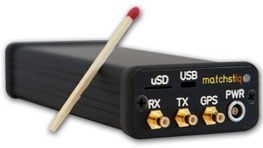
Matchstiq SDR combines a broadband RF transceiver with CPU/FPGA processing to provide a complete stand-alone software-defined radio. Covers 300 to 3800 MHz. Not really low cost (around 4500 US$), no outstanding performances (though largely sufficient for a wide variety of portable applications), but well integrated, wide band, and realy suitable for mobile spectrum RF measurements and control. Visit Epiq Solutions web pages. They have realy interesting SDR products !
|
|
Scooped by
Christophe Fourtet
December 20, 2011 4:35 PM
|
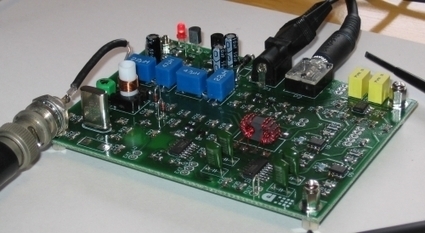
From Edson Pereira, the author of SDR-Shell, and João K. de Marco. A classical but realy well-designed QSD I/Q type receiver for low bands. Take a look at the schematics...
|

|
Suggested by
Avrel
April 8, 2012 8:31 AM
|
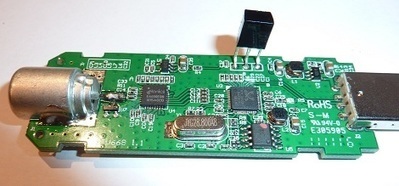
With a simple digital TV USB capture card, you can build your own software defined radio or spectrum analyzer. While it may not be as cool as [Jeri Ellsworth]'s SDR, it's still very useful and only requires $20 in hardware. However, be carefull, you have what you get for 20 $...I/Q interface is 8 bits which means around 48 dB maximum dynamics. This is OK for a single signal, isolated from others by physical filtering (TV signal indeed !), but not enough for narrowband multisignal handling (14 to 16 bits being a minimum). A solution is to oversample your baseband, and then decimate to increase the effective number of bits. For example, if you oversample by 128 around 4 Msamp/s, you will obtain an effective sampling rate of around 31 Ksamp/s, thus a combined I/Q bandwidth of 31 KHz after digital filtering, with an effective number of bits of 8+3,5=11,5 bits (70 dB dynamic). Analyze of the used Realtek chipset shows analog I/Q signal if fed to digital A/D-USB chip via 4 capacitors (I/Q differential interface). It is then possible, through HW modifications, to interpose 2 differental analog baseband filters in order to improve the system in addition to oversampling... In conclusion, an interesting solution, close to the "funcube dongle" concept, already presented here. But the funcube has more dynamic, by design.
|
|
Scooped by
Christophe Fourtet
February 18, 2012 3:21 AM
|
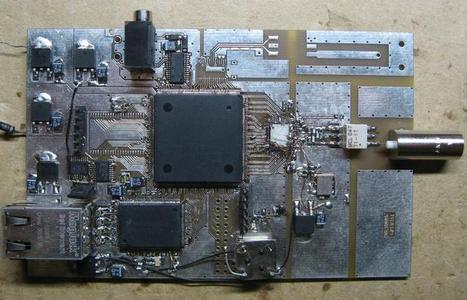
SDR MK1.5 Radio 'Andrus' is a shortwave Receiver covering 5KHz to 30 MHz with Network Interface. It is based on the National Semi LM97593 Dual ADC / Digital Tuner / AGC chip. Datasheet here : http://www.national.com/pf/LM/LM97593.html#Overview Here are some of its characteristics : -5kHz to 30MHz frequency range -0.02Hz tuning resolution -123dB total dynamic range with AGC (80dB with AGC off) -64MHz internal sampling rate -User Programmable AGC (automatic gain control) with enhanced Power Detector -48kHz/16-bit Ch A and Ch B simultaneous USB audio output, 196kHz output sample rate for single channel (A or B or diversity) in SDR-IQ protocol mode -10/100Base Ethernet interface for 400kHz sample rate through network (NetSDR protocol mode) -Max current consumption 800mA -Open software and hardware design for DIY development, filter upgrades etc. It is effectively an open design, so in case you want to customize the firmware of the radio for your own purpose, it is perfectly doable! As the schematic and layout for the radio is also available, it may also serve as the platform for your own integration project. The on-board Atmel 32-bit AT32UC3B0512 processor development GNU tools (C/C++, asm) with really nice Microsoft Visual Studio version 10 IDE are freely available from Atmel and there is an extension connector on-board with RS232TTL UART, I2C and GPIO pins dedicated for add-on hardware and user development. There is also a simplistic analog audio output on-board (24kHz/16-bit mono), that can be used for whatever it could be useful for, and a small prototyping area (space originally dedicated for custom PoE (power-over-ethernet) circuit development). Complete schematics are here : http://files.uvb-76.net/SDR_MK1.5/SDR_MK1.5_Schematic_v1.0_col.pdf

|
Suggested by
Martin
February 3, 2012 3:52 PM
|
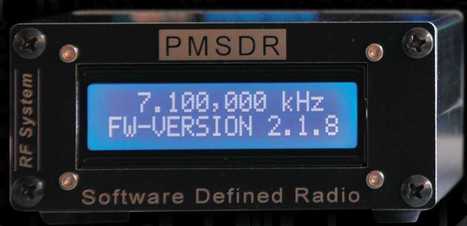
PM-SDR offers an excellent coverage/performance/cost compromise, for various 0.1 to 55 MHz SDR receive applications. It is a sum of 'little tricks" that leads to this point of optimisation. In addition, it is built in a small packaging. Based on I/Q principle, it delivers an analog I/Q interface. Thus final performance is, as usual, partially dependant on your A/D's quality and dynamics (noise floor as well as linearity...Etc). If you use a sound card for such a purpose, be carefull with "ugly" chipsets and/or designs. Potentially prefer an external high end one, like EMU0204... See RFHam site : http://www.rfham.com/c80.html PM-SDR is compatible with a large variety of SDR software. You can buy PMSDR here : http://www.rfsystem.it/shop
|
|
Scooped by
Christophe Fourtet
January 20, 2012 11:07 PM
|
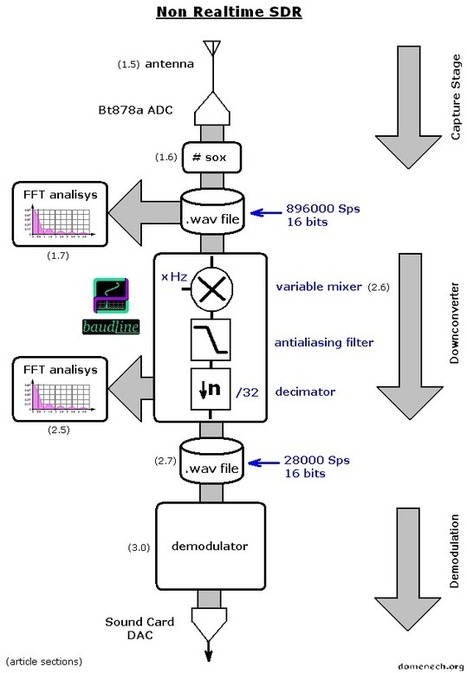
An experimental SDR receiver using the Conexant Fusion Bt878 A2D chip, working at 896 KS/s.
|
|
Scooped by
Christophe Fourtet
January 20, 2012 10:33 PM
|
A fast, free C FFT library; includes real-complex, multidimensional, and parallel transforms. Benchmarked against many other FFTs.
|
|
Scooped by
Christophe Fourtet
January 20, 2012 8:52 PM
|
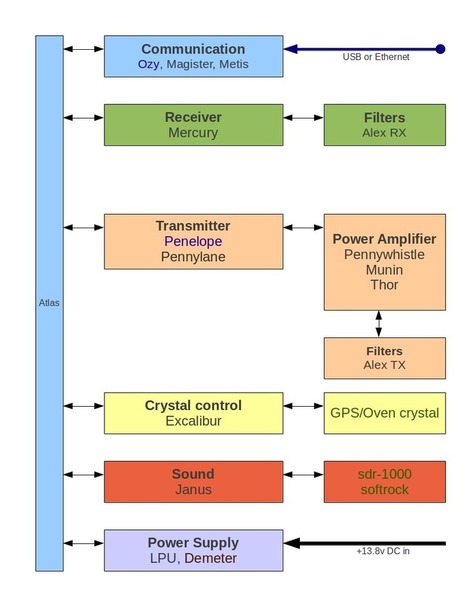
High Performance Software Defined Radio design group, open source design, uses FPGA...
|
|
Scooped by
Christophe Fourtet
January 18, 2012 10:35 PM
|
|
|
Scooped by
Christophe Fourtet
January 18, 2012 9:51 PM
|
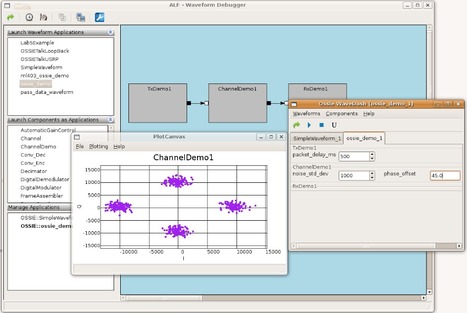
OSSIE is an open source SDR development effort based at Wireless@Virginia Tech. The project's primary goals are to enable research and education in SDR and wireless communications. The software package includes: an SDR core framework based on the JTRS Software Communications Architecture (SCA); the Waveform Workshop, a set of tools for rapid development of SDR components and waveforms applications; and an evolving library of pre-built components and waveform applications.
|
|
Scooped by
Christophe Fourtet
January 18, 2012 9:00 PM
|
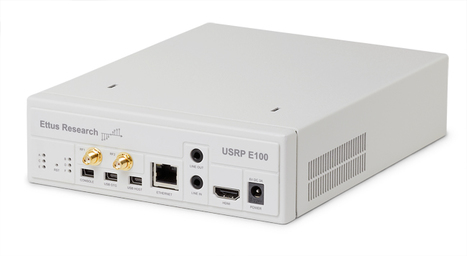
Ettus Research LLC is a California based company now part of Analog Device, designing, manufacturing and selling USRP SDR radios. Those radios are architectured around FPGA based "motherboard chassis" ensuring A2D/D2A as well as connectivity functions, on which different "RF daughterboards" can be plugged in. The various daughterboards allow to cover from 0 to 2.5 GHz or more. They use from simple wide band differencial amplifiers for short-waves to "on-the-shelf silicon tuners" (like NXP TDA18272) for V-UHF. Typical RX A2D of the chassis are 14 bits 100 MS/s devices allowing 10 to 16 MHz digital aquisition. You can't expect top level dynamics with such architectures, nor ultra high resistance to "unwanted" jammers, but they fit to most of the classical SDR missions, and more important, exhibit a high "versatility/cost" ratio ! All schematics can be found at this address : http://code.ettus.com/redmine/ettus/projects/public/documents USRP are supported by Mathlab, Labview, GNU-Radio, OpenBTS or OSSIE.
|
|
Scooped by
Christophe Fourtet
December 28, 2011 7:34 AM
|
Genesis Radio is producing and selling a series of HF SDR transceiver kits, roughly ranging from 150 to 350 $. They are using a very classical QSD/QSE architecture and potentially the well-known Si570 FracN synthesizer, but all the "commodities" are integrated (like TX/RX switching commodities) up to a realy well integrated SDR software "GSDR1.1" offering RX and TX image rejection and calibration, or 99 store/recall memories, for instance. They are also selling usefull accessories, like a 10 Watts PA.
|
|
Scooped by
Christophe Fourtet
December 20, 2011 5:32 PM
|
Here is an other GUI to control DttSP (Software DSP core), and thus implement SDR on multiple platforms... New blog here : http://g0orx.blogspot.com/
|
|
Scooped by
Christophe Fourtet
December 20, 2011 5:10 PM
|
An open software DSP core for SDR use, from Frank Brickle and Bob McGwier. Coded for LINUX or Windows, it is a good way to implement SDR systems on many platforms like LINUX (SDR-Shell or Java GUI and GTK+ GUI for instance) or Windows (Flexradio for instance), or even MAC or your i-Phone ! The SourceForge page for DttSP is here : http://sourceforge.net/projects/dttsp/
|