Your new post is loading...

|
Scooped by
Nik Peachey
November 15, 2011 5:23 AM
|
Innovative educators George Engel, Rob Griffith, Scott Newcomb, Lisa Nielsen, Jason Suter , and Willyn Webb know that when it comes to preparing students for success in the 21st century you not only have to think outside the ban, sometimes you have to dive in head first and break it. The following is a collection of ideas each teacher implemented to successfully break and/or work within the ban where they teach in an effort to empower students with the freedom to use their cell phones as personal learning devices.
|
|
Scooped by
Nik Peachey
November 14, 2011 5:47 AM
|
More than a decade into the 21st century and we are still keeping learners and teachers prisoners of the analog past by enforcing outdated mandates that ban and block them from using the digital resources of their world.
|
|
Scooped by
Nik Peachey
November 11, 2011 6:12 AM
|
And while you’ve been around stories your whole life, you also likely realize that stories have been around forever. Stories have been used by cultures since before written language to pass down oral history and teach valuable lessons.
|
|
Scooped by
Nik Peachey
November 11, 2011 3:55 AM
|
The study uncovered a range of factors concerning the teaching of English to young learners globally from the perspective of teachers involved in implementing these programmes. In particular, it shows that many of these factors are commonly experienced by teachers across different countries and contexts. The paper concludes with five key recommendations for future action to support teaching English to young learners.
|
|
Scooped by
Nik Peachey
November 10, 2011 9:20 AM
|
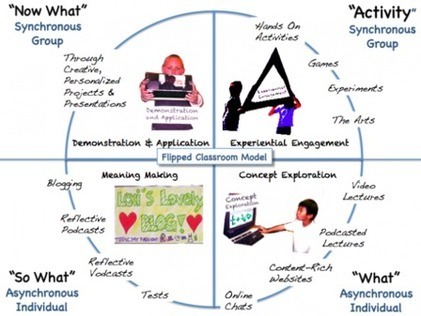
The flipped classroom provides avenues for teachers to become facilitators of learning and move away from the sage on a stage approach to teaching. The foundational concepts of instructors guiding students or facilitating their progress are based on the idea that the instructor is no longer at the center of the interaction and application of knowledge. The instructor remains available to students as a facilitator of resources, a resource who should frequently check students for understanding for their learning.
|
|
Scooped by
Nik Peachey
November 10, 2011 6:21 AM
|
For centuries, researchers have studied the brain to find exactly where mechanisms for producing and interpreting language reside. Theories abound on how humans acquire new languages and how our developing brains learn to process languages. We take a look at the mysteries of language and the brain in the infographic below.
|
|
Scooped by
Nik Peachey
November 8, 2011 1:30 PM
|
Over the last few years I've done a lot of work developing writing and redeveloping online courses and course materials. In the initial rush to get learning online many organisations got themselves a Moodle platform and then attached a whole load of PDFs and .docs, added some forums and the odd video clip and called it an online course. It's no surprise then that drop out rates for online learning courses have been so high.
|
|
Scooped by
Nik Peachey
November 8, 2011 11:20 AM
|
This past week in my undergraduate interpersonal communications course, I adapted the Bridge-It communications exercise to incorporate my students’ (most ages 17-20) mobile devices. It combined some of my favorite instructional strategies:
|
|
Scooped by
Nik Peachey
November 8, 2011 3:13 AM
|
This digital grade book would be connected to a Learning Management System (LMS) that instantly imported, as set up, the grades for various assignments into the grade book for instant view by the student or parent. This LMS would be extremely customizable by the teacher, allowing them to scale and weigh assignments as needed.
|
|
Scooped by
Nik Peachey
November 7, 2011 3:40 AM
|
So you have heard about blogging with your students and you are considering taking the plunge but just not sure what or how to do it? I am here to tell you; blogging with my students has been one of the most enriching educational experiences we have had this year, and that says a lot. So to get you started, here is what I have learned
|
|
Scooped by
Nik Peachey
November 4, 2011 3:33 AM
|
|
|
Scooped by
Nik Peachey
November 3, 2011 7:09 AM
|
As life grows more complex, so too does education. The role of the teacher, once essentially an autonomous, well defined position, is now vast and continually changing. It is now impossible for a teacher to be engaging in best practice unless they are part of a supportive, informed and well developed network.
|
|
Scooped by
Nik Peachey
November 2, 2011 11:02 AM
|
A few years ago, students like Amanda faced punishment for pulling out cellphones or other mobile technology in class. Today, more teachers see the devices not as distractions but as tools to help students learn. And experts say the future of education may revolve around these hand-held instruments.
|
|
|
Scooped by
Nik Peachey
November 15, 2011 3:21 AM
|
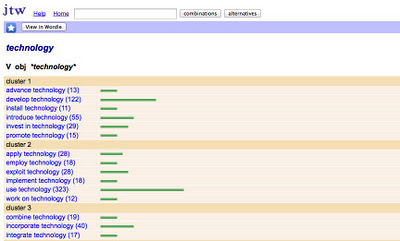
The word combinations option produces a great list of collocations for the word, and what's better, if you click on the collocates, you get the kind of list that a concordancer will produce, with the expressions highlighted in context.
|
|
Scooped by
Nik Peachey
November 11, 2011 6:52 AM
|
UNESCO’s framework emphasizes that it is not enough for teachers to have ICT competencies to be able to teach them to their students. Teachers need to be able to help students become collaborative, problem solving creative learners through using ICT so they will be effective global citizens. The Framework therefore addresses all aspects of a teacher’s work.
|
|
Scooped by
Nik Peachey
November 11, 2011 6:02 AM
|
It’s true, no matter what we do, our kids will leave us behind — it’s the natural way. But we must provide them with the knowledge they need to improve the world. Our generation is the one developing all the new tools that offer limitless access to knowledge. So, why wouldn’t we offer these advantages — the ones kids can’t keep their fingers off of, even during class — and help kids acquire the skills they need to survive in a connected world?
|
|
Scooped by
Nik Peachey
November 11, 2011 3:23 AM
|
We also realize there is a lot of mis-information about the Flipped Classroom and quite a bit of controversy about whether or not this is a viable instructional methodology. Thus the purpose of this article is to list out what we believe it is and what we believe it is not.
|
|
Scooped by
Nik Peachey
November 10, 2011 6:26 AM
|
I define a global project as any sort of collaborative project that involves two or more classes from different schools/countries. There is usually a defined purpose and structure to the project. The learning is usually documented and shared on an online space such as a blog. Some global projects have a culminating event.
|
|
Scooped by
Nik Peachey
November 9, 2011 6:31 AM
|
If you are an online student, you should know about various tools and techniques you can use to save time. And if you're not an online student, these tips can still be very helpful!
|
|
Scooped by
Nik Peachey
November 8, 2011 11:23 AM
|
The problem is that teachers and lecturers have become trapped in fossilised pedagogies – quite simply, huge dollops of talking at people in the classroom and lecture hall. To be fair, expectations of institutions, expectations of students, job titles (lecturer), buildings, budgets and quality evaluations, all target the fossilised model. So there will only be change when there’s a “concerted effort to change the fundamentals…. You have to redesign your course from scratch and not just add technology. It should be a compulsory part of teacher training to use technology in innovative ways”.
|
|
Scooped by
Nik Peachey
November 8, 2011 3:27 AM
|
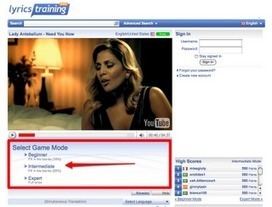
Listening to songs is a great way to learn a language. It's easy to listen to a song many times, especially if it's one that you enjoy and this can really help with your listening and pronunciation. This activity is based around the Lyrics Training website. The site helps you to listen to and understand songs.
|
|
Scooped by
Nik Peachey
November 7, 2011 3:47 AM
|
"Data storytelling" is all the rage on websites ranging from international news outlets, to political and economic organizations, to personal blogs. Indeed, this trend has captured the attention of those who research and work in information visualization. Scores of both aspiring and seasoned visual storytellers descended on the Telling Stories with Data workshop that we organized this year
|
|
Scooped by
Nik Peachey
November 4, 2011 1:03 PM
|
Whether you design classroom training, eLearning, m-learning, or work with another medium entirely, storytelling is a learning tool that possesses the power to motivate, persuade, educate, and even entertain.
|
|
Scooped by
Nik Peachey
November 3, 2011 10:19 AM
|
Now there are pecha-nights in 80 cities, from Amsterdam and Atlanta to San Francisco and Shanghai. Why? Dytham believes that the rules have a liberating effect. "Suddenly," he says, "there's no preciousness in people's presentations." Just poetry.
|
|
Scooped by
Nik Peachey
November 3, 2011 4:11 AM
|
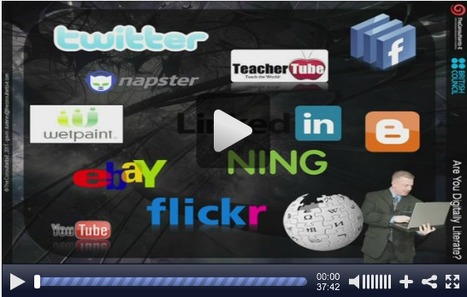
The latest recording from the British Council Seminars series is about digital literacy. What is digital literacy, and what is its significance to you as a teacher?
|