Your new post is loading...

|
Scooped by
Kim Flintoff
June 12, 2016 9:49 PM
|
The ScotXed Unit is part of Education Analytical Services Division within the Learning and Justice Directorate of the Scottish Government.
We support and develop a significant number of secure, efficient and effective electronic data exchanges between partners in the Scottish Government and wider service communities. ScotXed initially collected data solely for the Learning and Justice Directorate but is now being used more widely within the Scottish Government and its agencies. Data collections include the pupil and staff censuses, Looked After Children, Mental Health Benchmarking and Drug Treatment and Testing Orders to name a few. To view our extensive range of surveys, please see the links within the Data Collection Topics section below or the topics menu on the left hand side of this page.
We provide data to our analytical colleagues within the Scottish Government for national and international statistical publications. Analytical products contribute to the evidence base for policy development and making. We adhere to the principles of the National Code of Statistics and the Data Protection Act (1998) when collecting data for research and statistical purposes.

|
Scooped by
davidgibson
June 9, 2016 6:17 AM
|
|
|
Scooped by
davidgibson
June 9, 2016 6:11 AM
|
RT @SamiGhazali: What software you used for #Analytics, #DataMining, #DataScience, #MachineLearning projects? https://t.co/2bLGMbKTzZ via @…
|
|
Scooped by
davidgibson
June 9, 2016 6:06 AM
|
Algorithms. Cloud. Internet of Things. Data. No one can predict the future of technology with 100 percent accuracy. But these four pillars are certainly at

|
Scooped by
Peter Mellow
June 7, 2016 7:01 PM
|
There’s a counter-intuitive downside to collecting vast amounts of information about economics and human behaviour: it can mean we ignore the lessons of history.
|
|
Scooped by
Kim Flintoff
June 1, 2016 9:47 PM
|
Key Takeaways
Any national postsecondary education data system will consist of a large collection of data designed to provide useful and reliable information about postsecondary student success and outcomes.
Using this data to improve student outcomes must acknowledge the necessity of maintaining the privacy of students and their families and properly securing any data sets containing personally identifiable data.
With thoughtful planning, comprehensive information security and privacy practices can be implemented within the national postsecondary education data infrastructure in a way that reduces risk, safeguards data, and ensures transparency, accountability, and trust.
|
|
Scooped by
Kim Flintoff
May 29, 2016 10:23 PM
|
The chief executive of the Australian branch of multinational private education firm Pearson will warn an audience of educators that they risk becoming irrelevant in the hot-topic education debate.
In his speech to next week’s EduTECH conference in Brisbane, David Barnett, chief executive of Pearson Australia, will say those who work in education will have their voices drowned out in the economic and political debate about their own industry.
“Right now, some Australian educators are in danger of descending into irrelevance, by allowing economists to lead the debate about the future skills and jobs of Australians,” Barnett’s speech reads. “This should be the domain of educators.”
An advance copy of the speech was provided by Pearson Australia to Campus Review.
And where does Barnett want educators to focus the debate? The answer is technology. More specifically, education “should wrap our arms around technology just as tight as business does”, and acknowledge that automation will take away jobs. This is as inevitable as the implications of the car were for the horse and carriage.”
This line is part of a framework for the major part of Barnett’s promotion of artificial intelligence-assisted learning, the new business push for Pearson. The company released a report earlier this year, Intelligence Unleashed: an argument for AI in Education – in collaboration with experts from the UK’s University College London – promoting the case for unleashing AI in education.
AI has great potential, Barnett argues, from learning analytics in higher education, to online education games in schools. Barnett believes that by embracing technology, teachers can remove “distractors” to education.
“One day soon, we’ll look back on a past limited by what John Hattie [Australian Institute for Teaching and School Leadership chair and University of Melbourne education academic] calls ‘distractors’, like student-teacher ratios, and marvel not at how much has changed, but at how long we clung to the past,” Barnett’s speech reads.
|
|
Scooped by
Peter Mellow
May 26, 2016 6:23 PM
|
The college classroom has been impenetrable for those seeking to understand how students learn. This was more a function of the traditional methods of teaching and learning than a result of any intentional barriers. Student behaviors were fairly opaque—some note taking, possibly classroom discuss
|
|
Scooped by
Kim Flintoff
May 25, 2016 6:53 PM
|
A university that has been testing out the use of an analytics infrastructure to improve student outcomes and retention has reported positive results, including improvements in attendance, course drop rates and course success.
Strayer University, a for-profit institution with about 43,000 on-campus and online students in its fall 2015 enrollment, has been working with analytics software from Civitas Learning, including Student Insights Platform and Inspire for Faculty. The first is an online program that integrates and analyzes data from multiple sources and applies predictive analytics to provide users with information about student behavior and engagement. The second helps instructors pinpoint those students who are doing well and those who are struggling in order to target outreach and interactions.
|
|
Scooped by
Peter Mellow
May 25, 2016 6:21 PM
|
Higher education information technology must strategize to catch up with current business information technology.
|
|
Scooped by
Peter Mellow
May 19, 2016 9:01 PM
|
Plans to reward universities for excellent teaching could see a bigger role for metrics that track how students spend their time.
|
|
Scooped by
Kim Flintoff
May 10, 2016 2:50 AM
|
Watson and Elmo are joining forces.
Computing giant IBM and the nonprofit organization behind popular children's television show "Sesame Street" announced Wednesday a new partnership to bring so-called "cognitive computing" to early childhood education. The idea is to develop products featuring Sesame characters and content that are capable of responding in personalized ways to individual students based on their skills, interests, and developmental trajectories. Key to the effort will be the technology behind IBM's Watson, which takes a "big data" approach to understanding and responding to human language.
|
|
Scooped by
Peter Mellow
May 5, 2016 9:53 PM
|
Perhaps you’ve heard the term “learning analytics.” You may have heard it used in the same phrase with “big data” and “predictive analytics.” But is
|
|
|
Scooped by
Kim Flintoff
June 9, 2016 8:25 PM
|
Whether they like it or not, members of the educational technology community and faculty members should engage in debates about learning analytics algorithms, transparency and data access. That was the message delivered by George Siemens, executive director of the Learning Innovation and Networked Knowledge Research Lab (LINK) at the University of Texas at Arlington, during a recent Future Trends Forum discussion with futurist Bryan Alexander.
"You can hate something and still recognize that it is an important factor to think about," Siemens stressed. "You can think analytics are crap, but you can't deny they are influential. If we want a future that embodies values that are important to us, then we have to be active participants in the sociotechnical and economic spaces driving that change."
|
|
Scooped by
davidgibson
June 9, 2016 6:16 AM
|
Think of it as Google Now, Siri or Alexa for Google Analytics. Speak the stat you want, get the answer, courtesy of machine learning.
|
|
Scooped by
davidgibson
June 9, 2016 6:08 AM
|
Machine learning will have a barbell effect on the technology landscape. On one hand, it will democratize basic intelligence through the commoditization and..
|
|
Scooped by
davidgibson
June 9, 2016 4:49 AM
|
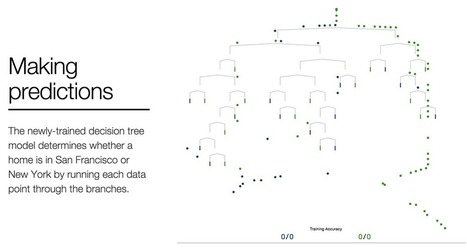
What is machine learning? See how it works with our animated data visualization.
|
|
Scooped by
Kim Flintoff
June 5, 2016 9:46 PM
|
So why should you consider moving to the xAPI?
In addition to the items I've already mentioned, there are a number of advantages to using the xAPI. I've listed a few below:
You can provide detailed test results and the report results for multiple test scores
It will work outside of a browser or an LMS
You have more control over your content
You can easily transition from computers to mobile devices and you can use mobile apps for learning detailed results can be tracked from more in-depth games and simulations
You can track real-world performance. Say that you're running separate security tests that relate to training you are providing to your employees. You can have the results of those tests linked to their course; then adapt course content for those specific learners.
You can track the results form interactive learning objects and adaptive learning modules that are delivered based on a learners specific learning path.
The xAPI also makes it possible to learn over long periods of time as well as support team-based learning activities
|
|
Scooped by
Peter Mellow
June 1, 2016 6:08 PM
|
Higher education needs to actively participate in discussions around learning analytics algorithms, transparency and data access, says UT Arlington's George Siemens.
|
|
Scooped by
Kim Flintoff
May 27, 2016 5:33 AM
|
Learning analytics is an emerging, highly interdisciplinary field where many disciplines--such as education, computer science, and engineering--intersect. Since its first significant scholarly gathering in 2011, learning analytics has been increasingly mentioned in news, technical reports, academic publications, and grant solicitations. The surge of this nascent field rests on a promise--and also a premise--that digital traces of learning could be turned into actionable knowledge to promote learning and teaching.
|
|
Scooped by
Kim Flintoff
May 26, 2016 4:12 AM
|
Interest and use of the xAPI has really gathered a pace since the turn of the year, so we’re updating our very popular Learn xAPI MOOC with new content and conversations.
Join this MOOC to explore both the technical realities and the strategic possibilities of the xAPI.
If you want to write your first xAPI statement and understand the difference between an Activity Type and a Context Extension, this is the place to be.
Equally, if neither of these things mean a darn thing, we are the community that will help you make sense out of your data strategy, and your roadmap for the medium term.
This MOOC will be open to contribution and allow you to explore the content and conversations that best fit your needs.
|
|
Scooped by
Kim Flintoff
May 25, 2016 6:50 PM
|
Strayer University has recently gone public with a partnership designed to help identify factors that contribute to success for students in online courses.
"Developed in collaboration with student-success analytics innovator Civitas Learning, the findings often buck conventional wisdom, suggesting that data captured through a student's digital footprints can provide better predictors of success than the typical demographic data points," according to a news release.
Over several years, the university partnered with Civitas to aggregate relevant data from disparate sources in the company's Student Insights Platform. The data was then used to identify initiatives that seemed most promising in engaging students and faculty, improving behavioral mindsets and closing the gap between in-person and online learning.
|
|
Scooped by
Peter Mellow
May 24, 2016 6:31 PM
|
Most of the more than 40,000 students enrolled at Strayer University in any given semester take classes online. They’re typically working adults who learn asynchronously, participating in lectures and assignments at different times that fit their busy schedules. Strayer is betting big on data ana
|
|
Scooped by
Kim Flintoff
May 11, 2016 3:13 AM
|
When we published “Disrupting Class” in 2008, we didn’t use the phrase “adaptive learning” once in the book. Just eight years later, it’s nearly impossible to imagine writing a book about educational technology and neglecting the term.
With the rapid growth of blended learning and technology more generally in schools, asking if educational software is capable of adapting to students’ needs is commonplace.
Teachers are increasingly attempting to reach each of their students who have distinct learning needs, at different times, with the right learning experience at the right time. Having effective adaptive software turbocharges those efforts and can provide a realistic pathway to accomplish that goal.
|
|
Scooped by
Kim Flintoff
May 8, 2016 9:08 PM
|
The basic idea of my bachelor thesis was to track the ping pong ball in realtime to create data visualisations for trainers and players. After a few weeks of working I started developing a projected mapped interface for the ping pong table to show the collected data. By projecting game obstacles on the surface I figured out that I can change the game play totally.
|