Institutions are using predictive analytics for a wide variety of operations — strategic enrollment management, early-alert systems, recommender systems and adaptive technologies, to name a few. Using sophisticated data systems can be beneficial for understanding students and guiding them through college, but with these powerful tools come a few pitfalls, for both the student and the institution. Therefore, institutions should understand the purposes of using predictive analytics, as well as the unintended consequences, like human biases and unethical usages of data.
Those findings and more can be found in a new report from New America, a nonprofit, nonpartisan think tank and civic enterprise based in Washington, D.C. “Predictive Analytics in Higher Education,” written by policy analysts Manuela Ekowo and Iris Palmer, outlines five guiding practices to ethically use predictive analytics. The Hechinger Report reported that the information was released this week at SXSWedu in Austin.
Findings from two research studies at scale reveal the implications of learning analytics for designing courses in learning management systems to enhance student success.
Universities have seized on big data to count every click their students make in learning management systems, but the focus needs to be on improving learning.
Technology can empower higher education students to boost their grades or attend classes despite other responsibilities — or locations. The Department of Education’s Office of Educational Technology hopes that all universities will take advantage of the possibilities technology can create for students.
In “Reimagining the Role of Technology in Higher Education,” the 2017 addendum to the 2016 National Education Technology Plan, the OET outlines how leaders in higher ed should use tech to create “everywhere, all-the-time learning and ensure greater equity and accessibility to learning opportunities over the course of a learner’s lifetime.”
Enrollment in higher education has increased for many years, and the report indicates that technology has the ability to spread access, boost retention and prepare students for the future. To help do this, the OET has provided design principles in its report that can make institutions more student-centered.
Key Takeaways A number of questions and issues confront educational technology leaders seeking to align system or campus policies, cultures, and practices with increasing faculty and student use of free online learning tools and services. The University of California is raising awareness about privacy concerns in a draft document of principles addressing learning data privacy and recommended practices. Continuing the conversation about data privacy benefits everyone: institutions, faculty, students, and the companies that provide free tools and services.
K12 education lags behind U.S. business and industry when it comes to using data to improve outcomes, says a 2016 report by the Center for Data Innovation.
Despite the wealth of information available—and the existence of technology to crunch those numbers—“most administrators still make decisions, often inaccurately, based on assumptions and intuition, rather than use detailed metrics and analytics to manage schools efficiently and fairly,” the report says.
“In short,” it concludes, “U.S. schools are largely failing to use data to transform and improve education.”
This report aims to understand the state of the art in the implementation of learning analytics for education and trainingin both formal and informal settings. It also aims to understand the potential for European policy to be used to guide and support the take-up and adaptation of learning analytics to enhance education in Europe. This study, called the Implications and Opportunities of Learning Analytics for European Educational Policy (henceforwardthe Study), therefore has an international scope, although the policy perspectives are discussed from the point of view of the EU. The research was conducted between September 2015 and June 2016.The key findings seek to inform, guide and inspire practitioners, researchers and policy makers at all levels (institutional, local, regional, national, international) inimplementing learning analytics in European education and training.
Harvard and MIT have created open-source tools to manage the growing data from edX MOOCs. Their workflow can help higher education institutions learn more from their own educational data and improve the overall educational experience.
We readily recognize Facebook and Twitter as these sorts of platforms; but I’d argue that they’re more pervasive and more insidious, particularly in education. There, platforms include the learning management systems and student information systems, which fundamentally define how teachers and students and administrators interact. They define how we conceive of “learning”. They define what “counts” and what’s important.
They do so, in part, through this promise of “personalization.” Platforms insist that, through data mining and analytics, they offer an improvement over existing practices, existing institutions, existing social and political mechanisms. This has profound implications for public education in a democratic society. More accurately perhaps, the “platform society” offers merely an entrenchment of surveillance capitalism, and education technologies, along with the ideology of “personalization”, work to normalize and rationalize that.
This NPF project will use participatory action research case studies to develop ways to translate learning analytics data into useful information for tertiary teachers and learning designers.
Seventy-seven percent of college students think schools should do a better job of using their personal data to improve the college experience, according to a new survey from Ellucian.
The company released the results of a survey on the same day as its new data analytics platform, Ellucian Analytics. The online survey was conducted by Wakefield Research from October 13 to 18 and included 1,000 United States college students.
The key takeaway from the survey is that students already share vast amounts of personal data with their schools, and they expect those schools to use that data in ways that benefit them. "Today's students are savvy users of technology and comfortable sharing their data, but they expect more from colleges and universities when they do," said Jeff Ray, president and CEO of Ellucian, in a prepared statement. "They expect institutions to utilize their data to improve their educational/academic experience just like the apps on their phone."
Join this MOOC to explore both the technical realities and the strategic possibilities of the xAPI. If you want to write your first xAPI statement and understand the difference between an Activity Type and a Context Extension, this is the place to be. Equally, if neither of these things mean a darn thing, we are the community that will help you make sense out of your data strategy, and your roadmap for the medium term. This MOOC will be open to contribution and allow you to explore the content and conversations that best fit your needs.
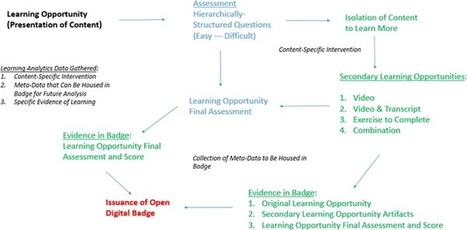
Learning analytics can play a role in helping open digital badges and differentiated assessment reach their potential by producing both public evidence for badges and private artifacts to support differentiated assessment at scale.
“Most of the predictive-analytics people are looking at grades,” Dr. Ram said. “A lot of times it’s not the grades but whether they feel comfortable and socially integrated. If they are not socially integrated, they drop out.”
Dr. Ram has tracked nearly 30,000 students over the last three years. Matching her findings against actual dropouts, she said, she has an accuracy rate of about 85 percent, but her project is still in the testing phase. She says identities are kept private.
That’s a major concern about big data: that student details could become public. It is not the only issue. Martin Kurzweil, a program director at Ithaka S + R, an education research organization, worries that students whose performance is setting off alarms could be discouraged from following their passion. “Algorithm is not destiny,” he said. “It’s important that human judgment is never removed from the process and that there is always an opportunity for a student to appeal a pathway that’s being plotted for them.”
Classes in a suburban Los Angeles elementary school were successfully taught by teacher robots during the 2015-2016 school year.
Unbeknownst to parents, all first-grade classes in a suburban Los Angeles elementary school were successfully taught by teacher robots during the 2015-2016 school year.
Only one parent was in on the secret. John Miller*, whose family moved to the area from Silicon Valley and whose son Jack enrolled as a new first-grade student last school year, first approached the district superintendent three years ago with a radical idea.
“We’ve been working on some super cool artificial intelligence (AI), and in lab tests, the AI robots demonstrated instructional capability,” Miller said. “I wanted to see if they could teach real students, because we’ve seen robots help children with social-emotional learning.”
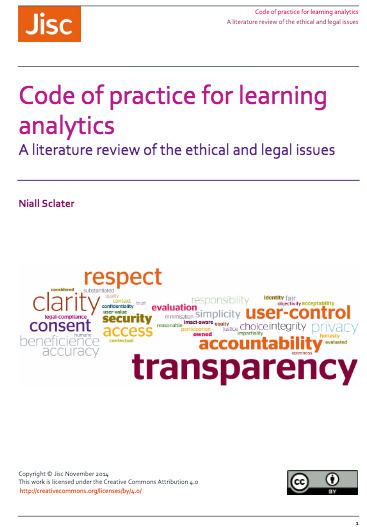
Consultation by Jisc with representatives from the UK higher and further education sectors has identified a requirement for a code of practice for learning analytics.The complex ethical and legal issues around the collection and processing of student data to enhance educational processes are seen by universities and colleges as barriers to the development and adoption of learning analytics (Sclater 2014a).Consequently a literature review was commissioned by Jisc to document the main challenges likely to be faced by institutions and to provide the background for a sector-wide code of practice.This review incorporates many relevant issues raised in the literature and the legislation though it is not intended to provide definitive legal advice for institutions.It draws from 86 publications, more than a third of them published within the last year, from a wide range of sources including:
»The literature around learning analytics which makes explicit reference to legal and ethical issues »Articles and blogs around the ethical and legal issues of big data »A few papers which concentrate specifically on privacy »Relevant legislation, in particular, the European Data Protection Directive 1995 and the UK Data Protection Act 1998 »Related codes of practice from education and industry
Expressing issues as questions can be a useful way of making some of the complexities more concrete.93questions have been extracted from the literature and are incorporated in the relevant sections of the review.They arise mainly in the areas of awareness, consent, ownership, control, the obligation to act, interventions, triage and the impacts on student behaviour.These headings, highlighted in the word cloud below, give an instant flavour of the main ethical, procedural and legal concerns around the implementation of learning analytics being raised by researchers and practitioners.
How colleges and universities can create a responsive classroom by using data to help courses keep up with changing markets and personalize learning.
When it comes to continuing education and skills-based learning, one of the biggest challenges that universities face is ensuring quality and uniformity of results.
Students trust universities to deliver on the promise that every topic taught is relevant, marketable, and will lead to clear returns on their investments (ROIs). But how do universities respond to changing market demands and variable classroom profiles, while also administering to the needs of thousands of students each year? How can institutions create a responsive classroom?
The Faculty of Engineering, Architecture and Information Technology (EAIT) at the University of Queensland has looked at learning analytics in new ways to encourage students to take ownership of their own learning. For more information please see: https://www.elipse.uq.edu.au/
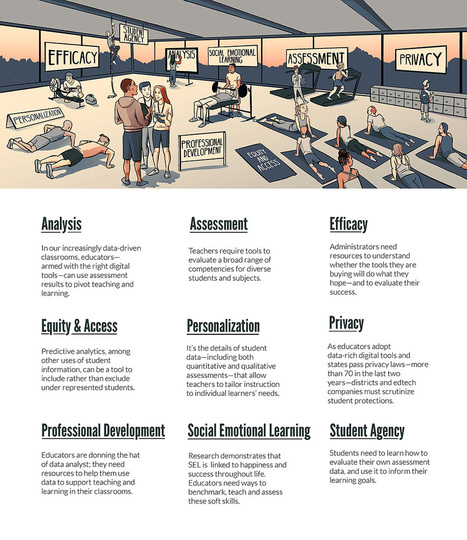
If you think data—in education, or any field—is cut and dry, think again. Working with data in the classroom, especially, can be either exhausting or exhilarating—depending on your fitness level. Data can be big, but also quite small. It’s often quantitative, but is increasingly qualitative. It’s pr
The rapid growth in data generated and collected during educational activities has great potential to inform how we teach and learn. In creating data-informed learning environments, campuses can generate synergies between learning analytics and learning design that allow for real-time adjustment and long-term iterative improvement of digital and classroom-based learning environments.
Data collected in the course of learning activities offers the appealing opportunity for educators to understand how students actually engage in the academic experiences designed for them. This provides a more detailed, comprehensive, and (relatively) impartial version of the kind of classroom feedback that instructors have relied on informally for years. The availability of real-time diagnostic information can support instructors in making responsive adjustments to their teaching in the moment and lead to iterative improvements in learning designs over the long term.
IBM Watson proved on Jeopardy it can process and “learn” information much faster than humans. But how well can it help teachers and students learn?
Last week, IBM Watson released Element for Educators, an iOS app designed for the iPad to give teachers a better understanding of factors affecting student performance. The tool also serves as a communications platform for teachers to share notes with other teachers or across the district, whether it’s about a curriculum standard or a student’s grade dropping.
The app is IBM Watson Education’s first education app, and the company, along with Apple, approached Coppell Independent School District in Coppell, Texas, to help build and pilot the app about a year ago. Marilyn Denison, the district’s assistant superintendent for curriculum and instruction, met with the company product teams every week to give feedback on the app.
With access to predictive analytics and more data than ever before, how can universities avoid invading students’ privacy while promoting academic success?
To get content containing either thought or leadership enter:
To get content containing both thought and leadership enter:
To get content containing the expression thought leadership enter:
You can enter several keywords and you can refine them whenever you want. Our suggestion engine uses more signals but entering a few keywords here will rapidly give you great content to curate.


 Your new post is loading...