Your new post is loading...
Time and again, there have been education techniques and pedagogy developed that challenged conventional teaching and learning methods. As ne
“Literacy has two beginnings: one, in the world, the other, in each person who learns to read and write.”—Margaret MeekThis quote has continued to rewind and repeat in my mind as a more than 50-year research “war” re-emerges to declare to the educational world that science has definitely and universally revealed how all children learn to read. Yes, all children… But what the science of reading hasn’t revealed is that the studies only represented “typical classroom teachers” and “typical American or English-speaking students” (National Reading Panel U.S. and National Institute of Child Health and Human Development, 2000). Leaving out the
For many language learners, fluency feels impossible. But being fluent is more about familiarity and confidence in writing and speaking than perfection.
Federal data suggests Asian Americans as the most likely to be learning remotely this year. Experts and community members say the reasons range from differing views of the pandemic to racist bullying.
YISD was one of 15 school districts nationally recognized for equity programs benefiting underserved students.
A study recently published in the journal Language and Literacy found that bilingual books, which are not often used in French immersion classrooms, are seen by students as an effective tool for second language learning.
Californians Together, a statewide education advocacy coalition, has introduced a new framework for accountability focused on the needs of English learner (EL) students in California, with the support of 20 organizations including Advancement Project California, California Association for Bilingual Education (CABE), Education Trust–West, Sobrato Early Academic Language (SEAL), and UnidosUS. Their brief, “The Accountability System English Learners Deserve: Framework for an Effective and Coherent Accountability System for ELs,”examines the state’s current system, identifies areas of improvement, sets aspirational goals for what a structure that is transparent and honest about EL needs could achieve, and outlines steps to build a framework

|
Scooped by
Dual Language Education of New Mexico
February 23, 2021 11:27 AM
|
Words by Nate Izzo Graphic by Aspasia Celia Tsampas
|
|
Scooped by
Dual Language Education of New Mexico
February 23, 2021 11:21 AM
|
/PRNewswire/ -- Students in project-based learning (PBL) classrooms across the United States significantly outperform students in typical classrooms
|
|
Scooped by
Dual Language Education of New Mexico
February 11, 2021 11:34 AM
|
Thousands of languages are considered endangered. Preservation requires documenting vocabulary and teaching new speakers before it's too late.
|
|
Scooped by
Dual Language Education of New Mexico
February 3, 2021 11:18 AM
|
/PRNewswire/ -- A new book that has already won high praise from language experts, CEOs, nonprofit leaders and two Pulitzer Prize winners invites al
|
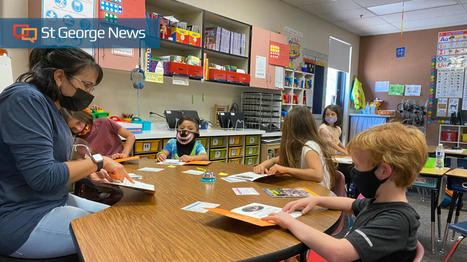
ST. GEORGE — Paradise Canyon Elementary School has won a 2021 School of the Year award for its Spanish-language dual immersion program. The recognition was bestowed by the Ministry of Education of the Embassy of Spain, and Paradise Canyon was honored as the best elementary school in the country. Five dual immersion teachers at Paradise […]
Three researchers at The University of New Mexico, including two affiliated faculty at the Latin American & Iberian Institute, were awarded a five-year National Science Foundation grant to develop and test a bilingual computer programming curricul
Translanguaging is a 21st-century way of thinking about language and the language practices of emergent bilinguals that takes a perspective of strength and is critical to designing effective and equitable instruction. Translanguaging creates a space for the bilingual person to bring their entire linguistic repertoire, the whole child, into the classroom. Although translanguaging is often described as a language practice—when bilinguals use two or more languages to communicate, translanguaging encompasses much more (Espinosa and Ascenzi-Moreno, 2021, p. 12). Emergent bilinguals, or students who use two or more languages in their daily lives, are often thought to be in need of
Andrew Warner analyzes New America's agenda for English learners
Project-based learning, a popular practice that uses lots of poster boards and student presentations, is billed as an antidote to boring classrooms where teachers drone on. Advocates say that hands-on projects motivate students to learn, think critically, solve problems and work collaboratively with their peers. But it’s an open question whether students can learn every […]
|
|
Scooped by
Dual Language Education of New Mexico
February 26, 2021 11:26 AM
|
A year ago, the kindergartners learning English in Tanya Gan Lim's class were thriving. Back then, she'd bring in props and pictures to help her students learn the language and sound out words.
|
|
Scooped by
Dual Language Education of New Mexico
February 23, 2021 11:26 AM
|
Refugee children who come to this country at an academic disadvantage can catch up to their peers if they're given the right support. Could refugee schools teach us something about academic recovery from COVID?
|
|
Scooped by
Dual Language Education of New Mexico
February 11, 2021 11:36 AM
|
A study on word learning recently published in Neuropsychologia is shedding light on the age-old question of how language learners’ minds store the target language. Researchers at the Pontifical Catholic University of Chile found that new words in the native language and the target language are stored in largely overlapping regions of the brain; however, L2 words triggered more activity in the primary auditory cortex, suggesting increased phonological processing efforts. “Our results shed new light on the neural representation of two languages in the bilingual brain, by examining newly learned words that participants had no prior experience with,” the paper
Children who grow up learning different languages express quicker cognitive reflexes as adults. But does that translate to a real bilingual advantage?
|
|
Scooped by
Dual Language Education of New Mexico
February 6, 2021 12:23 PM
|
There are enough myths about emergent bilinguals to drive English learner (EL) educators crazy trying to correct them all. We’ve gathered six of the most common myths and looked to see if, by dispelling them, we might uncover truths about teaching and learning that extend beyond the EL classroom to offer insights for teachers of any subject. Have Faith in Your Students and Engage ThemDoris Chávez-Linville: This tip is based on the myth that students must begin learning a second language early or they will never master it. Late starters often bring a lot more to the table than younger
|




 Scoop.it!