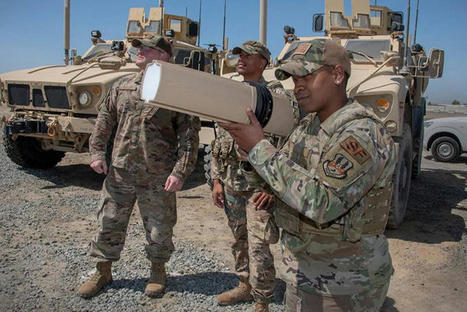
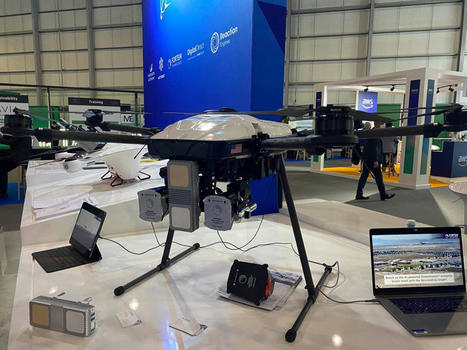
In a 10 day exercise led by the NATO Communications and Information (NCI) Agency, participants were able to test different drone defence systems under mission-like conditions. The live test event at the Lieutenant General Best Barracks in Vredepeel, The Netherlands, aimed to ensure that commercial systems from different NATO nations can work together to counter threats posed by drones.
The NCI Agency reported that some 70 systems were deployed during the exercise, including:
sensors drone defence devices so-called “effectors” Command & Control systems sample drones to serve as “threats”
The aim of the exercise was to raise technical interoperability standards between commercial drone defence systems, while improving NATO’s ability to counter potential drone threats.
One system used during the exercise was the NCI agency’s ARTEMIS* prototype, which uses machine learning algorithms to detect and classify drones.
“ARTEMIS is a prototype system developed by the Agency’s technical centre of expertise for countering unmanned aerial systems,” said Major General Göksel Sevindik, the NCI Agency’s Chief of Staff.
“It is an important tool that helps the Agency understand the technology used in the market and identify areas where NATO would benefit from developing standards for UAS defence systems.”
Germany's Guardion counter-unmanned aerial systems (C-UAS), a co-operation of ESG, Diehl Defence, and Rohde & Schwarz, has integrated Quantum-Systems Vector unmanned aerial vehicle (UAV) for wide area surveillance operations, the company announced at the Dubai Airshow 2021, held from November 14 to 18.
ESG, the system integrator and software provider of Guardion, chose electric vertical take-off and landing (eVTOL)-capable long-endurance fixed-wing Vector AV for extended intelligence, surveillance, and reconnaissance and counter-UAS missions from mobile platforms.
The Vector AV uses encrypted mesh IP link to transfer video streams up to 15 km range in harsh operating conditions. This allows the Guardion C-UAS to be deployed in high-secure beyond line-of-sight military operations, in urban areas, and maritime environment with real-time processing of sensor data using an in-house artificial intelligence-based software. The C-UAS is able to classify the threats from a range of 5 km.
During Rheinmetall's latest edition of the 35mm Air Defence Systems Group event in 2021, Rheinmetall presented the Skynex Air Defence System in a truck-mounted version, successfully engaging a swarm of eight small drones with the 35mm Revolver Gun Mk3. - - - Passion for technology. Rheinmetall is a market leader in the areas of environmentally friendly mobility and threat-appropriate security technology. - - - Learn more on the Rheinmetall website: https://www.rheinmetall.com - - - Imprint/Data protection: https://www.rheinmetall.com/imprint
Arlington Capital Partners’ portfolio company BlueHalo has announced the completion of the acquisition of counter-uncrewed aircraft system (cUAS) technology developer Citadel Defense.
Financial details and other aspects of the deal were not disclosed by the companies.
Citadel’s acquisition complements the acquirer company’s directed energy and layered perimeter defence capabilities according to Arlington Capital.
BlueHalo is a national security platform with capabilities spanning across directed energy, cUAS, advanced radio frequency (RF), autonomy, space technology, as well as cyber and signals intelligence (SIGINT).
Arlington Capital Partners vice-president Henry Albers said: “The Citadel team is passionate about developing cutting-edge technology to address novel security threats, making this acquisition an excellent fit from a cultural perspective.
“We are excited to welcome these talented engineers to the organization as well as incorporate Citadel’s technology into BlueHalo’s rapidly expanding portfolio of proprietary solutions.”
Citadel is headquartered in San Diego, California, US. Its advanced cUAS technology is used by customers within the US Department of Defense (DoD) and Intelligence Community.
Citadel’s cUAS capabilities and BlueHalo’s current portfolio of proprietary technology will allow the latter company to deliver multi-modal, unified cUAS solutions.
Overall, the cUAS solutions will support troops and safeguard key infrastructure.
BlueHalo CEO Jonathan Moneymaker said: “Citadel has established itself as a leader in the cUAS market and continues to innovate at a pace necessary to stay ahead of the rapidly evolving threat environment.
“The combination of Citadel and BlueHalo’s unique technologies, deep mission intimacy, and systematic approach to innovation will accelerate our technology roadmap and allow us to rapidly field technologies critical to the warfighter.”
In December last year, BlueHalo secured five contracts from the US Air Force Research Laboratory Space Vehicles Directorate to support Space Domain solutions development
DroneShield Ltd has published the 6th edition of its C-UAS Factbook which covers key trends in the C-UAS market. This includes the review of the emerging UAS threat and its key categories, UAS types and capabilities. Key threat categories include:
Nuisance Activity
Intelligence, Surveillance and Recognisance (ISR)
Payload Delivery
The UAS types include Unmanned Aerial Vehicles (UAVs), Unmanned Ground Vehicles (UGVs) and Unmanned Surface Vehicles (USVs).
UAS types range from group 1 (consumer and commercial UAS), all the way to group 5 (Reaper, Global Hawk, and other large sovereign UAS).
The Factbook considers various types of UAS detection sensors, including radiofrequency (RF) sensors, radars, acoustics, optics, and multi-sensor systems. It also reviews and compares various UAS effectors, including jammers (control link and GNSS jamming), spoofing, directed energy, counterdrone drones, other kinetic solutions, and layered C-UAS defeat options.
The Factbook finally reviews types of counter-UAS providers, ranging from start-ups and project companies, across to prime contractors, to established small businesses.
Raytheon Missiles & Defense is increasingly focused on counter-UAS technologies, notably through its KuRFS radar and Coyote family of effectors.
Brought to you in partnership with Raytheon Missiles & Defense
Unmanned Aircraft Systems (UAS) are a growing threat for the US and its allies. Adversaries can acquire drones in high volumes and at low cost, deploying them in various roles.
Raytheon Missiles & Defense recently demonstrated the Coyote family of effectors and KuRFS radar for the US Army at Yuma Proving Ground in Arizona.
Tom Laliberty, Vice President of Land Warfare and Air Defense at the Raytheon Technologies business, explains what was achieved during the tests.
Les drones sont un véritable casse-tête pour les armées du monde entier. Qu'ils soient ultra-technologiques ou low cost, seuls ou en essaims, ils sont désormais partout sur les théatres d'opération. Et malgré le développement de moyens de défense sophistiqués, il n'existe pas encore de parade idéale.
Pour lutter contre les petits appareils, le corps des Marines s'est récemment procuré un nombre non spécifié de SMASH 2000, un système de visée informatisé développé par l'entreprise israélienne Smart Shooter. Ce dispositif ressemble à une lunette classique, qui se glisse sur le haut d'un fusil d'assaut.
Le système est constitué d'une caméra et d'un laser afin de déterminer la distance entre l'arme et la cible. Un algorithme intégré permet ainsi de détecter automatiquement la cible, de prédire ses mouvements et d'indiquer au tireur où viser.
Les petits drones commerciaux sont bon marché, agiles, faciles d'utilisation et peuvent aisément servir d'espions ou d'armes DIY. Mais ils sont petits en taille et très mobiles par nature, ce qui les rend difficiles à atteindre avec une arme conventionelle.
Dans une vidéo de 2017 filmée par le New York Times, un régiment des forces spéciales irakiennes tire des dizaines de coups de feu en direction d'un petit quadrirotor équipé d'une grenade envoyé par les soldats de Daech. En vain: la machine finit par larguer son explosif, et blesser un soldat. Robot tueur
SMASH 2000 n'est pas seulement une lunette intelligente qui indique au militaire quand et où tirer: la machine prend littéralement le tir en main. Le dispositif est relié au corps du fusil. Une fois que la lunette a acquis sa cible, le militaire presse la détente de son arme et laisse le système électronique prendre le relais. C'est donc l'algorihtme qui décide de faire feu lorsqu'il est certain que la balle peut toucher sa cible.
S'il est sous le contrôle d'un soldat, c'est donc tout de même un robot qui prend la décision finale. Une tendance qui fait son chemin sur les champs de bataille modernes.
Dans sa déclaration à propos du contrat conclu avec l'armée des États-Unis, la PDG de Smart Shooter mentionne la «menace croissante des drones sur terre et sur mer». Seulement, le site internet de son entreprise ainsi que leurs démonstrations vidéo vantent davantage les mérites de leur invention sur les cibles humaines. Le système de détection de drone n'est d'ailleurs qu'une option du SMASH 2000.
Smart Shooter vend aussi des dispositifs enlevant encore un peu plus l'élément humain, qui placent l'arme sur une tourelle articulée et contrôlée à distance par un opérateur via une tablette.
A group of Turkish defense contractors is testing a kamikaze unmanned aerial vehicle (UAV) that will be used to counter and neutralize other drone-borne threats.
The UAV is part of a wide range of drone detection and destruction systems developed by Havelsan and Transvaro, exhibited at the 3rd Military Radar and Border Security Summit, organized by the Independent Industrialists and Businesspersons Association (MÜSIAD) in Ankara.
Speaking to Anadolu Agency (AA) at the summit, Havelsan Command Control Defense Technologies Business Development Manager Nezih Şişman said the threat posed by low-cost drones or UAVs is increasing by the day.
He noted that there are other stand-alone solutions, produced by different companies that can detect, diagnose and prevent threats using complex algorithms.
Şişman said they are looking to develop a system that can protect large campuses, critical facilities or infrastructures, organizations with scattered forces, like the gendarmerie, as well as critical locations like Ankara that is home to many important institutions.
He added that they took the vast STAR Refinery complex in western Izmir’s Aliağa as a prototype and started integration studies with its stakeholders for some defense plans.
1st in Turkey
The Havelsan official said they are creating an entire system by adding different algorithms to the Havelsan systems and integrating different components like radar, electro-optical suites, mixing devices and RF (Radio Frequency) detectors.
“At the end of the day, we attempting something that has not been done before in Turkey,” he said.
“We offer an artificial intelligence (AI) supported system that will utilize algorithms to detect, diagnose, analyze and eliminate a threat using the appropriate weapon. It will be able to do so thanks to software with a network-supported command and control system at its center, as well as software that can integrate different systems, weapons and sensors, provided that it is independent of the manufacturer,” he explained.
He added that the project’s stakeholder company is responsible for the drone detection radar, its electro-optical suite, control consoles, the ability to detect threats and use related fusion algorithms. Şişman said Havelsan removed the intermediate stages and moved such components to an integrated system.
Explaining how the system operates he said:
“When a UAV approaches, our radar detects it and warns the electro-optical suite. The electro-optical suite locks and starts to follow the target. Meanwhile, our command-and-control system provides situational awareness to the user by taking images of the target and the electro-optical system. At this point, the system’s new member, a kamikaze UAV solution called Fedai (Bodyguard) is put on alert. Developed by our partner company Transvaro Fedai has already been tested. After the detections, the intercept geometry is calculated by the command-and-control software and the kamikaze UAV is launched to counter the threat.”
The kamikaze drone, Şişman added,
“uses a certain target and identification information. It flies for a while and begins by visually scanning its target. As soon as it captures its target from a certain distance, which is 40 meters at the moment, it can destroy a single UAV or a swarm of UAVs at its location by detonating the warhead.”
He pointed out that solutions like signal jamming are also used against the drone threat. Şişman said when different methods and hybrid applications are used, jamming devices can become ineffective and in this case, it is possible to use the kamikaze UAV Fedai.
He noted that in the next one or two months, the company will demonstrate the capabilities of the entire system, from detection to destruction within a scenario, including destroying a UAV in the air by launching Fedai.
He said the system has an open architecture and the safe area it will provide will expand depending on the number of sensors and weapons are integrated.
Şişman added that by spreading different components like radar and electro-optical suite in a distributed architecture, they will achieve a system that can be controlled from a single center in a large area.
• Thales presents EagleSHIELD, the company's new integrated drone countermeasures solution to protect and secure sensitive sites and large-scale events in urban areas. • EagleSHIELD is a multi-sensor solution that detects, identifies, classifies and neutralises rogue drones flying at low altitude at ranges of up to 7 km. • Thales provides a graduated, context-sensitive response to the threat of unmanned systems flying in civil airspace.
Drone traffic in civil airspace has increased significantly in recent years. Since there is always a possibility that these unmanned aircraft could be used for malevolent purposes, effective countermeasures need to be available to protect citizens and critical infrastructure.
To address the growing threat of malevolent drone usage, Thales has developed a unique fully integrated drone countermeasures solution designed to detect, identify, track and neutralise drones flying in civil airspace in order to protect sensitive sites such as airports, sports arenas, critical infrastructure and large-scale events in urban areas.
The Gamekeeper holographic radar, the only radar on the market to provide full 3D coverage of airspace surveillance over 90° sector, identifies and tracks all types of air platforms flying at low altitude and medium speed within a radius of 7 km. Complementing the radar, infrared and radiofrequency sensors refine the system's threat identification and classification performance, using sophisticated real-time data fusion techniques to determine the exact type of unmanned aircraft involved.
The solution EagleSHIELD offers operators a clear, simplified view of the situation to protect the airspace in real time, and provides the security services and armed forces with a comprehensive, cohesive vision of the airspace.
Fully integrated with these surveillance capabilities, a variety of drone countermeasures are available to provide a proportional response to the threat depending on the operational context. If the existence of a threat is confirmed, Thales can incorporate a range of technical solutions, including electromagnetic signal jamming, interception by a swarm of drones and directed energy weapons, to neutralise the rogue drone.
Over the last seven years, Thales has invested heavily in the four key digital technologies of artificial intelligence, Big Data, connectivity and cybersecurity. The company is leveraging those investments today to bring citizens the benefits of commercial drones while countering the threats associated with the malevolent use of unmanned aircraft in civil airspace.
"The EagleSHIELD solution from Thales helps customers deal efficiently with drone incursions in the complex environments around critical infrastructure and sensitive sites so they can assess the situation and make the best decisions in a matter of seconds." Thomas Got, Thales Vice President, integrated airspace protection.
The Joint Counter Small Unmanned Aircraft Systems Office embodies a focused and targeted approach across the US armed services to develop a toolkit of solutions.
Cerbair et le groupe KEAS (Konsortium Engineering Activities & Security), deux références françaises de la lutte anti-drones, ont officialisé le mois dernier un partenariat stratégique global. L’enjeu ? Combiner les savoir-faire, faire émerger un leader dans ce segment et partir ensemble à la conquête d’un marché ultra-compétitif. Le drone, ce « missile du pauvre »
Nulle véritable menace dans le ciel lorsque les deux entreprises convient la presse fin octobre au camp de Beynes pour une démonstration de leurs produits de lutte anti-drones. Dehors, l’actualité récente rappelle néanmoins combien les drones sont devenus et resteront un défi sécuritaire majeur. « Missiles du pauvre », les aéronefs sans pilotes sont désormais un outil de prédilection pour les personnes malveillantes. La maîtrise de cette technologie à faible coût ne demande que peu de formation. Elle ne rencontre pour l’instant que peu de contre-mesures efficaces et contribue à maintenir l’impunité de l’opérateur, qui réduit la prise de risque en frappant à distance.
Résultat, des milliers d’incidents relatifs aux drones sont recensés chaque année. Jusqu’à peu, pratiquement n’importe qui était en mesure de paralyser totalement un aéroport international sans être repéré, comme ce fut le cas à Gatwick (Royaume-Uni) en 2018. Le survol des installations aéroportuaires par plusieurs drones avait alors entraîné l’annulation d’un millier de vols, affectant au passage près de 140 000 passagers. Pareil incident s’est répété en 2020 à Madrid et à Francfort, forçant les autorités à revoir la protection des aéroports et autres sites sensibles.
Avec une technologie en constante évolution, d’autres modes opératoires tout aussi malveillants sont apparus. Un drone facilite, par exemple, l’espionnage en autorisant tout un chacun à prélever de l’information en s’affranchissant des barrières classiques (chiens, murs, détecteurs de mouvement, etc.). De part sa capacité, même faible, d’emport, il sert aussi de plateforme pour la contrebande et les trafics de toute sorte. En Italie, une attaque à main armée aurait été réalisée avec une arme potentiellement livrée par les airs. Cette capacité d’emport fait du drone une arme potentielle, comme le démontre les attaques constatées dès 2016 en Syrie et en Irak avec l’État islamique, souvent sur base de drones chinois DJI modifiés.
Malgré une réglementation plus stricte et l’effort porté sur les mesures anti-drones, la menace ne cesse de croître. Jusqu’au cœur de l’appareil étatique français, comme le prouve la chasse aux drones intervenue le mois dernier au dessus de la Lanterne, la résidence secondaire du président de la République. Pour Cerbair et KEAS, il ne peut en conséquence y avoir de réponse technologique unique et parfaite en la matière. Tous deux ont d’emblée fait le choix de se concentrer exclusivement sur la détection et le brouillage des radio-fréquences de drones de classe 1 OTAN, laissant à d’autres le soin d’explorer des pistes différentes. En unissant leurs forces, ils visent par ailleurs à maximiser le niveau de couverture et d’effectivité tout en démocratisant leur portfolio. Leur stratégie se construit autour de l’intégration de plusieurs de leurs produits phares, dont les systèmes Hydra et Medusa de CERBAIR. Élément emblématique du portfolio de Cerbair, la solution Chimera peut être intégrée à un C2 plus grand Des outils pour détecter, localiser, caractériser et neutraliser
Focalisé sur la détection-localisation, Hydra repose sur l’écoute passive des communications échangées entre le drone et son pilote. « Autrement dit, il est indétectable car il n’émet rien », souligne Lucas Le Bell, co-fondateur et CEO de Cerbair. Hydra repose sur plusieurs antennes montées sur mât, chacune écoutant des plages de communication spécifiques. Ce sont essentiellement des bandes ISM, 2,4 ou 5,8 GhZ, mais aussi « des choses un peu plus exotiques. Nous avons pu voir des organisations malveillantes utiliser des drones sur des plages de fréquence plus basses, 433, 860, 915 MHz, voire quelques dizaines de MHz ».
Une fois captées, les communications descendent depuis les antennes via des câbles jusqu’à cinq boîtiers disposés soit dos à dos, soit au sommet du mât. « Ces boîtes, ce sont des capteurs qui reçoivent et analysent les signaux communiqués par les antennes. Elles vont effectuer le tri nécessaire parmi toute la pollution radiofréquence d’un environnement, notamment les réseaux Wifi ».
Hydra est conçu pour différencier le flux montant issu du drone, en jaune, du flux descendant du drone vers le pilote, en rouge. Le rayon jaune va suivre le drone, tandis que le rouge restera fixé sur la télécommande, permettant aux forces de l’ordre à répondre sur les deux tableaux en simultané. « Nous avons bien deux émetteurs qui communiquent et que nous sommes capables de distinguer pour les caractériser et les localiser », explique le CEO de Cerbair. Pareille technologie aurait changé la donne en 2018 à Gatwick en autorisant la localisation de télépilotes qui, en fin de compte, n’ont jamais pu être identifiés.
Destinée en priorité aux armées et forces de police, la variante mobile d’Hydra est déployable en 20 minutes par deux opérateurs. Sa seule « limite », au fond, est de ne pas être dotée d’une capacité de brouillage. C’est ici qu’intervient KEAS, dont les solutions de neutralisation digitales, analogiques, fixes et mobiles de dernière génération vont venir « robustifier » l’offre de Cerbair.
Côté Cerbair, la solution emblématique reste bien le fusil brouilleur Chimera. Première mondiale, Chimera rassemble les fonctions de détection, d’identification, de localisation et de neutralisation au sein d’un système intégré, mobile portable. Celui-ci rassemble trois briques principales : une antenne placée dans un sac à dos, une tablette de contrôle et un effecteur.
Fruit d’échanges multiples avec des unités spécialisées, Chimera agit en trois temps. Premièrement, l’antenne dorsale analyse le spectre radiofréquence environnant à 360° pour détecter un protocole répertorié dans la base de données de Cerbair. Les données sont ensuite analysées en quelques secondes et visualisées sur une tablette déportée. En cas de menace supposée, l’opérateur effectue un second balayage à 360°, cette fois via l’antenne directionnelle, pour localiser le drone et son télépilote. Si la nocivité de l’appareil s’avère confirmée, l’antenne directionnelle enverra une onde électromagnétique de brouillage, forçant éventuellement le drone à se poser. Cet outil, Cerbair l’a conçu comme un scalpel pour des menaces ciblées et non pour des essaims nécessitant beaucoup de puissance et une couverture continue à 360°.
Simple d’apparence, le processus de neutralisation sur base des radiofréquences comporte en réalité de nombreux obstacles. « Je ne peux neutraliser que ce que je connais », résume Lucas Le Bell. Autrement dit, pour détecter et caractériser une menace, il faut que sa « signature » soit connue et répertoriée dans une base de données « maison » aujourd’hui constituée à partir d’achats internes.
Heureusement pour Cerbair et KEAS, tous les drones obéissent aux règles constitutives du spectre de communication. « Dans un univers immense, il n’existe qu’un nombre limité de possibilités », assure Lucas Le Bell. Il est en effet extrêmement difficile de créer de nouveaux protocoles, mêmes pour les organisations et industriels majeurs. L’exercice reste malgré tout complexe, car il nécessite des mises à jour constantes et une brique d’intelligence artificielle permettant de repérer les communalités en quelques secondes.
Extraire une communication précise au sein du brouhaha ambiant n’est également pas chose aisée, tout particulièrement dans un environnement urbain surchargé d’ondes Wifi et GSM. « Nous allons devoir descendre dans le domaine de la microseconde, donc du millionième de seconde pour être capable d’identifier les petits éléments constitutifs d’un signal », précise Lucas Le Bell.
En misant sur les radiofréquences, Cerbair se heurte aussi à une limite physique en terme de réponse. Sans émission de communications, il n’y a rien à brouiller et il devient dès lors impossible de contrecarrer la menace. C’est pourquoi les deux industriels continuent de prôner la mise en réseau de plusieurs solutions de neutralisation, comme le laser, les micro-ondes, l’armement classique, etc.
NATO is to analyse the results of its first fully-fledged technical exercise to locate, identify, and counter hostile unmanned aircraft systems (UASs) – particularly from swarm attacks.
The data will then be farmed out to industry, researchers, and other trusted stakeholders in early 2022 to address gaps in capability and command-and-control (C2) reactivity. Looking ahead, NATO also aims to nudge the allies toward a new common standard for interoperable tactical data exchange among their diverse C-UASs and components, according to allied officials.
Seventy technical systems and some 30 companies, national defence agencies, and NATO research and policy units were involved in the 2–12 November exercise, dubbed C-UAS Technical Interoperability Exercise 2021 (TIE21). TIE21's counter-drone activities were carried out at a Royal Netherlands Air Force (RNLAF) base near Tenlo, and organised by the NATO Communications and Information Agency (NCIA).
A central objective for the NCIA was data-capture across TIE21's various radar units, jammers, radio direction finders, C2 systems, and effectors in order to finger problems such as bandwidth deficiency, excessive latency or false positives.
Meteksan Defense has entered into an agreement with the Turkish Presidency of Defence Industries to develop a new electronic warfare (EW) system that can detect and combat rogue drone threats as well as manned aircraft, helicopters and missiles. The system will be able to apply methods of electronic attack to the GPS and command and control (C2) systems used in many land, air and sea platforms.
Meteksan’s SEYMEN system will be used to jam or deceive a variety of threats, keeping friendly forces safe from harm. It will be composed of radar, electro-optic and electronic warfare elements integrated together on a military tactical vehicle.
SEYMEN will be able to jam and deceive navigational systems, including targets in multiple directions simultaneously and targets that use different types of GPS. It will also be able to record and analyse GPS signals, and link multiple systems together to perform co-ordinated tasks.
Une lettre d’information de la sécurité intérieure américaine révèle qu’un quadricoptère a été utilisé pour endommager une centrale électrique de Pennsylvanie. L'opération a raté mais c'est la première du genre à être documentée.
Des drones survolant des centrales nucléaires, des drones perturbant le trafic aérien. Et maintenant, des drones qui tombent sur des centrales électriques. Non pas par accident mais par volonté de nuire et de provoquer des dégâts. C’est ce qui est arrivé en Pennsylvanie, aux Etats-Unis, le 16 juillet 2020. En l’occurrence, le drone a raté sa cible et s'est écrasé sans dommage collatéral ni victime.
L’événement est rapporté dans le Joint Intelligence Bulletin daté du 28 octobre 2021, une lettre d’information commune au Département de la sécurité intérieure, au FBI et au Centre national de contre-terrorisme. La nouvelle a été révélée le 5 novembre par la division information de la chaîne ABC, qui s’est procurée le document.
Les faits relatés sont succincts, les enquêteurs ayant éliminé les détails permettant d’identifier l'installation visée et sa localisation. Mais le récit est assez limpide, avec un début de reconstitution des événements. Ainsi, un drone quadricoptère DJI Mavic 2 a été retrouvé sur le toit d’un bâtiment de la centrale en question. Un câble de cuivre était accroché par chacune de ses extrémités à deux cordes de nylon elles-mêmes reliées aux bras de deux rotors. Une identification impossible des opérateurs
Le câble pendait donc du rotor en vol, ce qui fait supposer aux enquêteurs que l'engin était destiné à s’abattre sur les installations électriques pour provoquer un court circuit avec le bout de métal, abîmer les transformateurs et perturber l’alimentation en électricité.
Preuve supplémentaire de l’intention néfaste, tout ce qui aurait permis d’identifier le drone, et donc d’éventuellement remonter à ses pilotes, a été retiré : références inscrites sur la machine, carte mémoire et caméra embarquée par défaut. L’appareil aurait justement raté sa cible parce qu’il n’avait plus sa caméra. Les opérateurs ont dû le guider de loin, à l’oeil nu, et non plus via un retour visuel - sur un smartphone ou une tablette - de la cellule optique donnant le point de vue du drone. Ils auraient mal évalué l'endroit où le faire descendre.
C’est la première fois qu’une telle attaque est documentée, mais ce n'est pas forcément une grande surprise. L’utilisation de drone en mode kamikaze est déjà notée sur certains champs de bataille (dans le Haut Karabagh en automne 2020 par exemple) et figure parmi les recommandations du rapport Drones dans les forces armées déposé au Sénat en juin dernier.
La possibilité d’une attaque terroriste, que le coût et la maniabilité des petits appareils vendus dans le commerce facilitent, est elle aussi mentionnée dans ce rapport. “Aucune attaque terroriste au moyen de drones n'a été relevée sur le territoire national mais les cibles potentielles ne manquent pas : installations industrielles de type Seveso, infrastructures essentielles et réseaux de distribution, lieux de pouvoir ou grands rassemblements...” Nous voilà prévenus.
Alors que la France s’apprête à accueillir des événements mondiaux comme la Coupe du monde de rugby en 2023 et les Jeux olympiques l’année suivante, la lutte anti drones pour sécuriser ces grands rassemblements connaît une accélération. Les industriels présentent leurs dernières innovations. Reportage
Raytheon Missiles & Defense has developed a set of enabling technologies and customisable systems for the counter-UAS (C-UAS) mission.
Brought to you in partnership with Raytheon Missiles & Defense
Counter-UAS is a growing focus for Raytheon Missiles & Defense, notably through its KuRFS radar and Coyote family of effectors.
Adversaries have a wide range of threats at their disposal, including missiles, aircraft and UAS.
Raytheon Missiles & & Defense’s systems help its customers address this complex threat, explains Tom Laliberty, Vice President of Land Warfare and Air Defense at the Raytheon Technologies business.
Unmanned aircraft systems (UAS) are a growing threat for the US and its allies, with adversaries acquiring the low-cost platforms in high volumes and deploying them in a range of roles.
The UAS threat is no longer a future fear but is ‘now right on us’.
Countering this danger is now a core focus for Raytheon Missiles & Defense, according to Tom Laliberty, Vice President of Land Warfare and Air Defense at the Raytheon Technologies business.
He noted that the proliferating, asymmetric threat centres on quiet and manoeuvrable platforms that come in many types and sizes and can be launched from almost anywhere, making them highly unpredictable.
UAS are a concern for national infrastructure in both the civilian and military domains, everywhere from stadiums to airports to forward operating bases.
Adversaries have demonstrated the ability to synchronise complex attacks, Laliberty warned, mixing UASs with cruise and ballistic missiles and fixed and rotary-wing aircraft.
‘When you combine all this, it can be very overwhelming to any singular defensive system,’ he said.
‘Adding cost-effective capabilities to address these threats is essential, without losing focus on the rest of the air defence mission.’
Raytheon Missiles & Defense has developed a set of enabling technologies and customisable systems for the counter-UAS (C-UAS) mission, aimed at supporting military customers and civilian authorities to defend against complex threats in a wide variety of environments.
The company has integrated high-performing sensors and cost-effective kinetic and non-kinetic effectors into its solutions to address such threats as efficiently as possible, enabling customers to select the right effectors against a range of dangers.
These solutions are based mainly on two systems: the Coyote, an effector that can target adversarial UAS, and the Ku-band Radio Frequency System (KuRFS) radar, which can sense incoming drones, along with rocket, artillery and other threats.
‘With the support of the United States Army, our KuRFS radar and our family of Coyote effectors have continued to mature,’ Laliberty explained.
‘We intend to serve a great number of warfighters, across combatant commands, branches of the US Armed Services, and then, of course, our international partners as well.’
For example, Raytheon Missiles & Defense conducted a series of tests at Yuma Proving Ground in Arizona over ten days in the summer.
The tests featured both the Block 2 and Block 3 variants of the Coyote effector. Block 2 has a kinetic defeat capability, using a warhead to defeat UASs of varying sizes, while Block 3 deploys non-kinetic effects.
The testing also featured updated KuRFS software, allowing the Army to confirm the operational capability of the radar to deploy with Coyote.
KuRFS is a highly precise radar; its focus on the Ku-band allows for high-resolution imaging, particularly important for tracking small, flying objects like drones. The multimission radar provides 360-degree coverage, supporting simultaneous “sense and warn” for a wide range of threats.
‘KuRFS can quickly detect and track airborne threats launched at medium to close ranges, and with very high precision identify what the threat is and report that to the command and control structure for the prosecution of the mission,’ Laliberty said.
Raytheon also produces a scaled version of KuRFS, the Ku720, explicitly designed for mobile operations.
‘We reduced the power, the weight and the cost, enabling KuRFS to essentially be used in more mobile environments,’ Laliberty explained, ‘but using the same proven technology for surveillance, threat detection, identification and tracking.’
At the Yuma tests, Raytheon demonstrated improvements against the latest UAS tactics ‘and showed the capabilities of KuRFS and Coyote integrated together to engage at these longer ranges and higher altitudes’.
The Block 2 Coyote effector demonstrated its ability to achieve a first-pass defeat of multiple threat targets and different classes of UASs, at much longer ranges and higher altitudes than similar effectors. These improvements enable warfighters to engage at the furthest point possible, providing a safe radius for the assets they’re defending.
‘You want to make sure that those threat UASs don’t get close to the asset that’s being defended,’ Laliberty said.
‘These additional capabilities have enabled us to push out that engagement envelope, such that you’re really getting these threats at the longest point away from the [assets] you’re defending.’
Raytheon is now working with the US Army to perform live-fire exercises as it evaluates Coyote and receives first-hand feedback from warfighters. The Army has brought the system into the field, Laliberty noted, both in the US Central Command (CENTCOM) and in US Africa Command (AFRICOM).
‘We’re looking forward to getting some feedback from the Army, and that’ll help us improve the system as we go,’ Laliberty added.
Because adversaries can quickly and cheaply acquire and deploy UASs, providing a cost-effective solution is imperative.
On top of this, drones can also be used in populated areas, so any C-UAS response must offer low collateral damage. For these reasons, Laliberty thinks that non-kinetic effects are likely to become increasingly important in the coming years.
He added that the adversary also has a wide range of threats at their disposal, which they’re using in creative ways to disrupt operations.
Affordable and effective solutions must include a range of technologies, from sensors to C2 and effects, to enable the US and its allies to detect, track and defeat any combination of threats simultaneously.
‘To do that, you really can’t use one point solution system,’ he added. ‘You end up with a layering of defence, a federation of capabilities that you integrate and make interoperable, such that you can efficiently and effectively defend against this very broad and complex range of threats.’
US Central Command (CENTCOM) is improving its counter-unmanned aerial system (C-UAS) effort with a “rapidly evolving set of tools and training”.
The C-UAS effort is being assisted by a dedicated Cyberspace Electromagnetic Activities (CEMA) cell serving with Task Force Phoenix, the aviation unit currently supporting US and coalition forces in Iraq and Syria.
“In response to recent UAS attacks on coalition bases in Iraq and Syria, the Task Force Phoenix CEMA cell performed battlefield assessments and identified gaps in C-UAS training,” CENTCOM said. “The team then reached out to the Yuma Counter-UAS Training Academy and US Army Forces Command to get the latest C-UAS training packages being used stateside.”
The result was a five-day training programme for C-UAS operators that includes virtual-reality simulation and hands-on training with handheld systems.
The first course was held for 16 US Army and Air Force personnel at Camp Buehring in Kuwait on 4–8 October and included a briefing from Raytheon on the DroneDefender V2, as well as hands-on training with NINJA and EnforceAir C-UAS systems, CENTCOM said.
It released a photograph of soldiers training with an older version of the DroneDefender made by Battelle, which jams the frequencies used to control most commercial unmanned aircraft.
The D-Fend EnforceAir system is designed to automatically detect UASs and their unique communication identifiers, then hack their controls to land them in a designated area without using jamming that can disrupt other communications.
BAE Systems, Inc. has successfully completed testing of its APKWS laser-guided rockets against Class 2 Unmanned Aerial Systems (UAS) at Yuma Proving Grounds.
The 2.75” test rockets were integrated with standard M151 warheads and Mk66 motors with APKWS precision guidance kits and a newly developed proximity fuze, enabling them to engage and destroy airborne drones at a fraction of the cost of traditional counter-UAS strike capabilities.
APKWS guidance kits transform unguided rockets into precision-guided munitions with explosive effects and range capabilities designed for modern dynamic military engagements. APKWS rockets have proven combat capabilities and the flexibility to strike a variety of stationary and moving targets from planes, helicopters, ground vehicles, boats, and remote weapon stations.
“Unmanned aerial vehicles of all sizes are a growing threat increasingly deployed by adversaries around the globe,” said Greg Procopio, director of Precision Guidance and Sensing Systems at BAE Systems. “The flexibility and affordability of APKWS rockets make them a good choice for taking out small, tactical military drones. Our successful test strikes demonstrate the creativity of our engineers and an innovative and economical use of existing DoD materiel to address an emerging threat.”
The proximity fuze, jointly developed by L3Harris Technologies and Technology Service Corporation, combines target proximity detection and point detonation capabilities, and is a drop-in replacement for existing M423 fuzes – allowing APKWS rockets to destroy UAS without the need for a direct hit.
Unlike expensive counter-UAS missiles, APKWS rockets do not need to lock on the target before launch, instead relying on semi-active laser guidance optics that activate on launch, saving warfighters time when it counts.
La sûreté des grands événements devient un sujet de plus en plus débattu. La France doit rattraper un certain retard en matière de lutte anti-drones. Start-up et grands groupes cherchent encore la meilleure parade. Par Anne Bauer Publié le 26 oct. 2021 à 07:26Mis à jour le 26 oct. 2021 à 13:58
La lutte anti-drones en est encore à ses balbutiements en France. Alors que les Etats-Unis et Israël y investissent des milliards, la place française attend avec impatience les résultats de la compétition Parade lancée l'an dernier par la Direction générale de l'armement (DGA) pour trouver des solutions européennes de lutte anti-drones en vue des Jeux Olympiques de 2024.
En novembre, la DGA fera des essais sur les dispositifs p
General Dynamics Land Systems and venture capital-backed startup Epirus have teamed up to integrate a counter-drone swarm system on combat vehicles, according to an Oct. 25 Epirus statement.
The strategic teaming agreement sets up a collaboration to integrate Epirus’ Leonidas directed energy system and broader high-power microwave technology into the GDLS-manufactured U.S. Army Stryker combat vehicle and other manned and unmanned ground combat vehicles to provide Short-Range Air Defense (SHORAD) capabilities, the statement said.
The Army recently fielded its first platoon of Stryker-based SHORAD systems to Europe. This summer, the service chose a team with Raytheon Technologies as the laser module provider to supply four SHORAD 50-kilowatt-class directed energy-capable Strykers.
But the Leonidas system integrated on a Stryker is meant to address drone swarms, not just singular drone threats, a rising problem for the U.S. military as it develops counter-unmanned aircraft systems capability.
The U.S. Army is set to begin development and integration in fiscal 2022 of a high-power microwave capability to destroy small drone threats.
The Leonidas system is primarily designed to use high-power microwave capability to take out airborne drone swarms, but also has the ability to knock out vehicles and sea vessels, Bo Marr, the co-founder of Epirus, told Defense News in an interview at the Association of the U.S. Army’s annual conference earlier this month.
“Leonidas can put our adversaries into the dark ages,” he said. “It really works against any electronics.”
Epirus has conducted multiple field demonstrations in an undisclosed location in the U.S. Southwest with attendees across the services observing Leonidas’ capabilities. The company has demonstrated it is an all-weather system capable of handling below-freezing temperatures as well as very hot climates, according to Marr.
The system “delivers unprecedented power and performance in a dramatically smaller form factor and is the only directed energy weapon with a proven ability to counter swarming drones and execute precision strikes at range,” according to the new statement. About Jen Judson
To get content containing either thought or leadership enter:
To get content containing both thought and leadership enter:
To get content containing the expression thought leadership enter:
You can enter several keywords and you can refine them whenever you want. Our suggestion engine uses more signals but entering a few keywords here will rapidly give you great content to curate.


 Your new post is loading...