Scientists have designed a brain implant that sharpened decision making and restored lost mental capacity in monkeys, providing the first demonstration in primates of the sort of brain prosthesis that could eventually help people with damage from dementia, strokes or other brain injuries.
The device, though years away from commercial development, gives researchers a model for how to support and enhance fairly advanced mental skills in the frontal cortex of the brain, the seat of thinking and planning.
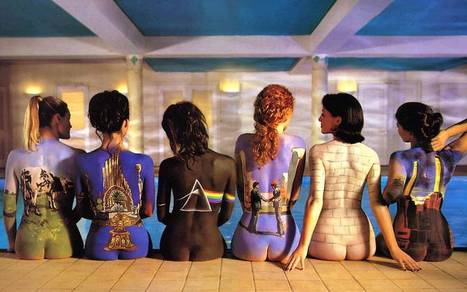
There might not be a band that I’ve had a more confusing relationship with throughout my life than Pink Floyd. The Wall was one of the first albums I bought with my own money, and I fell hard for all of their “big” records. As I moved on to college rock, learning about Syd Barrett made me turn against anything past A Saucerful of Secrets, the last Floyd album to feature Barrett. I discovered their amazing post-Syd/pre-Dark Side period years later, and after years of dismissing the Roger Waters-driven albums, I saw Waters' production of The Wall live this summer and came crawling back to their most famous works with open arms.
This is the first time in my life I’ve been on board with the entirety of their catalog at the same time, so allow me to explain why they’re worth the trouble of disassociating the name Pink Floyd from the dummy in your dorm who wouldn’t shut up about how deep The Wall was.
Piper At the Gates of Dawn is a straight-up masterpiece, and if you choose to detour from this to the solo Barrett albums, that’s fine. This was Syd’s band – he set the tone lyrically and visually, and his guitar work is wildly underrated, slashing and sweeping over the top of Richard Wright’s expert keyboard structures.
He was a doomed captain of a ship that would continue to sail, and he left behind one perfect Pink Floyd album. If the band would’ve packed it in after this, the legend of Syd Barrett would maybe stand even taller than it does now.
Once it was clear that Barrett wasn’t fit to helm the band, the remaining members did whatever they could to keep Pink Floyd going. The addition of David Gilmour initially meant the band would be a five-piece, with Gilmour holding down the guitar duties since Barrett was increasingly catatonic onstage. When that didn’t pan out they then hoped Syd would assume a Brian Wilson position in the band, writing songs at home while the band pounded the pavement. But Syd was fried and disinterested, so the remaining members moved on.
It wasn’t always smooth sailing – the studio disc for the double-LP set Ummagumma is a mess, each member barfing out indulgent solo works (Although the live disc is absolutely amazing!) – but endeavors like their soundtrack to the Barbet Schroeder film More showcases a band commonly known for spending months on end in the studio laying down tracks hard and fast. They had ideas and they were steadily figuring out what worked. None of the albums from 1968-72 are perfect. But their imperfection is exactly what makes these albums so great – they’re getting better each time out, to the point where 1972’s Meddle stands as the apex of their pre-Dark Side albums and could very well be their best album overall. A song like “Echoes” is Pink Floyd putting all their strongest suits – Gilmour’s ethereal vocals and mammoth guitar, Waters’ increasingly humane lyrics, Richard Wright’s textured keyboards – in one side-long epic. The band was at the peak of their powers, arguably surpassing the Barrett era. And they did it their way. And watch how Nick Mason – not known as the most spectacular drummer – absolutely KILLS IT on this version from Live at Pompeii.
By this point Waters was determined to have Pink Floyd actually say something on their next album. So over the next year-plus – with Waters transitioning into the sole conceptual/lyrical force, a position he would never cede control of – Pink Floyd produced an album that dealt with mortality, greed and the sad spectre of Syd Barrett, now a ghostly shadow floating around the band’s hometown of Cambridge. The jams were reined in, melodies assumed the forefront and the result was Dark Side of the Moon, one of the biggest-selling albums of all time – around 50 million copies sold since its release.
The band had pulled off the impossible, coming all the way back from losing their guiding light to conquering the world with an album that distanced them from a prog rock movement that they barely ever had anything in common with (you can’t have musicians as merely capable as Waters and Mason in a real prog rock band!) But they spent four years in the wilderness to ultimately make what is their version of a Beatles album, and from that moment on they would be a band that dealt with Big Ideas every time out. Yeah, they’d go to places that they – or anybody else, really – had never been before, but they’d never be as innocent or as perfectly flawed again.
Watch this short video and you’re likely to say what I said, “What the f*ck!”. The video is about an octopus species that was spotted near Indonesia in the 1990s. The octopus is pretty awesome; it can mimic 15 different species to protect itself from predators. I’m surprised “Paul the Octopus” from Germany got all the attention, as these little guys are way cooler.
1933 was a strange year for New York on film. When a giant ape wasn't climbing the Empire State Building in King Kong, a massive earthquake was shaking the city's skyscrapers to the ground in Deluge.
1933 was a strange year for New York on film. When a giant ape wasn't climbing the Empire State Building in King Kong, a massive earthquake was shaking the city's skyscrapers to the ground in Deluge. Watch how New York City met its doom long before Roland Emmerich knocked down his first Lincoln Log cabin.Directed by Felix E. Feist, Deluge was once thought to be lost until an Italian dub of the film turned up in the 1980s. The disaster sequence, however, had been kept as stock footage and re-used for the 1939 film S.O.S. Tidal Wave, 1941's Dick Tracy vs. Crime, Inc., and 1949's King of the Rocket Men.
WATERLOO — Up among the clouds in the Canary Islands, researchers have pulled off a teleportation experiment that opens the door to a satellite network for powerful quantum computers that could change our world as we know it.
In something that sounds straight out of a science fiction movie, the scientists worked only at night, battling dust storms and shooting green beams of light from one mountain top to another — successfully teleporting quantum information a record 143 kilometres.
And they did it with the help of three researchers from the University of Waterloo’s Institute for Quantum Computing and their highly specialized equipment and computer algorithms.
Vadim Makarov, Thomas Jennewein and Elena Anisimova teamed up with a group from Vienna’s Institute for Quantum Optics and Quantum Information to pull off the groundbreaking experiment that was years in the making.
The group’s research, published this week in the journal Nature, is a major step in the field of quantum physics, which studies the strange behavior of nature at the molecular level.
Here we take a look at the most badass maneuvers ever pulled off in spaceflight history. In this gallery you can find out about the men, women, and a few robots that had the right stuff to keep cool under the most difficult conditions.
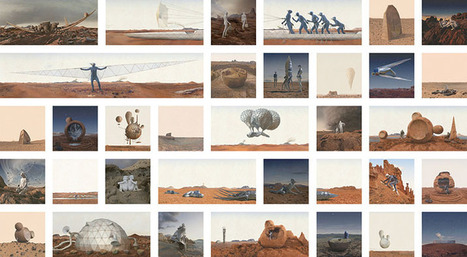
Artists Nicholas Kahn and Richard Selesnick's photo-montages depict a Martian landscape populated by two stoic women climbing rock formations, walking amongst romanesque ruins, examining technological relics and giving birth to children – and all...
While the landing of the Curiosity rover last week got people imagining what it would be like to send humans to Mars, likely no one was picturing the way artists Nicholas Kahn and Richard Selesnick show it.
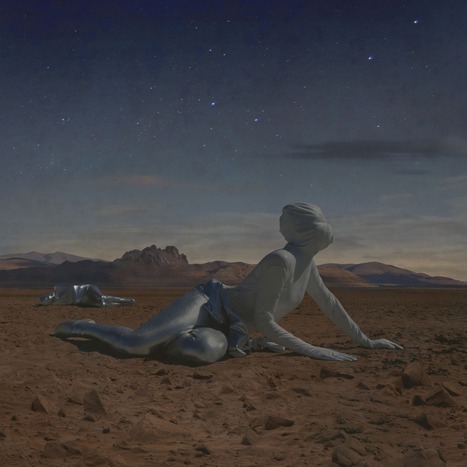
Their photo-montages depict a Martian landscape populated by two stoic women climbing rock formations, walking among romanesque ruins, examining technological relics and giving birth to children – and all the while in their space suits.
“Richard and I have been playing these kinds of games together since college, like we’re 11-year-olds,” says Kahn. “We create these alternative universes and try to make them real for each other. We love to pop back and forth between the future and the past. We’re not very good at the present.”
After exhibiting their previous lunar series, Appollo Prophecies, the two were approached by NASA’s Media Relations contact, Bert Ulrich, about a commission for a panorama. “They [NASA] told us Mars is where we’re going to next and if you’re going to do this project we’d like you to do it about Mars,” says Kahn. “We didn’t start thinking about mars until they told us to.”
NASA's Mars Reconnaissance Orbiter data have given scientists the clearest evidence yet of carbon-dioxide snowfalls on Mars.
September 11, 2012
PASADENA, Calif. -- NASA's Mars Reconnaissance Orbiter data have given scientists the clearest evidence yet of carbon-dioxide snowfalls on Mars. This reveals the only known example of carbon-dioxide snow falling anywhere in our solar system.
Frozen carbon dioxide, better known as "dry ice," requires temperatures of about minus 193 degrees Fahrenheit (minus 125 Celsius), which is much colder than needed for freezing water. Carbon-dioxide snow reminds scientists that although some parts of Mars may look quite Earth-like, the Red Planet is very different. The report is being published in the Journal of Geophysical Research.
"These are the first definitive detections of carbon-dioxide snow clouds," said the report's lead author, Paul Hayne of NASA's Jet Propulsion Laboratory in Pasadena, Calif. "We firmly establish the clouds are composed of carbon dioxide -- flakes of Martian air -- and they are thick enough to result in snowfall accumulation at the surface."
The snowfalls occurred from clouds around the Red Planet's south pole in winter. The presence of carbon-dioxide ice in Mars' seasonal and residual southern polar caps has been known for decades. Also, NASA's Phoenix Lander mission in 2008 observed falling water-ice snow on northern Mars.
NASA's Kepler space telescope, designed to find Earth-size planets in the habitable zone of sun-like stars, has discovered its first five new exoplanets, or planets beyond our solar system. January 04, 2010
PASADENA, Calif. -- NASA's Kepler space telescope, designed to find Earth-size planets in the habitable zone of sun-like stars, has discovered its first five new exoplanets, or planets beyond our solar system.
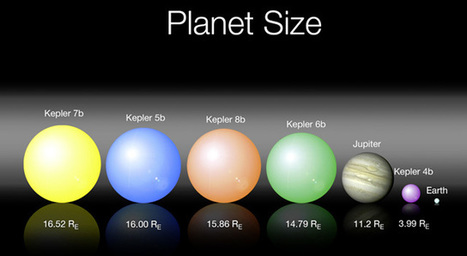
Kepler's high sensitivity to both small and large planets enabled the discovery of the exoplanets, named Kepler 4b, 5b, 6b, 7b and 8b. The discoveries were announced Monday, Jan. 4, by members of the Kepler science team during a news briefing at the American Astronomical Society meeting in Washington.
"These observations contribute to our understanding of how planetary systems form and evolve from the gas and dust disks that give rise to both the stars and their planets," said William Borucki of NASA's Ames Research Center in Moffett Field, Calif. Borucki is the mission's science principal investigator. "The discoveries also show that our science instrument is working well. Indications are that Kepler will meet all its science goals."
Known as "hot Jupiters" because of their high masses and extreme temperatures, the new exoplanets range in size from similar to Neptune to larger than Jupiter. They have orbits ranging from 3.3 to 4.9 days. Estimated temperatures of the planets range from 2,200 to 3,000 degrees Fahrenheit, hotter than molten lava and much too hot for life as we know it. All five of the exoplanets orbit stars hotter and larger than Earth's sun.
"It's gratifying to see the first Kepler discoveries rolling off the assembly line," said Jon Morse, director of the Astrophysics Division at NASA Headquarters in Washington. "We expected Jupiter-size planets in short orbits to be the first planets Kepler could detect. It's only a matter of time before more Kepler observations lead to smaller planets with longer-period orbits, coming closer and closer to the discovery of the first Earth analog."
Once, astronomers thought planets couldn't form around binary stars. Now Kepler has found a whole system of planets orbiting a double star. This finding show...
Nootropics are a topic most have little knowledge of outside of scare articles in mass-market publications, and today I'm here to shed some light on them. Limitless is a movie about an experimental drug – NZT-48 – that gave users mental superpowers, tunnel vision, and a host of methamphetamine blackout inspired side-effects. It showed the main character transforming from a slacker to a prolific writer overnight simply by taking the pill. He then proceeds to become a stock market prodigy and eventually after some drama becomes a candidate for the US Senate. Many viewers were enchanted by the idea of genius in pill form and started scouring the internet for a similar remedy.
The technology may be feasible in 50 or 60 years, researchers say.
Nuclear fusion reactions sparked by beams of antimatter could be propelling ultra-fast spaceships on long journeys before the end of the century, researchers say.
A fusion-powered spacecraft could reach Jupiter within four months, potentially opening up parts of the outer solar system to manned exploration, according to a 2010 NASA report.
A number of hurdles would have to be overcome ― particularly in the production and storage of antimatter ― to make the technology feasible, but some experts imagine it could be ready to go in a half-century or so.
We may be closer than most realize to significant increases in life expectancy.
In 1835, Charles Darwin reached the Galapagos Islands aboard the HMS Beagle. While there, someone (possibly Darwin) captured a tortoise named Harriet. She lived for 176 years, finally dying in 2006.
Other organisms in nature are known to live considerably longer than Harriet. These include the Methuselah tree, a bristlecone pine in Southern California that, at 4,843 years old, is perhaps the oldest known complex organism on Earth. Other creatures that age very slowly and live up to hundreds of years, showing little signs of senescence (aging), include rockfish, clams, lobsters and jellyfish.
Humans, too, live a long time compared to most species. The longest-living primates other than humans are our closest relatives in evolution, chimpanzees. They have an average life span of 53 years. This makes the current life expectancy in the West of nearly 80 years, with a maximum life span of 120 or so. Quite long, though not in the same league as Harriet the tortoise or bristlecone pine trees.
The Atlantic Home Tuesday, September 11, 2012 Follow the Atlantic » Politics Business Entertainment International Technology National Health Magazine video
David Ewing Duncan - David Ewing Duncan is a journalist in San Francisco. He is also a television, radio, and film producer, and he has written eight books. His most recent e-book is entitled When I’m 164: The Science of Radical Life Extension, and What Happens If It Succeeds. More
All Posts Books Share Share on facebook Share on linkedin Share on twitter « Previous Health | Next Health » Email Print When I'm 164: How Can Bioscience Push the Limits of Lifespan?
By David Ewing Duncan
inShare8 Aug 31 2012, 9:05 AM ET 23
We may be closer than most realize to significant increases in life expectancy.
(garryknight/Flickr)
In 1835, Charles Darwin reached the Galapagos Islands aboard the HMS Beagle. While there, someone (possibly Darwin) captured a tortoise named Harriet. She lived for 176 years, finally dying in 2006.
Other organisms in nature are known to live considerably longer than Harriet. These include the Methuselah tree, a bristlecone pine in Southern California that, at 4,843 years old, is perhaps the oldest known complex organism on Earth. Other creatures that age very slowly and live up to hundreds of years, showing little signs of senescence (aging), include rockfish, clams, lobsters and jellyfish.
Humans, too, live a long time compared to most species. The longest-living primates other than humans are our closest relatives in evolution, chimpanzees. They have an average life span of 53 years. This makes the current life expectancy in the West of nearly 80 years, with a maximum life span of 120 or so. Quite long, though not in the same league as Harriet the tortoise or bristlecone pine trees.
Many people receive messages from God. However, these usually tend to run along the lines of "Kill! Kill! Kill!" Such messages are not particularly interesting unless you happen to be on wrong end of the ax.
Jakob Böhme's transmission was considerably deeper than the usual psychotic imperative. In fact, his vision (well, let's call it that) contained profound theological insights well beyond his educational level, which amounted to little more than Bible study and sole-cobbling techniques.
Böhme wrote about his experience and the strange thoughts which resulted, but he sensibly decided to keep these notions within his circle of close friends. His friends had different ideas and copied Böhme's manuscript without his permission, circulating it around the prominent intellectual circles of the day.
The official video about Miniatur Wunderland Hamburg, the largest model railway in the world, and one of the most successful tourist attractions in Germany. ...
NASA's Aqua satellite has been producing amazing images of Earth for 10 years, collecting 29 million gigabytes of data and far outliving its life expectancy of three to five years.
The view of Earth from space has transformed our understanding of, as well as our admiration for, the planet. The data and images collected by Earth-observing satellites have been used in thousands of scientific papers, helped us better respond to natural disasters, improved weather and climate forecasts, enlightened us about our impact on Earth and captivated us with beauty.
One of the stars of NASA's fleet of satellites is Aqua. The satellite is named for its ability to measure water vapor in the atmosphere, water in the oceans, as well as ice and snow. When it was launched on May 4, 2002, scientists expected it to work for three to five years. But its six instruments have been functioning perfectly for 10 years, gathering 29 million gigabytes of data in that time.
One of the most useful and impressive instruments aboard Aqua is the Moderate Resolution Imaging Spectroradiometer, which measures visible and infrared radiation, and produces truly amazing, incredibly beautiful images of Earth. We've chosen some of our favorite MODIS images for this gallery in celebration of a decade of work. With funding for Earth-observing satellites on the decline, let's hope Aqua keeps going for 10 more years.
NASA will host a media teleconference at 10 a.m. PDT (1 p.m. EDT) on Thursday, Sept. 6, to provide a status update on the Curiosity rover's mission to Mars' Gale Crater.
September 05, 2012
PASADENA, Calif. -- NASA will host a media teleconference at 10 a.m. PDT (1 p.m. EDT) on Thursday, Sept. 6, to provide a status update on the Curiosity rover's mission to Mars' Gale Crater.
The Mars Science Laboratory spacecraft is one month into a two-year mission to investigate whether conditions have been favorable for microbial life and preserving clues in the rocks about possible past life.
NASA's Dawn mission is releasing two parting views of the giant asteroid Vesta, using some of the last images taken by the spacecraft as it departed Vesta.
September 11, 2012
PASADENA, Calif. - NASA's Dawn mission is releasing two parting views of the giant asteroid Vesta, using images that were among the last taken by the spacecraft as it departed its companion for the last year.
The first set of images is a color-coded relief map of Vesta's northern hemisphere, from the pole to the equator. It incorporates images taken just as Dawn began to creep over the high northern latitudes, which were dark when Dawn arrived in July 2011. The other image is a black-and-white mosaic that shows a full view of the giant asteroid, created by synthesizing some of Dawn's best images.
"Dawn has peeled back the veil on some of the mysteries surrounding Vesta, but we're still working hard on more analysis," said Christopher Russell, Dawn's principal investigator at UCLA. "So while Vesta is now out of sight, it will not be out of mind."
These will be the last daily images during the cruise to Dawn's second destination, the dwarf planet Ceres. Other images will be highlighted as findings are made. Other data will be archived at http://pds.nasa.gov .
To get content containing either thought or leadership enter:
To get content containing both thought and leadership enter:
To get content containing the expression thought leadership enter:
You can enter several keywords and you can refine them whenever you want. Our suggestion engine uses more signals but entering a few keywords here will rapidly give you great content to curate.


 Your new post is loading...