Half-way through Brian Friel: Theatre and Politics, Anthony Roche breaks off from his argument to make a brief confession – one that encapsulates perfectly the uniqueness of his book. The story he tells concerns Volunteers, Friel’s 1975 drama about a group of IRA prisoners who are forced to work on an archaeological dig. It’s not one of Friel’s better known plays, as Roche acknowledges. When it premiered at the Abbey Theatre, it was greeted with “blank incomprehension by the Dublin critics”, perhaps because it seemed to blend two controversies that audiences considered separate: internment in Northern Ireland and the construction of Dublin Corporation’s offices on the site of a Viking village on Wood Quay. Roche’s suggestion is that the play had to wait another twenty-three years for its “true premiere”
A Gather of Shadow is a slim volume that begins with a bang and ends in a comforting whisper. This new offering from Mark Roper is divided into two sections: ‘Keep-Net’ and ‘A Gather of Shadow’, the first being a miscellany of nature poems and the second addressing the passing of a loved one. Throughout the collection Roper weaves in a strong thread of spirituality. It’s difficult not to polarise or alienate readers when bringing in spirituality, particularly for those who have experienced religion as a force for expulsion,
Without the titanic vision of one man, Brian P. Burns, none of this would have been possible,” writes Roger Kohn of The Four Irish Nobel Laureates, a series of sculptures created by noted Irish artist Rowan Gillespie, now permanently housed in the John J. Burns Library, in the historic, leafy suburb of Chestnut Hill, at the heart of the Boston College campus. Under the direction of Dr. Robert O’Neill, the Burns Library continues to be the world’s premier repository of Irish cultural heritage outside Ireland.
THE Honourable Irish Society is gifting Londonderry a new cantata from Pullitzer-prize winning poet Paul Muldoon and composer Mark Anthony Turnage as part of next year’s City of London Festival 2013 which will aim to reflect the historic...
This essay addresses the influence of Beckett’s engagement with physics, particularly during the 1930s but also more broadly throughout his career, on the development of his own writing style and mature poetics.
In conversation with Georges Duthuit, Beckett famously remarked ‘there is nothing to express, nothing with which to express, nothing from which to express, no power to express, no desire to express, together with the obligation to express.’ Over the years, this statement has been read in numerous ways, and it is arguable that it has in fact been over-read as an aesthetic manifesto that casts interpretative light on Beckett’s project as a whole.
Starting on January 1st 2013, a different combination of poetry and art from Ireland is brought to you each Monday, and delivered free to your inbox.
The Poetry Project has a gift for you--
To celebrate Ireland’s Presidency of the European Union, this exciting digital post can be sent to you until July 2013. Twenty-six poems and twenty–six video shorts will offer you a unique insight into the creativity of contemporary Ireland.
For Christmas 1922, James Joyce sent a gift to his main benefactor and supporter, Harriet Shaw Weaver. It was a facsimile of some pages of the ancient Irish illuminated manuscript known as The Book of Kells. SinceUlysses was by that time published, Joyce was embarking on Finnegans Wake and plotting out its systems. The Book of Kells would remain an abiding influence on his work; he would refer to one of its pages explicitly in his new novel. When his friend Arthur Power needed advice about how to write, Joyce suggested that he study The Book of Kells. "In all the places I have been to," he wrote, "Rome, Zurich, Trieste, I have taken it about with me, and have pored over its workmanship for hours. It is the most purely Irish thing we have,
Sad and wonderful tension between what is sublime and what is commonplace — an astonishment at this world, augmented by the sardonic awareness that astonishment is nothing new – permeates themes of transience in Andrew Jamison’ first collection, Happy Hour. Critics may find some of these poems hackneyed, but I believe the poet is up to something. ‘The Bus to Belfast’ opens in the voice of a pre-transient speaker. The eponymous bus and its ‘pane’s black rubber seal… nicked to bits / by a penknife’ are as drab a welcome as any; however, in its first line, a sleight of hand evokes a dual theme of loss and scrutiny.
The exhibition, Yeats: The Life and Works of William Butler Yeats, which has been described in The Irish Times as "one of the most important literary exhibitions yet staged internationally," opened to unanimous acclaim on May 25, 2006.
Since then, over a quarter of a million people of all ages and nationalities have delighted in exploring the multimedia rich experience of this award-winning exhibition.
BOOKS OF THE YEAR: ANNA CAREYasks writers, poets, historians, comedians, politicians, broadcasters, an editor and a bookshop owner to nominate their favourites...
Donal Ryan’s brilliant debut novel The Spinning Heart has been voted the Bord Gáis Energy Book of the Year from a shortlist comprising the winners of the individual categories announced at the Irish Book Awards gala dinner on November 22nd. Despite competition from major writers such as Booker Prize winner John Banville, Edna O’Brien and the highly-acclaimed Atlas of the Great Irish Famine, Ryan’s expansive and ambitious novel emerged as the overall winner in what was commonly regarded as a wonderful year for Irish writing.
'Paradise Lost' is one of the longest poems in the English language and was written by John Milton after he had lost his sight. The read-a-thon event will raise money for the National Council for the Blind of Ireland (NCBI) who work with people with sight loss. The Read-a-thon which has been organised by Philip Coleman and Crawford Gribben of the School of English, has attracted the participation of a wide range of writers and public figures, including Terence Brown, Gerald Dawe, Seamus Heaney, Brendan Kennelly, Dave Lordan, Thomas Luxon, Iggy McGovern, Eiléan Ní Chuilleanáin, Nuala Ní Dhomhnaill, David Norris, Michael O'Loughlin, Nessa O'Mahony, Eve Patten, Patrick Prendergast, Gerard Smyth, Joseph Woods, Macdara Woods, members of Trinity Players, students and staff of the School of English, and many more.
A Trinity College Professorship, named in honour of one of Ireland’s greatest poets, was unveiled this morning. College Provost Dr Patrick Prendergast said the announcement of the Seamus Heaney professorship in Irish writing was “a significant event in writing in Ireland and internationally”.
Mr Heaney, an honorary fellow of Trinity since 1998, said he felt honoured by his association with the new post.
“The gratitude I feel is all the greater because of my high regard for the work being done in Trinity’s School of English, and my friendship over the years with the writers and scholars who have contributed to the study and practice of Irish writing.”
2013: “Beckett and the ‘State’ of Ireland” III will further expand issues concerning Beckett and Ireland. More to come….
“Beckett and the ‘State’ of Ireland” conference 2012 is a continuation from last year’s conference which is exploring the link between Samuel Beckett and his home country of Ireland.
beckettconference2012@gmail.com
Those who attend our conference will have the benefit of being in close proximity to the Samuel Beckett Summer School held at Trinity College Dublin the following. Attending the two in tandem will be a highly rewarding experience of a wide range of current Beckett topics mixed with already established and prominent scholarship. Please visit the Beckett
There's a view that we survive vicariously in the books we write and that therefore death is not ultimately lethal. This was a pagan argument and it's still going strong in post-modernity because its consolation is both timely and timeless. Poet and linguist Peter Sirr's 'document drama' for radio is a poignant study of work that's been lost forever in the whirlpool of the underworld - and of the glittering recent retrieval of an entire poem (almost) by the lesbian poet Sappho nearly two thousand five hundred years after its apparent disappearance from the classical canon.
As someone who ran away from Cambridge to enlist in the dragoons under the name Silas Tomkyn Comberbache, repeatedly fell off his horse, and finally won a discharge on the grounds of insanity, Samuel Taylor Coleridge still has a military record that most contemporary poets could only dream of. Rarely, these days, is a war poet a serving soldier or veteran, but if ever there was a decade in which Britain’s poets were placed on a war footing it was the 1790s. Decades before he became Shelley’s ‘old, mad, blind, despised, and dying King’, George III was already a tyrant, his paranoia fuelled by legions of government spies. In the early 1790s, the young Coleridge was still in the first bloom of radicalism, casting himself as a prophet of the coming democratic age and hatching schemes for a Pantisocratic utopian community in the United States.
Kerry Hardie’s newest collection is a dark and gorgeous hymn to human mortality. Death is, of course, such a common theme in poetry that it’s difficult to find anything new to say about it, but Hardie succeeds, injecting into these poems her usual quiet originality. For her, death is not to be feared — if anything, it is a place of comfort and safety. The refrain of ‘Sixty’, the first poem in the collection, is ‘everyone is slowly going home,’ and elsewhere, in the afterlife of ‘The Inmost Sea’, the dead ‘stretch in the fresh red graves / fennel and dill line the breath of the wind.’ Life, Hardie reckons, is messy — in ‘Happy Endings’, a scene of children playing on the beach becomes a metaphor for the way things inevitably unravel.
The democratisation of Irish Poetry has been a much sought-after state. The excluded constantly knocked at its gates, only to be sent away by the gatekeepers. But in recent times some of the gates have shown signs of forced entry.
Peadar O’Donoghue is a poet who, in barely two years, has literally come out of nowhere. He makes no secret of the fact that he is struggling with poetry, yet he is at the same time the founder editor of a much admired journal: The Poetry Bus. His success stems largely from blogging and from his quirky and likeable presence on Facebook. He is the quintessential e-poet, agitating for web-based poetry, badgering poets to contribute to his mad notions, from Poetrygeists to Lovegeists. He is the wise-cracking guru of the excluded poet. Under his Messiahship the democratisation of poetry appears to loom.
Down the years, James Patrick Michael Donleavy has been portrayed in the Anglo-Irish press as a gentleman recluse with a roistering life of hard drinking, fisticuffs and harlotry behind him. It makes nice copy: the former ‘hell-raiser’ sequestered in his Georgian mansion in Westmeath, Ireland. James Joyce wrote about this country pile, Levington Park, in Stephen Hero having, apparently, stayed there as a boy while his father was working in nearby Mullingar. Yet while the ‘literary recluse’ shtick seems overstated, it may contain a germ of truth. After all, Donleavy has admitted himself that he rarely leaves his home, and once said that, of all his protagonists, the one he most resembles is the sadly humane George Smith from his paranoiac second novel, A Singular Man.
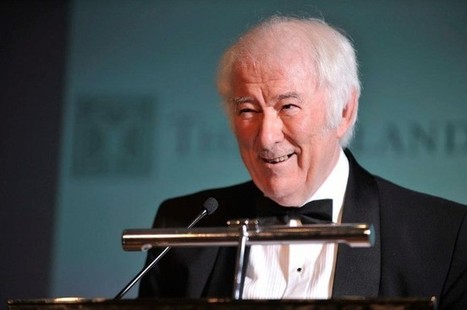
Irish poet Seamus Heaney was given the annual 'Contribution to Irish Culutral Life in the UK' award at a blacktie event in London.
The award, presented by the Ireland Fund of Great Britain, recognises 'Irish people who are influencing culture in the UK, in whatever category,' a spokesperson for the fund said.
To get content containing either thought or leadership enter:
To get content containing both thought and leadership enter:
To get content containing the expression thought leadership enter:
You can enter several keywords and you can refine them whenever you want. Our suggestion engine uses more signals but entering a few keywords here will rapidly give you great content to curate.


 Your new post is loading...