Nobel Laureate Seamus Heaney's new translation of Beowulf comes to life in this gripping audio. Heaney's performance reminds us that Beowulf, written near th...
“In a short story, everything can only happen once...there is something that you cannot name in the story, and will have no consequences...[it’s] something that you can’t quite fathom, and you put the book down for a moment and wonder.” So spoke...
FIFTYSOMETHING:The phone was ringing in the kitchen. It only rang six times. I belted down the stairs to get it. My brother Bob was on the line, calling from Bristol.
Who are some of the contemporary short story writers you admire? If you had to say, who do you regard as the three best ever short story writers? William Trevor, V.S Pritchett and James Plunkett. I admire others, Updike, for example, though find his mood disconsolate. Maugham is terrific, and Hemingway has a certain macho honesty. Younger story writers tend, with some exceptions, to be self-consciously 'aware' to an agonizing degree.
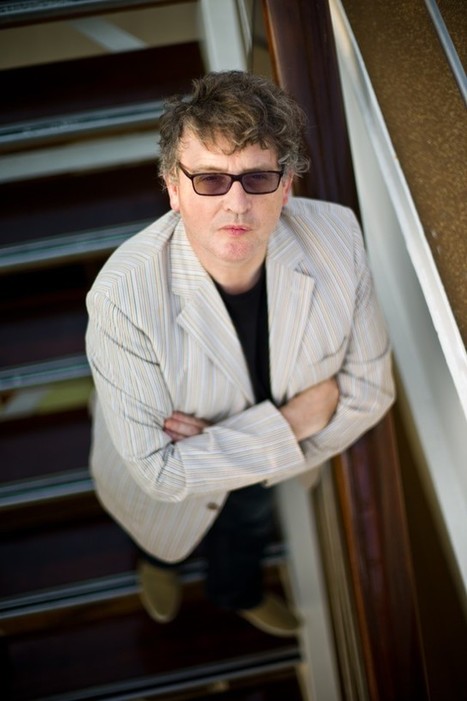
When he isn’t writing verse or teaching at Princeton University, Irish poet Paul Muldoon taps into his inner Dylan and jams with the New Jersey rock group Wayside Shrines.
Is existence enough, as Auden asserted in his poem, ‘The Riddle’? How much and what kind of companionship does one need? Some of us think we need lots, but are somehow unable to get enough, or any that satisfies.
In a series of 303 internal dialogues and pensées, this work explores the state of being alone—its pain, its absences and presences. There are three voices: One; The Other; and I. One is the voice of instinct. It is fearful and only hears itself. The Other is the voice of the larger world in the form of quotations—from scientists, poets, fiction authors, artists, philosophers, psychologists, mystics, loners. The third voice, I, is the rational portion of the self, and the only voice that also listens.
Nobel Laureate Seamus Heaney's new translation of Beowulf comes to life in this gripping audio. Heaney's performance reminds us that Beowulf, written near the turn of another millennium, was intended to be heard not read.
Composed toward the end of the first millennium of our era, Beowulf is the elegiac narrative of the adventures of Beowulf, a Scandinavian hero who saves the Danes from the seemingly invincible monster Grendel and, later, from Grendel's mother. He then returns to his own country and lives to old age before dying in a vivid fight against a dragon. - HighBridge Audio
RODDY DOYLE has been shortlisted for the 2013 Carnegie Medal for his children's novel A GREYHOUND OF A GIRL. The Carnegie Medal is awarded annually to the writer of an outstanding book for children & this year's winner will be announced on 13 June.
Dairena Ní Chinnéide reading her poem "The Day the Blaskets Were Stolen" in Irish and English. Event at the Irish Cultural Center at Elms College, March 5, 2...
The second instalment in a trilogy, after Jude in Ireland , this novel sees our orphan hero travel across the sea to find his true love, chip-shop girl Angela, meeting eccentric characters along the way. These often provide mirth as well as topicality, as in Jude’s exploration of the banking crisis with a goat trader from Somaliland. Jude’s lack of guile means he lands in some very odd situations: teetering on an iceberg in the Irish Sea, cycling down a hadron collider and being harassed into writing a new Ulysses .
Soho Press presents: Mike McCormack’s East Coast Tour March 13-17, 2013 For the US debut of his latest novel, NOTES FROM A COMA, Irish literary author Mike McCormack will be flying in from Galway for an east coast tour in mid-March.
Experiment or Die: A Conversation with Mike McCormack
: Mike McCormack is the author of Getting it in the Head (1996), a book of stories awarded the Rooney Prize for Irish Literature in 1996 and voted a New York Times Notable Book of the Year. He has also published two novels, Crowe’s Requiem (1998) and Notes From a Coma (2005). The latter was shortlisted for The Sunday Independent/Hughes & Hughes Irish Novel of the Year award and recently hailed by The Irish Times as “the greatest Irish novel of the decade just ended.” In this interview, McCormack discusses the influences and experiences which led him to writing, the ubiquity of technology, and the...
SOME rock musicians have been known to write poetry. Others have even looked to poets for inspiration. The music of Bob Dylan and Patti Smith, to take two examples, owes much to Arthur Rimbaud, a 19th-century French poet. But few contemporary poets regard rock lyrics with anything close to critical admiration.
Paul Muldoon may be the exception to this rule. A Northern Irish poet based in America, Mr Muldoon has won a Pulitzer prize and is a professor at Princeton University. His playful and inventive poetry has invited comparisons with Seamus Heaney, and he has often been mooted to be his successor. Mr Muldoon’s writing is muscular and taut, and previous collections, such as the critically acclaimed “Maggot” (2010), have gained him many fans. But his 12th collection, “The Word on the Street”, takes his work in a different direction. It is a series of rock lyrics that blur the distinction between poetry and song.
To get content containing either thought or leadership enter:
To get content containing both thought and leadership enter:
To get content containing the expression thought leadership enter:
You can enter several keywords and you can refine them whenever you want. Our suggestion engine uses more signals but entering a few keywords here will rapidly give you great content to curate.


 Your new post is loading...


 Scoop.it!