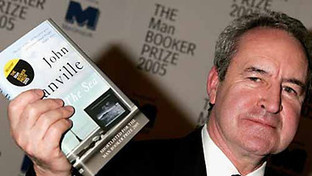
The Irish short story “has come alive again and is wriggling and it has about it all the demonic energy (and the undeniable immediacy) of a newborn infant”. It is “pulsing with great, mad and rude new energies”. So writes Kevin Barry in his introduction to Faber’s fourth anthology of Irish stories, and his claim is fully backed up by the 20 tales in his sharp, lively and varied selection...
City of Bohane, thriller set in a futuristic west of Ireland, takes €100,000 prize
“It’s a fantastic thrill for me,” said Barry. “It’s a big money prize, and it’s always useful for a poor writer to be put in the vicinity of stacks of cash. It’s an unpredictable life and it’s great to be able to buy time to sit in my little room and invent these demented little words.”
Michael Harding who was born and lived the early part of his live in Cavan talks to Aine of his live in Cavan, his time as a priest, his memories of his moth...
You’ll recall that I’m attempting to share my experience of reading Finnegans Wake by capturing some of the visual impressions generated by the text. I’m doing this through a process of annotation and rapid sketchbook notation made whilst ‘in the text’. I make drawings without the use of external visual references to try to get at the images as they are formed in my head. With the text at hand I develop this pictorial notation in other media as part of this visual mode of Wake reading.
Throughout my teenage years, I read A Christmas Carol by Charles Dickens every December. It was a story that never failed to excite me for as well as being a Dickens enthusiast, I have always loved ghost stories.
The only known audio recording of James Joyce reading from Ulysses is to be auctioned at Sotheby’s in New York in June.
Recorded in 1924 and produced as a private venture by Sylvia Beach, who published the book two years earlier, the copies did not go on sale but were given to Joyce for distribution among family and friends. Two copies were also kept by Beach at her Shakespeare & Company bookshop in Paris.
The first mention of the recording seems to be in a 1935 Beach catalogue of Joyce material, where it was recorded with the following note: “Phonograph record of a reading by James Joyce from Ulysses pages 136-137, recorded by His Master’s Voice on one side only....Signed James Joyce, Paris, 17 November 1926 (date of recording). Only remaining copy of the 30 that were made.”
A distinguished panel gathered in The Arms Hotel Ballroom on Thursday for the first of our Gathering strand of events, to discuss the very timely and relevant subject of Across the Waves: The Experience of Migration in Contemporary Irish Writing.
Professor Liam Kennedy: Emigration. Exile. In some ways there’s nothing new about the subject, but it’s timely. Why? Because migration is changing and it’s changing in the sense that the special coordinates by which we map our sense of identity as Irish are shifting and changing. The word academics use is globalisation, and what I mean by that is we’re experiencing an intensified flow of information, capital and people across national borders. I think we can broadly agree we are living in an age of globalisation in all of these ways, and particularly because of the way digital electronic communications has intensified this flow.
this year’s shortlist was one of the most disappointing in the 18-year history of the prize. And this in a year when there were, among the longlist of 154 library nominations, several wonderful novels, including – in my opinion – two worthy winners.
The Libyan writer Hisham Matar’s magnificently elegiac Anatomy of a Disappearance, which goes a long way to explaining the horrors of Libya, towered above all else. Nominated by three libraries, including Cork City Libraries, Anatomy of a Disappearance was the novel that should have won. It was not even shortlisted.
IRISH writer Kevin Barry has won the €100,000 International IMPAC Dublin Literary Award.
He won the prestigious award for his debut novel City of Bohane
He beat other big names on the shortlist of ten, including Michel Houellebecq and Andrew Miller (both previous winners, as well as the bestselling Japanese writer Haruki Murakami.
The winning novel is set 40 years into the future in a ruined city on the west coast of Ireland, a place laid waste by gang violence
WRITER Emma Donoghue has revealed her best-selling novel 'Room' is being made into a film and she's writing the screenplay.
The 2010 novel which has sold over one million copies worldwide and won the Dublin-born author major literary accolades was inspired by the story of Josef Fritzl, the Austrian who held his daughter Elizabeth captive in a dungeon in their home for 24 years, during which time she bore his children.
The story is told through the eyes of five-year-old Jack, who lives in a small room with 'Ma' who is visited at night by 'Old Nick'. The pair eventually escape and are reunited with family.
There is no easy way to categorise Neil Jordan or his work. He discusses writing, directing, tackling national monuments and battling the studio system
Sinead Gleeson interviewed Emma Donoghue at The Arms Hotel on Friday.
Sinead: You come from a big family and I’m guessing there were a lot of books in the house. When did you discover books and become excited by them?
Emma: I don’t remember a time before books. I used to make my mother read to me all the time, in particular one of those Andrew Lang fairy tale anthologies. I think it was called The Yellow Bookand there was one particular fairy story about a witch which I got her to read to me nightly. Now when I’m reading to my kids I think, oh no not that one again, and there’s certain books that I hide away, hoping they won’t ask me to read them.
To get content containing either thought or leadership enter:
To get content containing both thought and leadership enter:
To get content containing the expression thought leadership enter:
You can enter several keywords and you can refine them whenever you want. Our suggestion engine uses more signals but entering a few keywords here will rapidly give you great content to curate.


 Your new post is loading...