Fran Brearton enjoys a deft exploration of the artificiality of art in framing and containing its subject
Sinéad Morrissey's brilliant, Forward prize-shortlisted fifth collection, she defines its title as: "Parallax (Astron.) Apparent displacement, or difference in the apparent position, of an object, caused by actual change (or difference) of position of the point of observation." It's a fertile subject for a book that reveals an interest in parallax in all its multiple senses – photographic, philosophical, political. In photography, for instance, parallax is "the incorrect framing of an image due to the differing positions of the viewfinder and the lens" (OED). Morrissey, who has always been concerned with what lies "between here and there", the visible and invisible, with the artificiality of art in framing and containing its subject, exploits the potential inherent in this not immediately promising technical problem with consummate skill. Her previous collection, Through the Square Window, reimagined the window on to the world familiar from TV's Play School; here, films, paintings, maps, and particularly photographs – of "the different people who lived in sepia -/ more buttoned, colder" ("A Lie") – prompt reflections on perception and deception, what can and can't be captured within the frame of the poem, what the truth leaves out.
nstituto Cervantes Dublin is pleased to present the second edition of the Isla Festival of Literature.
This is a unique opportunity to attend a gathering of Irish and Hispanic literature where you will enjoy round tables, readings and other parallel events during three consecutive days. This year, on the second edition of this festival we will have 16 authors from Argentina, Chile, Cuba, Ireland, Mexico and Spain. Poetry, novel, essay, theatre and cinema will be the main characters of a pluralistic program for all audiences.
In just five minutes she gave us our narratives: you were the smoother-over, the peacemaker, while I was the perfectionist, and together we had passed these traits to our daughter, given her food for her eating disorder...
From Edna O’Brien’s earliest novels, many commentators have noted that desire is at the core of the narratives. The true irony in such observations lies in their frequently blinkered understanding of what comprises that desire, reducing it to a heteronormative, Barbara-Cartland-style pursuit of “romance.” While the characters themselves may think this is what they hunger for, the text inevitably opens up vaster sources of insatiable longing. As Mary Douglas has established, “the body is capable of furnishing a natural system of symbols” (xxxii), and in O’Brien’s texts the human mouth, especially when at its most “animal,” metonymizes numerous desires, most often balked and even impossible ones, including those that actuate the scene of writing. Mouths are everywhere in O’Brien’s novels, licking, yawning, weeping, swallowing, keening, grimacing, biting, shrieking, chewing, singing, speaking, and opening in silence. These mouths give voice to the immaterial, and even animate the inorganic, which, for all of its immateriality, can yet resist manipulation. The inscrutable “inhuman” voice that emerges ultimately reveals “that words themselves are sphinxes, hybrids of the animal, the human, and the inorganic” (Ellmann 77).
Hello Fred and welcome to writing.ie. You’ve had such a long writing life so far, I’m not sure where to start. But I’ll start at the beginning. How did you first get interested in poetry?I was writing poetry very early on, at about the same time that I began to write short stories. I wanted only to be a short story writer, as it transpires. Steinbeck influenced me, and James Baldwin and later the French writers. Dear me, but I toted things up the other day, and it is forty-two years since I published my first short story! Poetry was always dear to me in so much as, writing songs, which I also did from an early age, I believed in the measured potency of words. I also believed – and it was in the air then too – that poetry had a social and political importance; certainly, that poets had or should have. Not many Irish contemporary poets want to hear that now, sadly.
Celebration was tinged with a shared sadness at the loss of an original voice
A poignant period for Irish poetry continued in Dún Laoghaire on Saturday as this year’s Dlr Irish Times Poetry Now award, won by Dennis O’Driscoll’s final collection, Dear Life, was presented to his widow, poet Julie O’Callaghan. In receiving it, she read the words of Czech poet Miroslav Holub’s Ode to Joy: “Like caryatids/our uplifted arms/hold up time’s granite load/and defeated/we shall always win.”
Victory was not, however, all that important; a sense of loss presided and O’Driscoll’s collection had been dominated by mortality and musings on the randomness of life, its sneaky haste. “The tally of years/added up so rapidly/it appeared I had/been short-changed,/ tricked by sleight/of hand, fallen victim/to false bookkeeping.” (From Time Enough.)
With John Banville, you get two authors in one. And now there are three.
Under his own name, the Irish writer creates brilliant, luminous and intellectual literary novels like The Sea, which won the prestigious Man Booker Prize in 2005. He's also a playwright, screenwriter, journalist and take-no-prisoners book reviewer.
Banville, 67, has also published six novels as Benjamin Black, a series of darkly atmospheric noir mysteries set in Dublin in the 1950s. Their main character, a pathologist with a troubled past (and present) and the single name Quirke, appears for a seventh time in Black's gripping, terrific new novel, Holy Orders. A BBC series based on the books, Quirke, is now in production, with Gabriel Byrne in the title role.
So, our greatest contemporary poet dead and the fiftieth anniversary today (September 3rd) of the death of the second, no the third ... well one of the first division chaps anyway, Louis MacNeice.
Born in Belfast, mother a Cleshan from Ballymacrony, father a minister (of the other sort), and on his way to a bishop. Carrickfergus, school in pretty Sherborne in Dorset, then Marlborough, where a few hard lessons about hierarchy and power were taught. Betjeman and Blunt (the latter finding him “totally, irredeemably heterosexual”). Oxford, Auden, Spender, Day-Lewis, Marxism, the whole gang christened “MacSpaunday”; Mac, though “progressive”, was not so convinced or ready to be convinced about the benefits of the Revolution as Spaunday.
Donegal Bay and Blue Stacks Festival is pleased to celebrate the memory of much loved Killybegs poet Noelle Vial, who died 10 years ago this year, with the creation of a special poetry bursary under her name.
The sun was setting and there were shadows on the ground from the flats. Jamie sat on a horse, his baby in his arms, looking at the unfinished overpass where he used to work.
Richard Murphy was born in County Mayo in Ireland in 1927. He spent part of his childhood in Ceylon (now Sri Lanka) where his father was the last British mayor…
The period between 1450 and 1850 in Europe is often referred to as the ‘Little Ice Age’ but it was in the years 1739-1741 that Ireland experienced some of the most severe weather conditions ever recorded in the country. The Great Frost, as it later became known, caused unprecedented disturbance in Ireland’s ecology: lakes and rivers were frozen, potato crops and grain harvests were ruined, and livestock and humans perished from hunger and disease. This devastation of the natural world was accompanied by upheaval in civic life, including the break-up of rural communities and an increase in crime and social unrest. Though the extraordinary weather witnessed at this time has largely been forgotten, it calls attention to the impact of climatic conditions on both human and non-human environments, as well as exploring the challenge these circumstances presented to existing human perceptions of the relationship between man and nature. Many of the poems written and published at the time explore this unprecedented experience, some drawing on the conventions of poetic representations of the natural world, others offering innovative expressions of diverse conditions. Using the work of well known figures such as William Dunkin and Laurence Whyte, as well as hitherto uncollected texts by lesser-known and anonymous writers, this essay will explore the poetic mediation of this important environmental event and consider its impact on our understanding of the natural world in Ireland in this period.
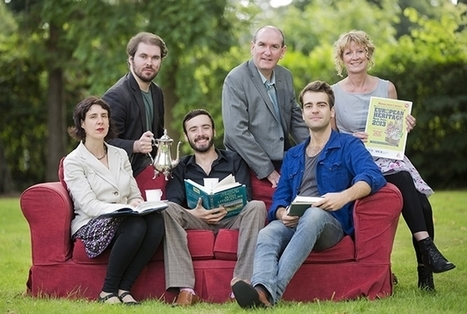
MacNeice House, once home to one of Northern Ireland's great poets, Louis MacNeice (1907 - 1963), and now home to the Arts Council of Northern Ireland will throw open it's door to the public on Saturday 14th and Sunday 15th September.
This year European Heritage open days (EHOD) will take place on 14th and 15th September and MacNeice House on Belfast’s Malone Road, once home to one of Northern Ireland’s greatest poets, Louis MacNeice from 1907-1963, will be throwing open its doors to the public who are encouraged to come
Many of the poems in this enchanting and enchanted first collection are set in the early light of morning, the half-light of evening or the firelight of a damp day. Many occur by water’s edge — quayside, shore or riverbank – and abound in memorable images: the storm unfolding its rope of cloud, a speaker catching ‘the minnow of your reflection’. By conjuring seasons and landscape — and, in particular, expanses of the West of Ireland — Michelle O’Sullivan becomes a meteorologist of emotional states. Grief is a place to be departed from. Threats are at bay: ‘and I don’t think anything terrible / is going to happen yet’.
Tom Williams: Raymond Chandler's estate have chosen John Banville to write a new Philip Marlowe novel – but can he capture the hero's loneliness and the bleak glitter of LA?
"For reasons hard to fathom, the novels of Joyce Carey are largely forgotten now."
Prizes are a powerful means of celebrating books that might otherwise fail to find due recognition. We asked our Academicians to imagine that the Folio Prize had existed through time, and to nominate a book that they would like to have seen win. Some of their choices qualify as truly undiscovered, while others may not have received the attention they deserve, but they take in every kind of form, style and subject, and are all wonderful books.
Involvement in a recent Zurich workshop on Joyce and newspapers brought with it, for me, the strange experience of being part of the history that was being discussed. Newspaper technology changed very little between the 1890s and the mid-1980s (indeed, the printing process, although massively magnified, is still essentially the same).
The major innovation of those years, the Linotype machine, whereby type could be set by the line instead of by the letter, was already in place in the Freeman’s Journal by 1904 (there is a very valuable photograph of the caseroom (production area) of the newspaper from those years showing the Linotype machines).
Critically Acclaimed author Kevin Barry tells a witty and imaginative tale of a series of apparitions across Dublin, that bring the old writers of the city c...
Marina Lewycka enjoys a refreshing rejection of the escapist fantasy
It lures you in by seeming to be one kind of novel; as you read on, you discover that it is really quite another.
In the opening scene, the recently widowed narrator, referred to throughout as Our Woman, confesses to her "grief counsellor" that she is plagued night and day by thoughts of naked men. The counsellor suggests that she should try vigorously scrubbing the kitchen floor. You guessed – it doesn't work. The images come back, but worse
To get content containing either thought or leadership enter:
To get content containing both thought and leadership enter:
To get content containing the expression thought leadership enter:
You can enter several keywords and you can refine them whenever you want. Our suggestion engine uses more signals but entering a few keywords here will rapidly give you great content to curate.


 Your new post is loading...