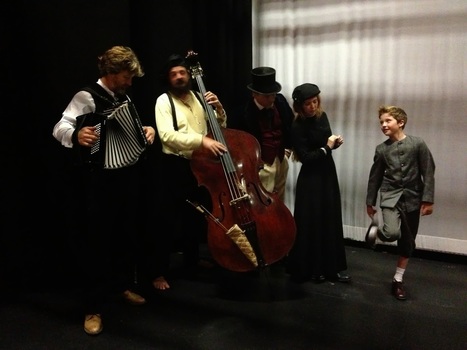
Help the writer deliver the best play possible. Get the basics right early. Do very little for a successful show, then claim the credit. Welcome to the tricks of the dramaturg’s trade

 Your new post is loading...
 Scoop.it! Help the writer deliver the best play possible. Get the basics right early. Do very little for a successful show, then claim the credit. Welcome to the tricks of the dramaturg’s trade 
No comment yet.
Sign up to comment
Scoop.it!

Everyone knows that poetry is best when listened to, so kick back, relax and belatedly celebrate National Poetry Day with some readings from our poets. Conor O’Callaghan reading “January Drought” f...
Scoop.it!

He has covered three tribunals, but now Colm Keena has written a book about what happens to a bishop when he tells the truth, writes Arminta Wallace
Scoop.it!

The light bulb over the table burst and the kitchen went dark; bits of bulb glass landed in my hair and I shook my head and swiped them away. ‘Shit,’ Imogen said, reaching across to touch my arm, ‘it must be a power surge.’ ‘It’s Dana,’ I said, standing up, ‘she’s dead.’ ‘For fuck’s sake, Sonny. What are you talking about?’ Imogen snapped her hand away and fumbled towards the hall. ‘This one’s gone too,’ she shouted. I heard her bump into the coat-stand and curse, then head up the stairs to the nursery.
Scoop.it!
n Frank O’ Connor’s classic study of the short story, The Lonely Voice, he says that one of the things which characterises the short story (and for him differentiates it from the novel) is ‘an intense awareness of human loneliness’ and that: it might be truer to say that while we often read a familiar novel again for companionship, we approach the short story in a very different mood. It is more akin to the mood of Pascal’s saying: Le silence éternal de ce espaces infinis m’effraie [the eternal silence of those infinite spaces terrifies me.]
Scoop.it!
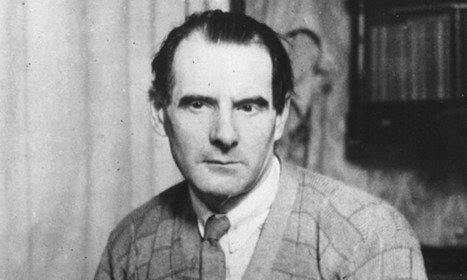
His sister Bella hardly featured in Sean O'Casey's autobiography but Morrissy fills in the missing years
The playwright Sean O Casey composed six volumes of autobiography but didn't reserve much space for his sister, Bella, whom he killed off at least a decade earlier than her actual demise during the Spanish flu epidemic of 1918. Fifteen years older, and practically a second mother to him, her principal sin was that of marrying a common soldier, thus throwing away the advantages of an above-average education "for the romance of a crimson coat". Morrissy's novel restores the missing years and invents some fairly convincing extenuating circumstances
Scoop.it!

In We Are Bone, we witness the poet Maria McManus exploring with wit, charm and vigour what it means to belong to a place, a people and to a time. It is from belonging that she claims her place in her native Fermanagh, and within her family. She is in turn, claimed. Indeed, her use of language captures the natural rhythms of Ulster vernacular speech to produce poems of peculiarity and warm inclusiveness. In cinematic and intimate vignettes of solitude and quiet, McManus has a bracing range of concerns: globalisation, colonialism, the atomisation of the individual, the duplicities of the modern media.
Scoop.it!

Eimear McBride’s ‘A Girl is a Half-Formed Thing’ deals with familiar themes in an innovative way
Scoop.it!

Following on from the welcome revival of interest in recent years in Louis MacNeice as writer and producer for radio, as well as a poet, a one-day conference will be held at Corpus Christi College,...
Scoop.it!

‘The Sweet Forbearance of the Streets’ chosen from more than 300 entries to Irish Times competition for fictional reflections on Ireland after the crash
Scoop.it!

The final interview in the series is, fittingly enough, with poet, critic & founder editor of the original Burning Bush magazine, Michael S. Begnal. How long have you been writing? I started wr...
Scoop.it!
The Shouting Man
|
Scoop.it!

From the archive: in a story first published in 1941 Seán Ó Faolain takes a close look at why Knocknagow (1879), the novel by Charles Kickham, became such a hit with Irish readers

Marie Arndt's curator insight,
October 12, 2013 5:48 AM
Sean O'Faolain had a firm foot in the Irish past, as well as commitment to modernising Ireland. This dicotomy often created contradictions in his discourse, but it adds to making him an interesting writer. His ouvre spans almost the entire 20th century, and reflects the political and social aspects of that era.
Scoop.it!

In advance of publication of her new book The Love Object, a 500-page retrospective of stories, Edna O’Brien looks back on life, loves, and her passion for writing
Scoop.it!

Frank McGuinness’s new play, The Hanging Gardens, and Arimathea, the novel he thought he should write as research for it, draw deeply on his experience of growing up in a threatening, oppressive Ireland...
Scoop.it!
He was beginning to notice a lot. Every light-reflecting surface in the hostel’s kitchen glared at him. The kettle accused him. The four cooker rings accused him. The shiny linoleum floor accused him. Get your own place. Why are you always here? Viv, his care worker, flicked the switch on the boiling kettle lowering its rumbles to a hiss. Viv came twice a week to see that he went to work. He looked at her feet in her flat-heeled shoes planted on the black-and-white squares of the lino.
Scoop.it!

"This, I hope, is an appropriate word for those generations of us who have been described as belonging to the Diaspora: we with our vagrant voices, we who sometimes think that the only home we have is our names, we who are both here and there at the same time.
Marie Arndt's curator insight,
October 7, 2013 7:54 AM
Identity is, indeed, a very subjective word, and means different things for those of us who live elsewhere, in a different place from where we were born or grew up. Some change their identity over time, as thier relationship to their original point of reference changes, others retain the one identity. It dependson our flexibility and willingness to evolve over time.
Scoop.it!
New collections by Anne Fitzgerald and David Troupes, reviewed by John North - The Manchester Review
Anne Fitzgerald’s Beyond the Sea. Here are the mind-blowing first few lines of ‘Dévotion’: It makes sense all the same when you think of it. Born
Scoop.it!

From the archive: In 1966 Eavan Boland wrote this introduction to three young poets: Seamus Heaney, Michael Longley and Derek Mahon
Scoop.it!
Patrick Mason and Frank McGuinness discuss the rehearsal process of The Hanging Gardens and the challenges of presenting new work. The Hanging Gardens runs o...
Scoop.it!

The Irish Hospice Foundation asked some well-known people to contribute to its new book, ‘The Gathering: Reflections on Ireland’.
Scoop.it!

Donegal Now - The writing community celebrates the late Noelle VialKillybegs poet Noelle Vial who passed away 10 years ago is being honoured at the Donegal Bay and Bluestacks Festival. Ms Vial was a founding member of the Killybegs Writers’ Group. She won the Hennessy Literary Award for Best Poetry by an Emerging Writer and in 1995 produced a highly acclaimed debut collection Promiscuous Winds. Faith in the Constellation – A Night for Noelle Vial takes place this Friday evening at No 22 Main Street, Killybegs. Introduced by journalist Tony O’Callaghan, the evening will feature readings and music by family and friends. Contributors include Jenny Vial, Derek Vial, Seamus Hayden, Rob Anderson, Paddy Sharkey and John Doherty.
|