The Value of Data Visualization is a cool motion graphic used as an advertisement for infographic design services from our friends at Column Five Media. The short video does a really good job of showing the viewer a few good examples of why visual information can be easier to comprehend.
According to Cathy N. Davidson, a professor of interdisciplinary studies at Duke University, and the author of the new book "Now You See It: How Brain Science of Attention Will Transform the Way We Live, Work, and Learn," much of the panic about children's shortened attention spans isn't just misguided, it's harmful. Younger generations, she argues, don't just think about technology more casually, they're actually wired to respond to it in a different manner than we are, and it's up to us -- and our education system -- to catch up to them.
Fullan, one of the world's leading thinkers about large-scale educational change and reform specifies how systems often focus on the wrong drivers to move a reform agenda. He then describes the four drivers that are much more likely to lead to systemic improvement. Published April 2011.
Khan Academy announced this morning that it has raised $5 million from the O’Sullivan Foundation (a foundation created by Irish engineer and investor Sean O’Sullivan).
Online and free, Nov. 14-18. Fabulous keynoters and presenters. Topics look amazing. This conference gets more terrific every year! Don't miss it! - JL
In her time as principal of Dyker Heights Intermediate School, Madeleine P. Brennan has outlasted more than a dozen schools chancellors and transformed a troubled school into one of the city’s best.
McREL's mission is to make a difference in the quality of education and learning for all through excellence in applied research, product development, and service.
Learn it in 5 is a powerful library of how-to videos, produced by technology teachers, for the purpose of helping teachers and students create classroom strategies for today's 21st century's digital classroom. These step-by-step how-to videos walk teachers through Web 2.0 technology, demonstrating how to use Web 2.0 applications like blogs, social networks, podcasts, interactive videos, wikis, slide sharing and much more.
A couple of blog posts ago, the discussion turned to using questioning as a tool for learning, which found many supporters. To be honest, I know no other way to learn.
Data presentation can be beautiful, elegant and descriptive. There is a variety of conventional ways to visualize data - tables, histograms, pie charts and bar graphs are being used every day, in every project and on every possible occasion.
In her new book "Now You See It" to be released August 18, Duke University Professor Cathy N. Davidson explores how the advent of the Internet is changing what we see. Learn more at http://www.nowyouseeit.net
In his new book, Child’s Mind: Mindfulness Practices to Help Our Children Be More Focused, Calm and Relaxed (Parallax Press), Willard makes a case for a simpler, more grounded life, amid all the commotion. He suggests using specific mindfulness techniques to help children and teenagers pay more attention to the world around them—and maybe enjoy life a bit more.
Only a few months before the Producers Guild sanctioned the role of transmedia producer, Henry Jenkins, the professor who was among the first scholars to define transmedia, assembled a list of ‘seven principles of transmedia storytelling’…
[Kevin Maloney's excellent examination of Henry Jenkins' seven principles of transmedia storytelling.]
The Rubix Cube has long been sited as a tool to help develop problem-solving and spatial thinking, and the YouCanDotheCube.com offers lesson plans and activities (all matched to state standards) for teachers who want to use the Cube to visualize other aspects of the math curriculum — fractions, geometry, algebra. There are also templates for classrooms to their Cubes to do things other than just “solve” them, including creating large mosaics (it takes 225 Rubix Cubes, according to one template, to recreate Lincoln’s portrait).
The creator of Second Life built the software for his new work exchange site, Coffee and Power, by hiring programmers from around the world and dividing up the work into small tasks.
Expand the description and view the text of the steps for this how-to video. Check out Howcast for other do-it-yourself videos from TwitterVideos and more vi...
Dawn Hallybone, Senior Teacher, Oakdale Primary presents her work where she has integrated gaming and commercial video game technology within her teaching pr...
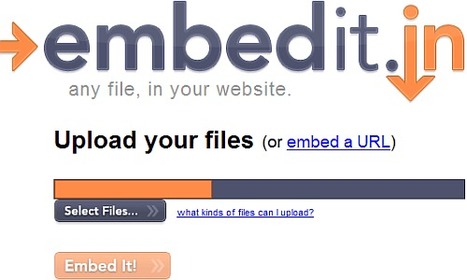
embedit.in is the easiest way to embed any document or any webpage in your blog, profile, or website. It works with PDF, Word, Excel, PowerPoint, and many other formats. It's totally free of charge.
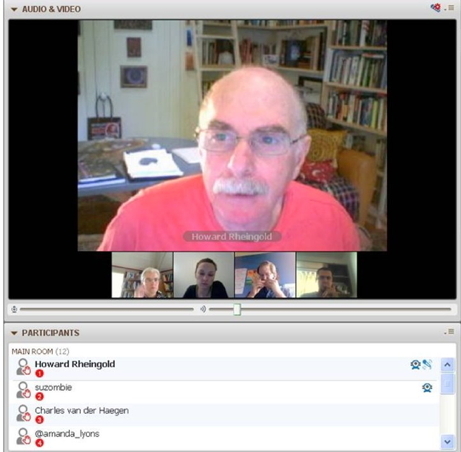
A portal into some of the available work of Howard Rheingold, a leading thinker in the social media, information, and education worlds. Of particular note here are Harold's many free videos and access to his excellent coarses in information management, social media, collaboration, and curation. - JL
To get content containing either thought or leadership enter:
To get content containing both thought and leadership enter:
To get content containing the expression thought leadership enter:
You can enter several keywords and you can refine them whenever you want. Our suggestion engine uses more signals but entering a few keywords here will rapidly give you great content to curate.


 Your new post is loading...