Over the last few weeks, I’ve been on a bit of a risk kick. I’ve been reading books on how risk plays out at the operational and financial level, and one thing keeps sticking out, Intel feels like…
Richard Platt's insight:
It’s hard to pinpoint exactly when the decline started. Like most corporate failures, it didn’t happen all at once, it rolled in slowly, one missed step at a time. Intel’s fall traces back to a series of leadership missteps culminating in one of the most consequential fumbles in tech history: missing the mobile market. Intel had a front-row seat to the iPhone revolution. Apple came to them 1st, Ottelini passed, believing the volumes weren’t worth it. The mobile shift was already in motion Intel ignored it. It was a failure of strategic judgment. The current leadership reflects this today, not with accountability, but with rationalization. No sense of ownership, no clear admission that the call was wrong. Just soft hindsight and shrugged shoulders. That’s not leadership. That’s deflection. - Intel never had a financial problem (before) they had a risk management problem specifically, in its leadership class. Otellini, came from an economics background, but Intel is famed for being run by engineers. There was the Intel Atom, which flopped in mobile; the QLogic Ethernet acquisition, which they let wither; and the infamous Arizona fab , a billion-dollar facility shuttered before it ever opened. These aren’t the moves of a cautious company they’re the missteps of a leadership team stuck between 2 identities.
If Intel truly wants to minimize risk, it should lean into its strengths as a front-line innovative manufacturer, becoming a world-class foundry.
The problem is identity. Intel still sees itself as the architect of x86 dominance. Those days are past. This crap self-image is increasingly out of step with market reality. They don’t want to supply the stars, they still think they are one. Intel is going to be almost entirely dependent on what they do over the next 12–18 months. Long-term success means pivoting away from designing in-house chips and becoming a one-stop manufacturing hub for the broader market. Intel as a household name began to fade when people stopped using home computers and started paying their bills from their phones. That consumer relevance is gone. But there’s still value Intel can bring specifically, as a world-class foundry with capabilities TSMC can’t easily match. Intel can step in as the alternative, with manufacturing sites across Oregon, Ireland, and soon Germany. If TSMC’s capacity maxes out, or its economics falter, Intel can capture share. And then there’s compliance. Intel’s deep ties to U.S. regulators and defense contractors make it uniquely positioned to maintain ITAR compliance something that could become critical in an increasingly digitized military landscape. Intel says it wants to build the next great global foundry. But right now, its customer list reads more like an internal memo than a marketplace. I’ll be more optimistic when Intel’s foundry serves more external partners than internal product lines.
"The leaders who thrive are the ones who adapt with purpose, aligning every experiment with strategy and using AI to elevate, not erode, human skills."
The era of AI evangelism is giving way to evaluation. Stanford faculty see a coming year defined by rigor, transparency, and a long-overdue focus on actual utility over speculative promise.
Nineteen-year-old Lia was at a follow-up appointment at a boutique dermatology practice in New York City. She was interested in a prescription for hair growth. Since she was already on another medication, the dermatologist decided to check for potential drug-drug interactions — using ChatGPT on her phone.“I just was kind of like, that’s strange,” Lia, who did not share her last name out of privacy concerns, told Fierce Healthcare. “I guess I’ll just do my own research in addition to her.” | Publicly available generative AI tools like ChatGPT are popular, easy to access and simple to use. If consumers are using them, are doctors, too? The answer, Fierce Healthcare finds, is yes.
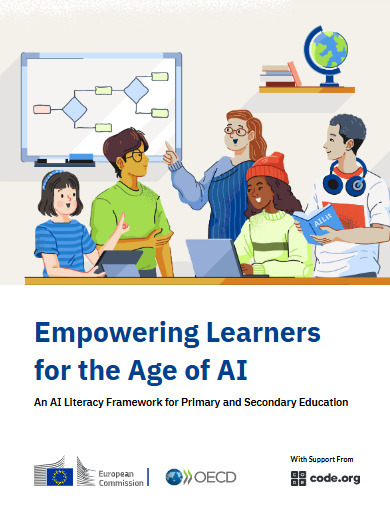
As Artificial Intelligence (AI) increasingly influences how we access information, communicate, and make decisions, AI literacy becomes essential for navigating daily life, creating with purpose, and preparing for the future of learning and work. AI literacy equips learners and educators to understand both the risks and opportunities that AI presents, and to make meaningful and ethical decisions about its use.
As Artificial Intelligence (AI) increasingly influences how we access information, communicate, and make decisions, AI literacy becomes essential for navigating daily life, creating with purpose, and preparing for the future of learning and work. AI literacy equips learners and educators to understand both the risks and opportunities that AI presents, and to make meaningful and ethical decisions about its use
“Integrating AI literacy into education is essential to equip students with the critical thinking skills necessary to understand, interact with, and innovate using digital technologies, preparing them to contribute meaningfully to society” (Lidija Kralj)
Discover how integrating artificial intelligence and critical thinking strategies can foster transformative learning experiences in higher education. Learn how educators can model, guide, and support students in navigating AI with intention, reflection, and integrity. Whilst a lot of articles like this see critical thinking as a tool to apply to AI-generated content, I find myself seeing AI as a tool to critically examine the world
Whilst a lot of articles like this see critical thinking as a tool to apply to AI generated content, I find myself seeing AI as a tool to critically examine the world
Watch the recording of the webinar from Tuesday 8 July 2025 to explore how teacher educators can help teachers partner with AI to identify relevant and credible research, and extract insights that inform their classroom practice.
Over the last few weeks, I’ve been on a bit of a risk kick. I’ve been reading books on how risk plays out at the operational and financial level, and one thing keeps sticking out, Intel feels like…
Richard Platt's insight:
It’s hard to pinpoint exactly when the decline started. Like most corporate failures, it didn’t happen all at once, it rolled in slowly, one missed step at a time. Intel’s fall traces back to a series of leadership missteps culminating in one of the most consequential fumbles in tech history: missing the mobile market. Intel had a front-row seat to the iPhone revolution. Apple came to them 1st, Ottelini passed, believing the volumes weren’t worth it. The mobile shift was already in motion Intel ignored it. It was a failure of strategic judgment. The current leadership reflects this today, not with accountability, but with rationalization. No sense of ownership, no clear admission that the call was wrong. Just soft hindsight and shrugged shoulders. That’s not leadership. That’s deflection. - Intel never had a financial problem (before) they had a risk management problem specifically, in its leadership class. Otellini, came from an economics background, but Intel is famed for being run by engineers. There was the Intel Atom, which flopped in mobile; the QLogic Ethernet acquisition, which they let wither; and the infamous Arizona fab , a billion-dollar facility shuttered before it ever opened. These aren’t the moves of a cautious company they’re the missteps of a leadership team stuck between 2 identities.
If Intel truly wants to minimize risk, it should lean into its strengths as a front-line innovative manufacturer, becoming a world-class foundry.
The problem is identity. Intel still sees itself as the architect of x86 dominance. Those days are past. This crap self-image is increasingly out of step with market reality. They don’t want to supply the stars, they still think they are one. Intel is going to be almost entirely dependent on what they do over the next 12–18 months. Long-term success means pivoting away from designing in-house chips and becoming a one-stop manufacturing hub for the broader market. Intel as a household name began to fade when people stopped using home computers and started paying their bills from their phones. That consumer relevance is gone. But there’s still value Intel can bring specifically, as a world-class foundry with capabilities TSMC can’t easily match. Intel can step in as the alternative, with manufacturing sites across Oregon, Ireland, and soon Germany. If TSMC’s capacity maxes out, or its economics falter, Intel can capture share. And then there’s compliance. Intel’s deep ties to U.S. regulators and defense contractors make it uniquely positioned to maintain ITAR compliance something that could become critical in an increasingly digitized military landscape. Intel says it wants to build the next great global foundry. But right now, its customer list reads more like an internal memo than a marketplace. I’ll be more optimistic when Intel’s foundry serves more external partners than internal product lines.
On this first episode of "Bloomberg Tech: Asia," we explore the impact of China's AI advancements on competition with the US. We hear from key players in Asia's AI revolution including Manycore, one of China's so-called "Six Dragons" and Tokyo Electron, one of the world's top chip-tool makers. China Growth Capital's Wayne Shiong and Power Dynamics' Jen Zhu Scott also weigh in on the outlook for the AI race and investments in the sector.
AI has already infiltrated the workforce, so higher ed institutions have a responsibility to teach their students to use it responsibly and effectively.
AI has already infiltrated the workforce, so higher ed institutions have a responsibility to teach their students to use it responsibly and effectively. Without clear guidance, training, and inclusion, many Gen Zers risk being left behind in an AI-driven economy. Schools and employers must step up by creating inclusive policies, integrating AI education, and expanding access to tools and training, especially in underserved sectors and communities.
Without clear guidance, training and inclusion, many Gen Zers risk being left behind in an AI-driven economy. Schools and employers must step up by creating inclusive policies, integrating AI education and expanding access to tools and training, especially in underserved sectors and communities.
Artificial intelligence is no longer a distant possibility. It is a defining reality of our present moment. From predictive analytics in admissions to generative AI tools shaping classroom practice and research workflows, AI is rapidly transforming higher education. Yet this transformation is not simply technological. It is cultural, ethical, and institutional. The question before us is not whether we will use AI but whether we will guide its use with purpose, clarity, and care.
On the provider side, 58% of organizations polled are using AI for administrative tasks, such as medical coding, billing and scheduling, while 44% are deploying it for clinical decision support and imaging analysis.
On the provider side, 58% of organizations polled are using AI for administrative tasks, such as medical coding, billing and scheduling, while 44% are deploying it for clinical decision support and imaging analysis
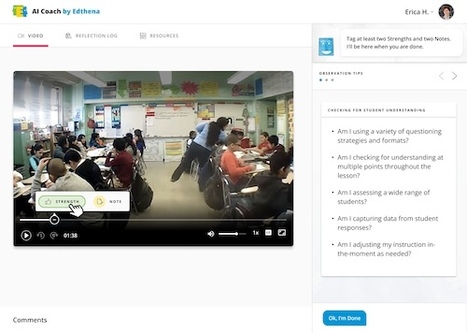
A computerized AI coaching support model enables pre-service teachers to engage in scalable, self-guided reflection for teacher preparation. It is worth having a look at, as it will likely lead to more improvements for Teachers and Instructors.
"An AI-powered video coaching platform enables pre-service teachers to independently reflect on their teaching, receive time-stamped feedback, and improve their practice by aligning lessons with self-identified goals—fostering scalable, self-guided professional growth."
In de VS wordt AI ingezet om toekomstige docenten te begeleiden met directe feedback, gesimuleerde praktijksituaties en reflectievragen. Doel: betere voorberetiding, meer gelijkheid én opschaling van lerarenopleidingen.
� Interessant voorbeeld van hoe AI niet vervangt, maar versterkt.
The US and Europe both need Rare Earth Minerals for their industrial bases, for the transition to green technology, and for their defence. But China controls the majority of the supply, from mining all the way through to the end-use stage. Beijing has begun to wield this strategic influence, raising questions about America and Europe's need and ability, and in this case, for the EU to find its own critical minerals. In this episode of Business Beyond, this video looks at how China conquered the market and asks if there is any way Europe can develop strategic independence.
In 2025, semiconductors are not just components in consumer devices – they are the essential building blocks for the technologies shaping America’s future. From artificial intelligence and quantum computing to advanced communications networks and defense systems, chips are at the heart of the competition for global technology leadership in the 21st century.
American engineers invented semiconductors 65 years ago, and the U.S. semiconductor industry remains the global leader, commanding just over 50% of global chip revenues. But as competitors from around the world have sought to challenge U.S. leadership, America’s share of global chip manufacturing capacity was declining sharply – from 37% in 1990 to just 10% by 2022. If this trend were to continue, the U.S. semiconductor industry would risk falling back from the forefront of further advances in manufacturing processing technology, designs and architectures, and materials critical for developing the next generation of chips that will underpin the technologies of tomorrow.
This foundational technology is the hidden force driving modern innovation – and a testament to the wonder of advanced semiconductor research, design, and manufacturing.
Semiconductors are a marvel of modern technology and the foundation of our digital world. The chips powering modern smartphones contain more than 15 Billion transistors, each smaller than a virus and capable of switching on and off billions of times/second.
Semiconductors are the heart of today’s AI data centers can contain hundreds of billions of transistors, a number so high that if you counted one transistor per second, it would take more than 6,000 years to count all the transistors on a single chip.
I increasingly find people asking me “does AI damage your brain?” It's a revealing question. Not because AI causes literal brain damage (it doesn't) but because the question itself shows how deeply we fear what AI might do to our ability to think. So, in this post, I want to discuss ways of using AI to help, rather than hurt, your mind. But why the obsession over AI damaging our brains?
Author Ethan Mollick states, "I increasingly find people asking me, 'Does AI damage your brain?” It's a revealing question. Not because AI causes literal brain damage (it doesn't) but because the question itself shows how deeply we fear what AI might do to our ability to think. So, in this post, I want to discuss ways of using AI to help, rather than hurt, your mind. But why the obsession over AI damaging our brains? - This article is well worth reading. - AI can help or hurt our thinking. I particularly like the conclusion, “Our fear of AI's damaging our brains” is a fear of our laziness. The technology offers an easy out from the hard work of thinking, and we worry we'll take it. We should worry. But we should also remember that we have a choice. Your brain is safe. Your thinking, however, is up to you.”
This article is well worth reading. - AI can help, or hurt, our thinking. I particularly like the conclusion “Our fear of AI “damaging our brains” is actually a fear of our own laziness. The technology offers an easy out from the hard work of thinking, and we worry we'll take it. We should worry. But we should also remember that we have a choice.
Your brain is safe. Your thinking, however, is up to you.”
"Voice technologies are no longer just about recognizing what we say; they are beginning to understand how we say it. As artificial intelligence (AI) advances, it can detect subtle emotional signals in our speech, promising more human-like interactions with machines. Emotional AI is reshaping how voice data is used across industries."
"Paralinguistic voice analysis focuses on non-verbal elements of speech like tone, pitch, volume, pauses and rhythm that convey emotion, intention or attitude. While traditional voice recognition focused on transcribing spoken words, emotional AI adds a new layer: interpreting how those words are delivered. Today’s AI systems use deep learning to identify these paralinguistic features in real time."
The Chinese tech sector has been on a roll since the arrival in January of DeepSeek, the AI startup that stunned the world with a language model that claimed to match or outperform Western rivals, at a fraction of the cost. Bloomberg's Annabelle Droulers reports on how the rapid strides in AI are poised to escalate the tech "cold war" between the US and China.
Last week in my Sunday Suggestions I shared a prompt that turned your AI chatbot into a critical friend as an example of how AI CAN develop critical thinking, we just have to think a little more critically about how we apply it!
However, I suspect that what many teachers mean, when they talk about the impact of AI on critical thinking, is that students will get information from AI sources and won't think critically about whether or not it's true.
The widespread investment in AI furthers economists’ optimism about a “roaring 20’s” of worker productivity on the horizon. However, this will not take place in health care without accompanying systemic and organizational actions that rethink what we financially incentivize, how we integrate new technologies, how we shift tasks, and how we prepare the workforce.
Two years ago, every health conference I attended had multiple panels on clinician burnout. The problem is well known, and the actual system-level contributors have been called out.
In the last year, the solution to burnout is splashed on every conference app log-in screen: generative artificial intelligence (AI).
The AI scribe revolution
In health care, ambient documentation tools have become the star of the show. These “AI scribes” listen to the patient-physician conversation, transcribe the discussion, and then use generative AI to create a first draft clinical note. These solutions remove the laborious work of fully capturing the patient’s story or the physician’s thoughts about the plan. This technology is seen by some as a miracle. Before large language model chat applications were popularized, many physicians did not think such solutions were possible during our careers.
Conflicting visions for AI’s impact
Organizational leaders are stoked about the future AI can potentially create. There are endless administrative inefficiencies that affect patient care or inflate costs.
Frontline clinicians are still quite wary. Their concerns stem from the technology itself and also from what organizational or system leaders will do with the new efficiencies gained from the deployment of such technology. Those next steps – the policy changes and operational actions that follow broad AI scribe implementations — are the critical pieces that will determine its success.
Will organizations simply continue to add more patients and more tasks to physicians’ plates? Will we slot generative AI solutions into existing clinic processes that may not serve clinicians’ ideal workflow? Will we integrate these generative AI tools into EHR systems that do not support physicians’ thought patterns or desired storytelling purposes?
To get content containing either thought or leadership enter:
To get content containing both thought and leadership enter:
To get content containing the expression thought leadership enter:
You can enter several keywords and you can refine them whenever you want. Our suggestion engine uses more signals but entering a few keywords here will rapidly give you great content to curate.
It’s hard to pinpoint exactly when the decline started. Like most corporate failures, it didn’t happen all at once, it rolled in slowly, one missed step at a time. Intel’s fall traces back to a series of leadership missteps culminating in one of the most consequential fumbles in tech history: missing the mobile market. Intel had a front-row seat to the iPhone revolution. Apple came to them 1st, Ottelini passed, believing the volumes weren’t worth it. The mobile shift was already in motion Intel ignored it. It was a failure of strategic judgment. The current leadership reflects this today, not with accountability, but with rationalization. No sense of ownership, no clear admission that the call was wrong. Just soft hindsight and shrugged shoulders. That’s not leadership. That’s deflection. - Intel never had a financial problem (before) they had a risk management problem specifically, in its leadership class. Otellini, came from an economics background, but Intel is famed for being run by engineers. There was the Intel Atom, which flopped in mobile; the QLogic Ethernet acquisition, which they let wither; and the infamous Arizona fab , a billion-dollar facility shuttered before it ever opened. These aren’t the moves of a cautious company they’re the missteps of a leadership team stuck between 2 identities.
If Intel truly wants to minimize risk, it should lean into its strengths as a front-line innovative manufacturer, becoming a world-class foundry.
The problem is identity. Intel still sees itself as the architect of x86 dominance. Those days are past. This crap self-image is increasingly out of step with market reality. They don’t want to supply the stars, they still think they are one. Intel is going to be almost entirely dependent on what they do over the next 12–18 months. Long-term success means pivoting away from designing in-house chips and becoming a one-stop manufacturing hub for the broader market. Intel as a household name began to fade when people stopped using home computers and started paying their bills from their phones. That consumer relevance is gone. But there’s still value Intel can bring specifically, as a world-class foundry with capabilities TSMC can’t easily match. Intel can step in as the alternative, with manufacturing sites across Oregon, Ireland, and soon Germany. If TSMC’s capacity maxes out, or its economics falter, Intel can capture share. And then there’s compliance. Intel’s deep ties to U.S. regulators and defense contractors make it uniquely positioned to maintain ITAR compliance something that could become critical in an increasingly digitized military landscape. Intel says it wants to build the next great global foundry. But right now, its customer list reads more like an internal memo than a marketplace. I’ll be more optimistic when Intel’s foundry serves more external partners than internal product lines.